
How to Reduce Late Tuition Payments at Your School: A Prevention-First Approach
Prevention vs. Recovery: The Two Approaches to School Tuition Delinquency
Every private school director has two strategic options for managing late tuition payments. The first is the reactive approach: let payments come in, identify the ones that are late, and then pursue collection through escalating reminders, phone calls, and — in the worst cases — enrollment holds and collections referrals. This is the approach most schools use by default, often because it is the path of least initial resistance. The second approach is prevention-first: use proactive systems to reduce the probability that a payment will be late in the first place, so that collection effort is spent on the genuinely difficult cases rather than families who were simply disorganized or uninformed.
This article focuses on the prevention-first approach — which is distinct from the recovery systems covered in our guide to failed tuition payment recovery. Recovery is necessary; prevention is more cost-effective. A family that never makes a late payment costs zero administrative time and zero relationship friction, regardless of how efficiently your recovery system would have handled the delinquency.
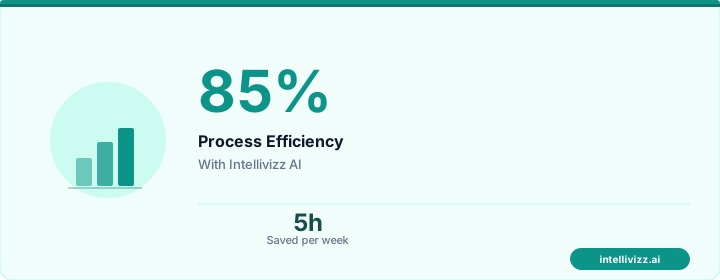
🛡️ Stop Late Payments Before They Start
Prevention-first tuition management reduces delinquency by 50–70%
Understanding Why Tuition Payments Arrive Late
Before designing prevention systems, it is worth understanding the actual distribution of causes behind late tuition payments — because the interventions that work depend entirely on the cause being addressed.
| Root Cause | Estimated Share of Late Payments | Primary Prevention Lever |
|---|---|---|
| Forgot / administrative oversight | 35–45% | Proactive reminder cadence, autopay enrollment |
| Waited for paycheck / payday timing | 20–30% | Flexible due date options, payment method optimization |
| Cash flow difficulty / temporary financial stress | 15–25% | Payment plan options, early communication of financial concerns |
| Dispute or confusion about invoice amount | 5–10% | Clear billing statements, itemized invoices, easy dispute path |
| Intentional delay / chronic non-payment | 3–7% | Escalation protocol; this is the recovery case |
The insight from this distribution is that the vast majority of late tuition payments — roughly 75–85% — are preventable through better systems. Only the chronic non-payment segment genuinely requires the recovery tools covered elsewhere. Every investment in prevention reduces the volume of work flowing into the recovery pipeline.
Designing the Proactive Reminder Cadence
The most powerful single intervention for preventing late tuition payments is a well-designed proactive reminder sequence that begins before the due date, not after. Most school billing systems default to reactive reminders: a notice sent after the payment is already late, which puts the communication in the uncomfortable frame of "you owe us money" rather than the much more productive frame of "here is helpful information to make payment easy."
Recommended Pre-Due-Date Reminder Sequence
- Invoice delivery (14 days before due date): The tuition invoice is delivered with a clear, itemized breakdown of charges, an easy-to-read total, and multiple payment method options. The invoice design matters: a confusing invoice with unclear line items creates disputes; a clear invoice with prominent payment links creates prompt payment. Include the due date prominently — not buried in fine print.
- 7-day reminder: A brief, friendly reminder that the invoice is due in one week, with a direct payment link. This is the most critical single reminder in the sequence — families who receive this reminder are significantly less likely to be late because the due date is now recent in their awareness. The tone should be warm and helpful, not transactional.
- 3-day reminder (optional, high-value for schools with chronic late payment patterns): A shorter message — SMS works well here — that simply notes the due date is three days away and provides a one-tap payment link. SMS payment reminders have dramatically higher read rates than email for the 48-hour window before a due date.
- Due date morning reminder: A same-day reminder sent at 8 AM on the due date. Some schools find this reminder generates a meaningful payment bump for families who have been procrastinating. Others find it creates friction with families who pay on time and resent the assumption that they need a same-day nudge. A/B test this reminder against your family demographic before making it standard.
For schools building out their first automated tuition reminder system, the tuition reminder system for private schools guide covers the technical implementation in detail, including platform options and integration with common school management systems.
Autopay Enrollment Campaigns
Autopay is the single most powerful structural intervention for preventing late tuition payments. A family enrolled in autopay cannot make a late payment through administrative oversight — the payment processes automatically on the due date, regardless of whether the family remembered. Across industries, autopay conversion reduces late payment rates by 60–80% for the enrolled segment.
Most private schools offer autopay options but achieve low enrollment rates — often 20–35% of families — because the enrollment process is passive: information about autopay is buried in the enrollment packet, families intend to set it up but never get around to it, and the school does not actively pursue enrollment. An autopay enrollment campaign treats autopay conversion as an active objective with its own outreach sequence:
- Annual autopay enrollment drive (August/September): At the start of each school year, a dedicated campaign prompts all non-autopay families to enroll. The campaign emphasizes convenience benefits ("Never worry about a tuition due date again") rather than the school's operational interest in autopay. A three-message sequence over two weeks with a direct enrollment link typically converts 20–30% of targeted families.
- New family autopay default: For newly enrolling families, autopay enrollment can be built into the enrollment contract workflow as the default option — families opt out of autopay rather than opting in. This framing dramatically increases autopay adoption among new families. Ensure that opt-out is easy and clearly communicated to avoid any perception of manipulation.
- Post-late-payment autopay offer: When a family makes a late payment (even on the first occurrence), a friendly message that goes out with the payment confirmation offers autopay enrollment as a solution: "We noticed this payment arrived a few days late. Many families find autopay makes tuition management easier — here's how to set it up in 60 seconds." This converts a friction moment into a relationship improvement opportunity.
- Annual autopay confirmation: Existing autopay families should receive an annual confirmation that their autopay is still active, their payment method is current, and their scheduled payment dates for the year are correct. Expired cards are the leading cause of autopay failure — this annual check prompts families to update payment information before the card failure creates a late payment.
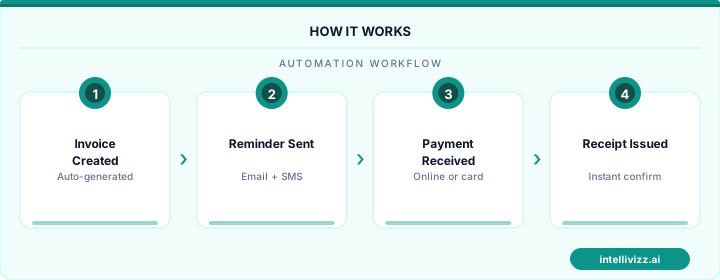
✅ Autopay: The Best Late Payment Prevention Tool
Schools with 60%+ autopay enrollment see 50–70% fewer late payments
Early Payment Incentives
Early payment incentives flip the standard tuition collection dynamic: instead of penalizing late payments, they reward early ones. The most common structures include:
- Annual tuition prepayment discount: Families who pay the full year's tuition before the school year begins receive a discount — typically 1–3% of annual tuition, which represents a meaningful dollar amount (on $30,000 tuition, a 2% discount is $600). The school benefits from complete cash certainty on the enrolled student before the year begins; the family benefits from the discount and the simplicity of a single annual payment.
- Early installment discount: For families on installment plans, a small discount (0.5–1%) on installments paid 5+ days before the due date rewards proactive payment without the complexity of annual prepayment.
- Priority enrollment renewal for on-time payers: For schools with competitive re-enrollment, on-time payment history can be a factor in re-enrollment priority — communicated transparently to families as an incentive for consistent on-time payment rather than as a threat.
The financial math on early payment incentives is typically favorable: the discount cost is less than the administrative cost of late payment follow-up, the cash flow benefit of early receipt has real value, and the relationship dynamic of rewarding good behavior is healthier than punishing poor behavior. However, incentives should be carefully designed so they do not create pressure on families with genuine financial constraints — those families need a different conversation, not a discount they cannot access.
Late Fee Policy Design and Communication
Late fees serve a dual function: they create a financial incentive against delay, and they compensate the school for the administrative cost of late payment processing. The design and communication of late fee policy significantly affects both its effectiveness and its relationship impact.
Late Fee Policy Design Principles
- Transparency at enrollment: Late fee policy should be clearly communicated in the enrollment contract, the annual tuition billing schedule, and the top of every invoice. Families who are surprised by a late fee — even a small one — experience it as a punitive ambush rather than a stated consequence of a known policy.
- Grace period: A 3–5 day grace period before late fees apply reflects the reality that payment processing occasionally takes a day or two and that a payment submitted on the due date may not clear immediately. Grace periods also reduce the administrative friction of processing one-day-late fee waivers, which consume more staff time than the fee is worth.
- One-time courtesy waiver: Many schools offer one automatic late fee waiver per family per year — communicated at enrollment — for families with no prior late payment history. This policy costs the school very little (the waiver applies only to first offenses) while significantly reducing the relationship friction of first-time late payment situations. The waiver should be automatic, not requiring the family to call and request it.
- Escalation clarity: Families should understand exactly what happens at each stage of delinquency — late fee on day 6, account review at day 30, enrollment hold at day 60 — so there are no surprises at any point in the escalation process.
Seasonal Patterns and Proactive Intervention
Late tuition payments are not randomly distributed across the school year — they cluster around predictable stress points that savvy school finance administrators can anticipate and address proactively:
- September: High late payment rates as families adjust to the resumption of tuition billing after the summer gap. Back-to-school expenses (supplies, uniforms, activity fees) compete with tuition for household cash flow. Pre-September reminder sequences and autopay re-confirmation campaigns reduce September delinquency significantly.
- December: Holiday expenses create cash flow pressure. December tuition due dates that fall in the first week of the month compete with gift budgets and travel costs. Schools with flexibility to move December due dates to December 15 or later, or to offer an explicit early-January payment option, see lower December delinquency without increasing overall late payment rates.
- March/April: Tax season creates complex cash flow dynamics — some families receive refunds that improve payment reliability; others discover tax liabilities that create new financial pressure. Spring tuition billing can be the first indication of a family heading toward genuine financial difficulty that will require a payment plan conversation.
For schools developing the complete billing automation pipeline — from invoice generation through autopay management through late payment follow-up — the tuition payment automation guide covers the full system architecture including platform options and integration with school management systems. And for schools already managing a late payment situation and looking at recovery rather than prevention, the failed tuition payment recovery guide covers the escalation workflow in depth.
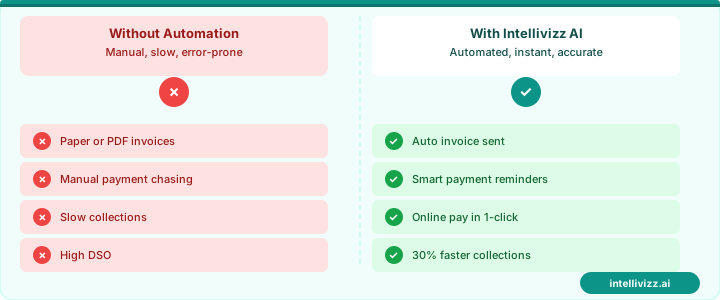
📈 Benchmark: What Good Looks Like
Top-performing schools achieve late payment rates below 5% with prevention systems
Benchmarking Against Peer Schools
Private schools rarely share tuition collection performance data publicly, which makes benchmarking difficult. Based on available industry data and admissions finance surveys, the following ranges represent typical performance at peer institutions:
| Metric | Typical Range | Top Quartile |
|---|---|---|
| Monthly late payment rate (% of accounts) | 8–18% | Below 5% |
| Autopay enrollment rate | 20–40% | 60–75% |
| Annual prepayment rate | 10–20% | 25–35% |
| Average days past due at first payment | 8–15 days | Under 5 days |
| Administrative hours per month on late payment follow-up | 6–14 hours | Under 3 hours |
| Annual tuition bad debt write-off rate | 0.5–2% | Under 0.25% |
Schools in the top quartile on these metrics share several common practices: high autopay enrollment achieved through active campaigns, proactive reminder sequences beginning two weeks before due dates, clear late fee policies communicated at enrollment, flexible payment scheduling options, and early identification of families heading toward financial difficulty — which enables a payment plan conversation before a payment is missed rather than after. The investment in these prevention systems is modest compared to the administrative cost of reactive collection and the relationship cost of delinquency escalation.
Ready to modernize your school's operations? Explore our education automation solutions.