
How to Increase Private School Enrollment: A Complete Growth Strategy
The Enrollment Growth Problem Most Private Schools Have
Most private schools approach enrollment marketing the same way they have for twenty years: update the website, run an open house, wait for inquiries, and hope yield holds. In markets where independent and parochial schools have historically maintained waitlists, this passive approach worked. In today's environment — with demographic shifts in suburban markets, growing competition from public charter schools, increased price sensitivity post-pandemic, and parents conducting exhaustive online research before making first contact — a passive enrollment strategy leads to declining enrollment cohorts within 3–5 years.
The schools gaining enrollment in competitive markets are not necessarily the ones with the best programs — though program quality matters. They are the schools with the most intentional, systematic approach to every stage of the enrollment funnel: generating initial inquiry from the right families, converting inquiries to applications with a well-managed admissions experience, optimizing open house attendance and conversion, retaining enrolled families for multi-year engagement, and turning satisfied current families into active referral sources.
This guide covers each layer of a comprehensive private school enrollment growth strategy, with specific attention to the digital, operational, and relational approaches that produce measurable results in 12–24 months.
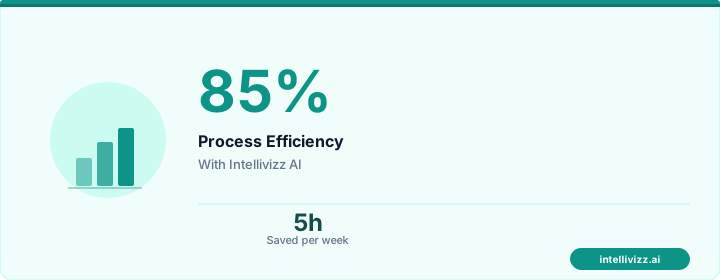
🎓 Enrollment Growth: From Inquiry to Alumni Referral
A complete, systematic approach to private school enrollment growth
Digital Marketing: Where Enrollment Inquiries Begin in 2026
Private school enrollment research begins online in over 85% of cases. Parents in your target market are searching Google before they call any school, reading reviews before they attend an open house, and comparing websites before they download an application. Your digital presence is not supplementary to your enrollment marketing — it is the first impression for the majority of prospective families.
Search Engine Optimization for Private Schools
The most valuable organic search traffic for private schools consists of parents in your geographic market searching for school type and grade range. "Best private elementary school [city]," "Catholic high school [county]," "Montessori school near me," and "private school tuition [city]" are the query types that generate high-intent visits from parents actively in the enrollment decision process.
SEO for private schools requires three foundational elements: a content strategy that answers the specific questions prospective parents are asking (curriculum, tuition, financial aid, extracurriculars, college outcomes), a local SEO presence that ensures you appear in map pack results for relevant searches, and a website technical foundation that loads quickly and works flawlessly on mobile devices (where more than 60% of initial school research happens).
Paid Search and Social Advertising
Google Ads targeting enrollment-intent keywords in your geographic market generates immediate visibility while organic SEO builds. For most private schools, a monthly paid search budget of $1,500–$4,000 targeting zip codes within your enrollment draw area generates 40–120 qualified inquiries per month at a cost per inquiry of $30–$90 — a highly efficient acquisition cost given that a single enrolled student represents $15,000–$60,000+ in tuition revenue.
Meta (Facebook and Instagram) advertising is particularly effective for private schools because of its demographic and interest-based targeting: parents of children in specific age ranges, within a defined geographic radius, who have expressed interest in education, parenting, or relevant community activities. Lookalike audience campaigns based on your current enrolled family email list are among the highest-ROI paid social strategies available to independent schools.
Open House and Campus Visit Optimization
The open house remains the pivotal conversion event in private school enrollment — the point where a family transitions from digitally interested to personally committed. Yet most schools underinvest significantly in the open house experience and follow-up sequence, treating it as an event to be planned rather than a conversion system to be optimized.
Pre-Open House Conversion
The majority of families who attend an open house and subsequently enroll decide to attend the open house within the first 72 hours after their initial inquiry. The follow-up sequence that executes in those 72 hours — the speed, personalization, and quality of the first contact — determines whether a family attends your open house or another school's. The automated enrollment follow-up sequence for private schools is covered in depth in our guide to automated enrollment follow-up for private schools, which details the inquiry-to-open-house conversion workflow.
Open House Experience Design
High-converting open houses share several design elements that most schools underutilize:
- Student and family ambassadors: Prospective parents are influenced most by current students and satisfied families, not by administrators. Structured student ambassador programs and family testimonial formats within the open house format consistently outperform administrator-led presentations.
- Grade-specific tracks: Families with a kindergartner have completely different questions and interests than families with a 9th grader. Schools that run grade-banded open house experiences (even within a single event) dramatically improve relevance and conversion compared to generic all-school tours.
- The "financial aid conversation" opportunity: Families who are interested but uncertain about tuition affordability need a clear, private, non-stigmatizing pathway to learn about financial aid options. Schools that handle this conversation at the open house — through a designated financial aid office station or a clear call-to-action for a private financial aid consultation — convert significantly more price-sensitive families.
Post-Open House Follow-Up
The 48-hour post-open house follow-up sequence is the highest-leverage moment in the admissions funnel. A warm, personalized follow-up that references specific conversations from the open house, provides a direct application link, and includes a deadline for early admission consideration converts 20–35% of open house attendees to applicants. A generic follow-up email converts 8–15%. The personalization detail — referencing the child's name, grade, interests mentioned in conversation — is the variable that drives the gap. For schools managing high inquiry volume, the admissions CRM workflows covered in our guide to private school admissions CRM systems enable this personalization at scale.
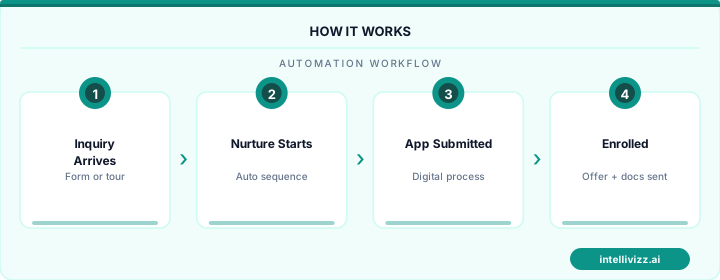
🏫 Open House to Application — A Conversion System
Pre-visit nurture, experience design, and follow-up automation that converts
Referral Programs: Activating Current Families
The highest-quality enrollment inquiry is a referral from a current family. Referred students enroll at 2–3x the rate of cold inquiries, stay enrolled longer, and have parents who are more engaged in the school community. Despite this, most private schools have no systematic referral program — they rely on organic word-of-mouth and hope that satisfied families mention the school when the topic arises naturally.
Building a Structured Referral Program
An effective private school referral program includes:
- A clear, communicated incentive: Tuition credits ($500–$2,000 credited against the enrolled family's next year's tuition when a referred family enrolls) are the most effective incentive for private school referrals. Application fee waivers for the referred family are secondary incentives that reduce friction for the prospect without requiring a significant incentive from the school.
- An easy referral mechanism: Current families should be able to refer a prospective family in under 60 seconds — via a web form, a unique referral link that tracks attribution, or a simple SMS/email to the admissions office. The fewer steps, the higher the referral rate.
- Timing-optimized asks: The optimal times to request referrals from current families are immediately after re-enrollment confirmation, following a positive event (award ceremony, championship, concert), and in October–November when social networks are discussing the upcoming school year enrollment decision for younger children. These moments, not January (when families are busy with year-end obligations), are when referral requests convert.
- Sibling enrollment program: A dedicated sibling enrollment pathway — simplified application, sibling tuition discount, dedicated admissions contact — treats the most likely referral source (families with multiple children) as the high-conversion segment they are.
Financial Aid as an Enrollment Tool
Financial aid is frequently discussed as a cost center in independent school budgeting. The more useful frame is financial aid as an enrollment yield tool: the school's ability to offer need-based and merit-based financial assistance determines which families in your target market can afford to choose your school, and by extension, the size of your potential enrolled population.
Schools that treat financial aid strategically — increasing aid allocation in years when enrollment pressure requires it, offering merit scholarships to attract families who can pay but need a differentiated reason to choose a more expensive option over a public or charter alternative — consistently outperform their peers in enrollment stability across economic cycles. Communicating the availability and accessibility of financial aid clearly in all marketing materials (not hiding it on a secondary page) expands the funnel by 15–25% in most markets.
Re-Enrollment Retention: The Enrollment Growth Multiplier
New enrollment and re-enrollment retention are the two sides of the enrollment growth equation. A school that enrolls 40 new students and retains 90% of its existing enrollment grows. A school that enrolls 60 new students but retains only 75% of its existing enrollment is running to stand still — or losing ground. Yet most schools invest 5–10x more in new student recruitment than in re-enrollment retention.
Re-Enrollment Timing and Process
Re-enrollment decisions are made by families in a specific psychological window: typically December–February for schools with March–April re-enrollment deadlines. The schools that achieve 92–96% re-enrollment rates (versus the industry average of 82–88%) consistently do three things in this window that lower-retention schools do not:
- Proactive satisfaction outreach: October–November outreach from division heads or the head of school to every family — not just families known to have concerns — creates an opportunity to identify and address dissatisfaction before re-enrollment decision season, rather than discovering it in a non-renewal that arrives after another school's commitment.
- Early re-enrollment incentives: Schools that offer a meaningful incentive for re-enrollment commitments made before a January deadline (tuition rate lock, application fee waiver for younger siblings, priority course selection) achieve re-enrollment rates 5–8 percentage points higher than those with a single March deadline and no incentive structure.
- Automated re-enrollment campaign: A structured communication sequence — reminder of the re-enrollment deadline, a celebration of the year's highlights specific to the student's grade, a personal message from the division head, a final deadline reminder — systematizes what previously depended on individual administrators remembering to follow up. The complete re-enrollment campaign workflow is detailed in our guide to school re-enrollment campaign automation.
Feeder School and Community Partnership Strategies
Feeder school relationships — partnerships with elementary schools that send graduates to your middle school, or middle schools whose graduates attend your high school — are among the highest-ROI enrollment marketing investments for many independent schools. A formal feeder school partnership that includes campus visits for 5th or 8th grade students, scholarship opportunities for feeder school graduates, and a maintained relationship with the feeder school's counseling team can generate 10–25 new applications annually from a single partnership.
Community partnerships extend the feeder school concept to non-school institutions: youth sports leagues, community arts programs, faith-based youth groups, and community service organizations whose members include families in your target demographic. Presence at these organizations' events — through sponsored activities, scholarship announcements, or campus tours for participants — builds awareness in the family networks most likely to consider private education.
Brand Positioning and Differentiation
In markets with multiple private school options, enrollment growth ultimately depends on articulating a clear, credible, differentiated position: what your school offers that families cannot get at comparable schools. Vague positioning — "rigorous academics in a nurturing environment" — describes every private school and differentiates none. Specific positioning — "the only school in [market] with [specific program], producing [specific outcomes] for graduates" — creates a decision criterion that a specific segment of families uses to choose your school over others.
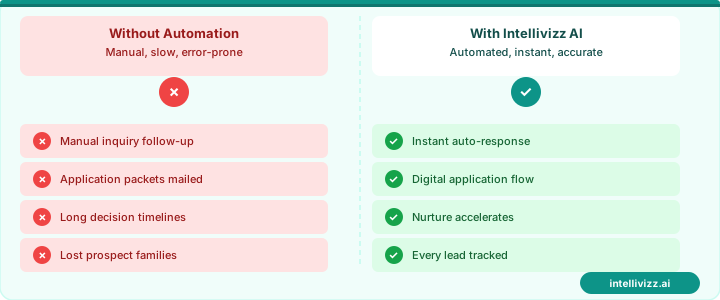
📈 Enrollment Growth Is a System, Not a Campaign
Every layer — from digital marketing to re-enrollment retention — compounds over time
Enrollment Yield Optimization
Enrollment yield — the percentage of admitted students who enroll — is the most often-ignored metric in private school admissions. Schools that admit 120 students to enroll 80 are spending significant admissions resources on 40 families who ultimately chose another school. Understanding why admitted families do not enroll — through systematic exit surveys and post-decision conversations — reveals the specific objections (tuition, program gap, geographic inconvenience, competitive offer) that drive yield losses, enabling targeted adjustments to the admissions process, financial aid strategy, or program mix.
For schools building out the full enrollment management system — from inquiry capture through application management and waitlist conversion — the comprehensive guide to school enrollment funnel automation covers the automation layer that makes it operationally possible to execute this strategy at scale without proportionally increasing admissions staff. Enrollment growth is the compound outcome of getting every stage of the funnel right — and the schools that build each layer systematically are the ones that grow consistently, regardless of market conditions.
Ready to modernize your school's operations? Explore our education automation solutions, or read our guide to School Enrollment Automation: Streamlining the....
Relevant AI Automations
AI Review Management
All-in-one review management: automated review requests, AI-powered responses, and review repurposing for web & social — 3 engines in 1.
Missed Call Text-Back
Instantly respond to missed calls from prospective parents with AI-powered SMS, capturing enrollment leads 24/7
AI Voice Agent - Inbound
AI answers calls 24/7, handles FAQs about programs, tuition, availability, and books tours