
School Enrollment Funnel Automation: From First Inquiry to Signed Contract Without Dropping Leads
Where the Enrollment Funnel Leaks
The school enrollment journey has 5-7 stages, and prospective families drop off at every one. A typical private school loses:
- Inquiry → Tour: 40% drop-off (families inquire but never schedule a tour)
- Tour → Application: 30% drop-off (families tour but don't apply)
- Application → Acceptance: 10% drop-off (incomplete applications, missed deadlines)
- Acceptance → Enrollment: 15% drop-off (accepted families choose another school)
Cumulative loss: 60-70% of inquiries never become enrolled students. For a school receiving 200 inquiries per admissions cycle, that's 120-140 families lost — at $15,000 tuition each, representing $1.8M-$2.1M in potential revenue.
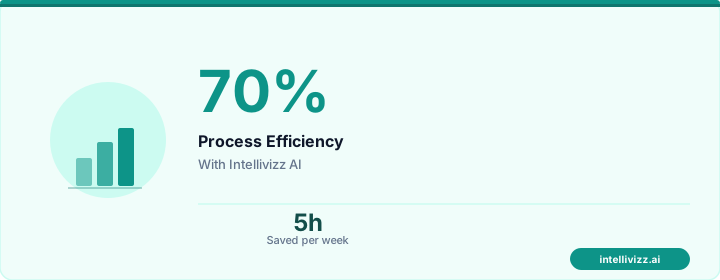
🎓 Keep families engaged with automated communication
The data speaks for itself
Automating Each Funnel Stage
Stage 1: Inquiry Response (0-24 hours)
Speed matters enormously. Families contacting multiple schools enroll at the first one that engages them meaningfully.
- Immediate: Auto-response with school overview, virtual tour link, and tour scheduling link
- 1 hour: Personalized follow-up from admissions mentioning the child's grade level and specific programs
- 24 hours: If no tour scheduled — "We'd love to show you around. Here are this week's available tour times: [link]"
Stage 2: Tour Conversion (Pre and Post)
Pre-tour:
- Confirmation with what to expect, parking info, and key people they'll meet
- "What questions would you like us to address during your visit?" (personalizes the tour)
Post-tour:
- Same-day thank you with photos of the school and link to apply
- Day 3: Testimonial from a current parent in the same grade level
- Day 7: "Thinking about [SchoolName]? Here's what makes our [grade] program special: [link]"
- Day 14: Application deadline reminder with direct link
Stage 3: Application Nurture
- Started but incomplete applications get reminder sequences with specific missing items
- Submitted applications get acknowledgment and timeline communication
- Families waiting for decisions receive engagement content (student spotlights, upcoming events)
Stage 4: Acceptance to Enrollment
- Immediate congratulations message with enrollment packet and deadline
- Welcome video from the division head or teacher team
- Invitation to connect with current families (parent ambassador program)
- Deadline reminders for enrollment deposit
- If no enrollment by Day 14: personal call from admissions director
Lead Scoring for Prioritization
Not all inquiries deserve equal attention. Automated lead scoring prioritizes admissions team effort:
| Action | Points |
|---|---|
| Web form inquiry | +10 |
| Phone call inquiry | +15 |
| Tour scheduled | +20 |
| Tour attended | +30 |
| Application started | +25 |
| Application submitted | +40 |
| Email opened (each) | +2 |
| Website revisit | +5 |
| Financial aid inquiry | +10 |
Leads above 80 points get personal attention from senior admissions staff. Leads below 40 remain in automated nurture. This ensures high-potential families get white-glove treatment while no inquiry is neglected.
Integration with School Systems
Effective enrollment automation connects to:
- SIS: Student Information System for enrollment status tracking
- Website: Inquiry forms, virtual tour pages, application portal
- Calendar: Tour scheduling with real-time availability
- Financial: Deposit processing and tuition agreement generation
- Communication: Multi-channel parent communication for email, SMS, and call tracking
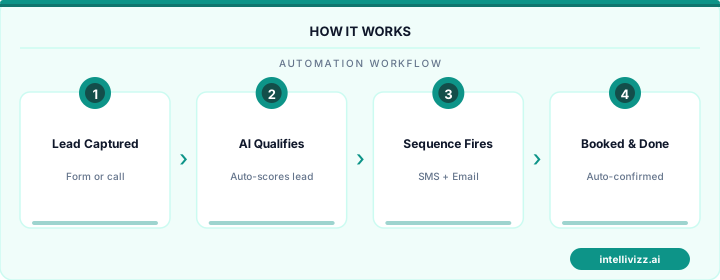
🎓 Keep families engaged with automated communication
Smart technology, better results
Results from Automated Enrollment Funnels
- Inquiry-to-tour conversion improves from 35% to 60%
- Tour-to-application conversion improves from 50% to 75%
- Overall inquiry-to-enrollment conversion doubles from 20-25% to 40-50%
- Admissions team capacity increases 2-3x (can manage more inquiries with same staff)
- Revenue impact: 15-30 additional enrolled students per cycle
Schools that combine enrollment funnel automation with enrollment process automation and AI administration tools create an end-to-end admissions machine that consistently fills seats without proportionally increasing staff.
Mapping the Private School Enrollment Funnel
Private school enrollment funnels follow a predictable multi-stage structure, but the length and complexity of each stage varies significantly by school type, tuition level, and competitive market. Independent day schools with tuitions above $25,000 per year typically run 6-8 month enrollment funnels (September inquiry through March decision day), involving campus tours, shadow days, parent interviews, student assessments, financial aid applications, and reference checks. Smaller private schools and micro-schools with more accessible tuition may run 4-6 week funnels. Understanding your specific funnel structure is the prerequisite for building effective automation, because different funnel lengths require very different automation timing and touchpoint intensity.
Every enrollment funnel has the same fundamental stages, regardless of length: awareness (prospective families discover the school through search, word-of-mouth, or advertising), inquiry (the family requests information or makes first contact), engagement (campus visits, information sessions, interviews), application (formal submission of enrollment application), decision (the school's admission decision and the family's acceptance or decline decision), and enrollment completion (financial aid settlement, enrollment contract, deposit). At each stage transition, a percentage of prospective families drop out — the funnel narrows. Automation that addresses the drop-out points at each stage transition produces the highest enrollment yield from a given inquiry volume.
The stage with the highest drop-out rate in most private school funnels is the gap between inquiry and scheduled campus tour. Research across independent schools shows that 35-55% of families who submit initial inquiries never schedule a campus visit — the single most important next step in the enrollment process. The primary driver of this drop-out is response latency: families who inquire during off-hours (evenings, weekends) and don't receive a response until the next business day have already lost much of their initial excitement, and 40-50% of them will have contacted one or two additional schools in the interim.
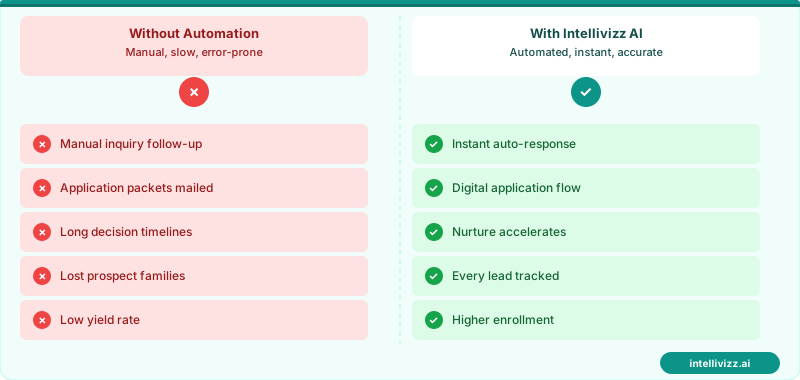
🎓 50% of school inquiries drop off before the campus tour — automation keeps them engaged
Automated inquiry response within 5 minutes increases campus tour scheduling by 45%.
Automation Sequences for Each Funnel Stage
Stage 1 (Awareness to Inquiry) automation focuses on lead capture optimization: ensuring that every form submission, phone call, and website chat initiates an immediate, personalized response. The inquiry response sequence should deliver an acknowledgment within 5 minutes (available 24/7 via automation), a personalized follow-up within 24 hours from the admissions team, and a campus tour scheduling offer within 48 hours. This 3-touchpoint sequence can be entirely automated with AI — the acknowledgment and scheduling offer require no human input, while the admissions team review is triggered automatically and routed to the appropriate admissions counselor.
Stage 2 (Inquiry to Engagement) automation focuses on campus tour scheduling and pre-visit nurturing. Families who have not scheduled a tour within 5 days of their inquiry should receive an automated re-engagement sequence: a follow-up with alternative tour dates, a virtual tour option for families who can't visit in person, and a family testimonial or student spotlight that reinforces the school's value proposition. Tour reminder sequences (48 hours before, day-of) reduce tour no-shows by 35-45%.
| Funnel Stage | Average Drop-Off (No Automation) | With Automation | Key Automation |
|---|---|---|---|
| Inquiry → Campus Tour | 40–55% | 20–30% | Immediate response + scheduling |
| Campus Tour → Application | 25–35% | 12–18% | Post-tour nurture sequence |
| Application → Enrollment | 15–25% | 8–14% | FA settlement + deposit automation |
| Enrolled → Re-enrolled | 12–18% annual attrition | 7–11% attrition | Engagement + re-enrollment campaign |
Financial Aid Integration in Enrollment Automation
For private schools with need-based financial aid programs, the financial aid process is a critical enrollment funnel step that can make or break a family's decision to enroll. Families who are uncertain about financial aid availability or timelines are more likely to choose a school with a more transparent, faster financial aid process — even if the educational program is less preferred. Automation that streamlines financial aid application, communication, and settlement dramatically improves enrollment yield among aid-eligible families. Related: learn how daycare enrollment automation applies similar funnel principles to early childhood programs. Related: learn how school waitlist management software handles automated updates and priority systems. You may also want to explore campus tour no-show recovery to convert absent parents into enrolled students.
Automated financial aid workflows include: online application submission with document upload capabilities, automatic acknowledgment of application receipt with expected timeline, automated reminders for missing documents (with specific document names and upload links), preliminary award calculation notifications (where appropriate under the school's process), and final award communication with enrollment contract. Schools that automate the financial aid communication timeline and make it transparent to families report 20-30% higher enrollment yield among aid-applicant families compared to schools with opaque, slow aid processes. Pair enrollment funnel automation with after-school program upsell automation to build a full lifecycle automation system from first enrollment through multi-program family development.
Using Data to Continuously Improve Your Enrollment Funnel
Enrollment funnel automation generates data that, when analyzed regularly, reveals opportunities to improve yield at every stage. The core analysis framework is conversion rate by stage: what percentage of inquiry-to-tour, tour-to-application, application-to-enrollment, and enrollment-to-re-enrollment conversions are you achieving, and how do these rates compare to schools with similar profiles? Most independent school benchmarking organizations (NAIS, AISAP) publish conversion rate data that provides context for your school's performance.
Beyond overall conversion rates, segmentation analysis reveals which prospect segments convert at different rates. Geographic segmentation may show that families from certain zip codes convert at much lower rates — potentially indicating that transportation concerns are a barrier that could be addressed with shuttle programs or virtual attendance options. Grade-level segmentation may show that middle school enrollment converts at lower rates than lower school — possibly indicating that the school's middle school program needs marketing attention or that the value proposition isn't landing for that age group. Financial aid segmentation typically reveals that aid-eligible families convert at lower rates due to process friction — a finding that directly motivates financial aid automation investment.
Seasonality analysis — examining conversion rates for families who inquire in different months — helps optimize marketing spend. Most private schools find that September and October inquiries convert at the highest rates (families planning ahead for the following year), while January and February inquiries convert at lower rates (families in reactive mode, often because their first-choice school rejected their child). Understanding this seasonality allows smarter allocation of marketing budget and admissions staff time across the enrollment cycle. Schools that build this analytical discipline into their enrollment management practice — reviewing conversion rates monthly and making data-driven adjustments to their automation sequences — consistently outperform schools that run the same automation year after year without measurement-driven optimization.
Ready to modernize your school's operations? Explore our education automation solutions, or read our guide to Automated Enrollment Follow-Up for Private Schools:....
Relevant AI Automations
AI Review Management
All-in-one review management: automated review requests, AI-powered responses, and review repurposing for web & social — 3 engines in 1.
Missed Call Text-Back
Instantly respond to missed calls from prospective parents with AI-powered SMS, capturing enrollment leads 24/7
AI Voice Agent - Inbound
AI answers calls 24/7, handles FAQs about programs, tuition, availability, and books tours