
After-School Program Upsell Automation: Increase Enrollment Without More Sales Calls
The Untapped Revenue in After-School Programs
After-school programs — athletics, tutoring, arts, enrichment, extended care — represent 15-30% of total revenue for many private and independent schools. Yet they're typically marketed with a paper flyer sent home in backpacks and a single email to the parent distribution list. The result: programs run at 50-70% capacity while interested families miss sign-up deadlines because the information got lost in the noise.
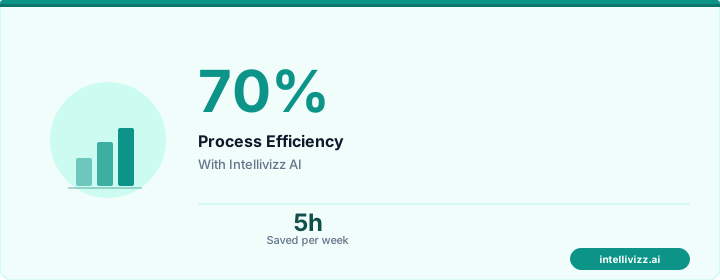
🎓 Keep families engaged with automated communication
From manual processes to automated excellence
Why Automation Transforms After-School Enrollment
Effective after-school promotion requires reaching the right families with the right programs at the right time. A parent with a 3rd grader who loved last year's robotics club needs a different message than a kindergarten parent who hasn't explored enrichment options yet. Manual segmentation and outreach at this level is impossible for school admin teams already stretched thin.
Automated Upsell Campaign Framework
Campaign 1: Historical Interest Targeting
Use past enrollment data to target families with programs they're likely to want:
- Families who enrolled in a program last year get first notification and early registration for the same program
- Families who enrolled in related programs get cross-sell suggestions ("Your child loved Drama — they might enjoy our Musical Theater program this spring")
- Families who registered but didn't attend get a re-engagement message ("We missed [ChildName] in Chess Club last session — registration is open for spring")
Campaign 2: Age/Grade-Based Recommendations
Automatically recommend age-appropriate programs as students move through grade levels:
- K-2 families get recommendations for beginner programs
- 3-5 families get intermediate and competitive options
- Middle school families get leadership, academic prep, and advanced enrichment suggestions
Campaign 3: Deadline-Driven Urgency
A multi-touch sequence around registration deadlines:
- T-14 days: Program announcement with descriptions, schedules, and costs
- T-7 days: Reminder with testimonials from past participants
- T-3 days: "Spots filling up" urgency message with real-time availability counts
- T-1 day: Final reminder: "Last day to register for [Program]. [X] spots remaining."
- Post-deadline: Waitlist offer for filled programs
Campaign 4: New Family Welcome
New families receive a comprehensive after-school program overview within their first 30 days:
- Welcome message highlighting the range of available programs
- FAQ addressing common questions (pickup procedures, costs, scheduling)
- Testimonials from current families about their children's enrichment experiences
- Easy one-click registration links for each program
Extended Care Promotion
Extended care (before- and after-school supervision) is the highest-margin program most schools offer. Automated promotion includes:
- Targeted outreach to families where both parents work (based on contact info patterns)
- Seasonal campaigns when working parents most need coverage (summer, school breaks, teacher workdays)
- Flexible scheduling promotion — "Use extended care as needed with our drop-in option"
- Bundle pricing with other after-school programs
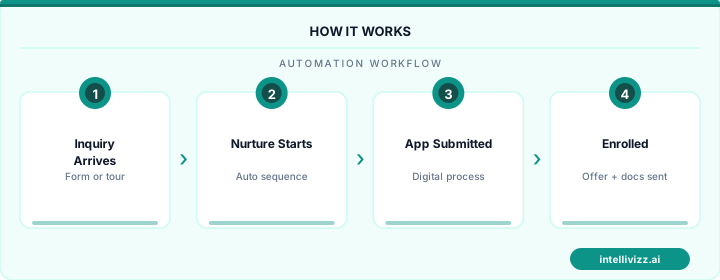
🎓 Keep families engaged with automated communication
See how automation transforms industry operations
Impact on School Revenue
- After-school program enrollment increases 25-40%
- Extended care utilization increases 20-30%
- Registration deadline compliance improves 60% (fewer late registrations disrupting planning)
- Admin time on program promotion drops from 15-20 hours per season to 2-3 hours
- Revenue per enrolled family increases 15-25% through cross-program enrollment
Schools already using parent communication automation can add after-school upsell as a campaign within their existing platform, avoiding additional tool costs. Combined with re-enrollment automation, schools create a complete revenue optimization ecosystem.
The Psychology of After-School Program Upsells
After-school program upselling works because parents who have already committed to one program have demonstrated both willingness to pay for supplemental education and trust in the provider. The psychological friction of the first enrollment decision — evaluating options, getting comfortable with the program, discussing with a spouse — has already been overcome. A second enrollment requires a much lower barrier: the parent simply needs a relevant offer at the right time, presented in a context where they're already engaged with the program.
Effective after-school upsell automation maps the parent relationship lifecycle to identify optimal offer timing. Week 1-2 of enrollment is too early — parents are focused on whether their child likes the program and is adjusting well. Weeks 3-4 are ideal for a first upsell contact, when the child has settled in and the parent is likely receiving positive feedback. This is when an automated message highlighting a complementary program (math enrichment alongside existing tutoring, sports camp alongside academic enrichment) lands with maximum receptivity. Month 2-3 is the optimal window for premium tier upgrades — parents have seen value and are open to deepening the investment.
The content of upsell messages matters as much as timing. Messages framed around the child's specific progress ("Based on Alex's progress in our reading program, our writing workshop would be a great next step") outperform generic promotional offers by 3-4x in conversion rate. AI systems that integrate with student management software can personalize upsell recommendations based on the child's enrolled programs, attendance record, and any progress notes — creating the impression of a personalized recommendation from a knowledgeable educator.
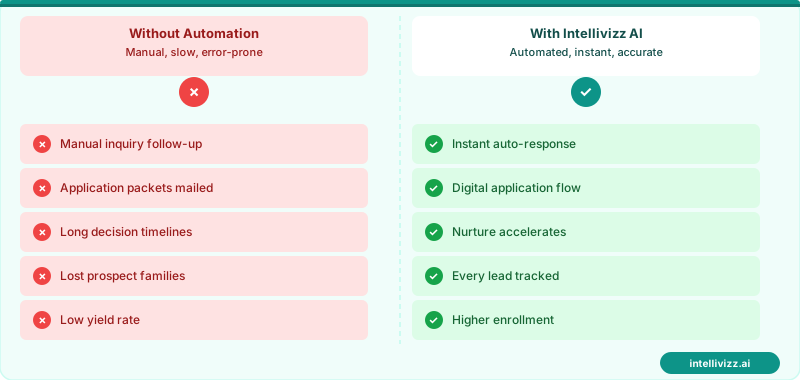
📚 Existing program families convert at 4x the rate of new prospects
Automated upsell sequences turn enrolled families into multi-program participants with no sales staff required.
Building a Multi-Program Enrollment Automation Sequence
A complete after-school upsell automation sequence typically runs 6-8 touchpoints over 45-60 days from initial enrollment. The sequence opens with a welcome and onboarding series (not an upsell — pure value delivery). Parent guides, what to expect, how to communicate with instructors, and a personal check-in message from the program director establish relationship equity before any commercial ask. The first upsell offer appears at touchpoint 4 or 5, presented as a logical extension of the existing program rather than a sales pitch.
Offer presentation format significantly affects conversion. Email messages with a clear program description, specific outcomes ("students in this program improve standardized test scores by an average of 18 points"), a limited-time enrollment incentive (early registration discount, sibling discount), and a single clear call-to-action outperform longer promotional emails by 40-60%. SMS follow-ups to non-openers of the email sequence capture an additional 15-20% of families who would otherwise have missed the offer.
| Sequence Stage | Timing | Message Type | Conversion Role |
|---|---|---|---|
| Welcome + orientation | Day 1–3 | Relationship building | |
| Progress check-in | Week 2 | Email + SMS | Engagement + satisfaction signal |
| First upsell offer | Week 3–4 | Email (personalized) | Primary conversion opportunity |
| SMS follow-up | Week 4 | SMS | Non-opener recovery |
| Premium tier offer | Month 2 | Revenue per student uplift |
Measuring Upsell Automation Performance in After-School Programs
After-school program operators should track four core metrics for upsell automation: multi-program enrollment rate (what percentage of families are enrolled in more than one program), average revenue per enrolled family (total program revenue divided by enrolled family count), upsell conversion rate by program type (which complementary programs convert best), and lifetime enrollment duration (how long families stay across all programs combined).
Industry benchmarks for well-run after-school programs with automation suggest multi-program enrollment rates of 30-45%, up from 12-18% for programs without automated upsell sequences. Average revenue per family increases from approximately $180/month (single program) to $310-$420/month (multi-program families). The long-term compounding effect is significant: a family enrolled in multiple programs has a 65% lower attrition rate than a single-program family, because switching costs are higher and perceived value is stronger. For programs also managing enrollment funnel automation, see the companion guide on school enrollment funnel automation.
Seasonal Upsell Opportunities in After-School Programs
After-school programs have distinct seasonal enrollment windows that, when addressed with targeted automation, produce disproportionate upsell results. Summer program enrollment is the largest seasonal opportunity for most programs: families enrolled in academic-year programs are natural targets for summer camp or enrichment offerings, and the enrollment window (March–May) is predictable and short. Automated summer program marketing sequences that launch in late February to existing enrolled families — before general public marketing begins — capture the highest-intent audience first and often fill summer cohorts before external marketing is needed.
Back-to-school season (July–August) is the second major upsell window. Families who attended summer programs are at peak engagement with the organization and are natural targets for academic-year enrollment upsells or upgrades. A re-enrollment priority window (giving summer families first access to coveted time slots for the academic year) creates urgency and rewards the organization's best customers, while automated communications ensure that every summer family receives the offer at the optimal time.
Mid-year (January) represents the third major opportunity: families who enrolled their children at the start of the school year have now had four months of experience and are deciding whether to continue, upgrade, or add additional programs. January is also when many families receive tax refunds and reassess their household budgets — making it a good time to offer annual enrollment incentives (pay upfront for the remaining year and save 5-8%). An automated mid-year check-in sequence that assesses satisfaction, offers upgrade options, and presents the annual enrollment incentive can capture 15–25% of enrolled families in multi-program or upgraded enrollments.
After-school programs that master upsell automation gain a durable competitive advantage: they generate more revenue per enrolled family, they reduce dependence on expensive new student acquisition, and they build the deep family relationships that produce long-term loyalty and powerful word-of-mouth. In the competitive DMV after-school market, where families have abundant choices and program quality is often perceived as similar across providers, these relationship and revenue advantages are decisive differentiators. Begin with a single upsell sequence for your most natural cross-sell, measure results over 90 days, and expand to additional cross-sell and upgrade sequences based on what the data shows converts best in your specific program portfolio and family demographic.
Ready to modernize your school's operations? Explore our education automation solutions.