
AI for School Administration: 8 Ways Artificial Intelligence Is Transforming How Schools Operate
The Administrative Burden on Schools
School administrators are drowning in operational tasks. Enrollment processing, attendance tracking, parent communication, financial management, compliance reporting, scheduling — the list grows every year while staff sizes remain flat. A 2025 survey found that school administrators spend 60% of their time on tasks that could be automated, leaving only 40% for the strategic, relationship-driven work that actually improves educational outcomes.
AI isn't replacing administrators — it's giving them back the time they need to lead, mentor, and build the community relationships that make great schools great.
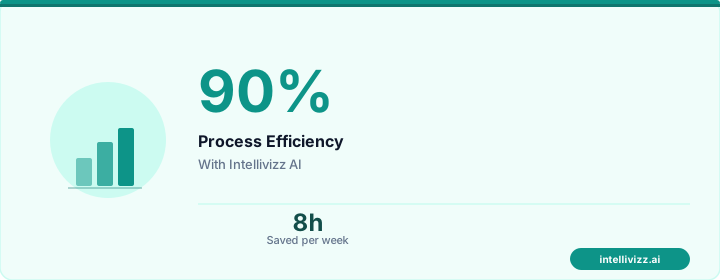
🎓 Keep families engaged with automated communication
From manual processes to automated excellence
1. Enrollment and Admissions Processing
AI transforms the enrollment funnel from a manual paper-chase into a streamlined digital experience:
- Inquiry response: AI chatbots answer prospective family questions 24/7, qualify leads, and schedule tours automatically
- Application review: AI pre-screens applications for completeness, flags missing documents, and categorizes applicants by criteria
- Communication sequences: Automated drip campaigns keep prospective families engaged from inquiry through enrollment
- Re-enrollment: Automated re-enrollment campaigns retain 90%+ of current families
Schools using AI-powered enrollment automation report 40% reduction in admissions staff time and 25% increase in inquiry-to-enrollment conversion rates.
2. Parent Communication Management
AI handles the volume and timing of parent communications that overwhelm manual systems:
- Automated message routing based on urgency, audience, and channel preference
- AI-generated summaries of school events and updates for weekly digests
- Chatbot-powered parent helpdesk for FAQs (hours, dress code, calendar, policies)
- Sentiment analysis on parent feedback to identify emerging concerns
3. Attendance and Absence Management
Manual attendance processing — calling absent students' families, tracking patterns, filing reports — consumes 5-8 hours per week in most schools. AI automates:
- Instant parent notification when a student is marked absent
- Pattern detection flagging chronic absenteeism before it becomes critical
- Automated absence reporting to state/district systems
- Predictive alerts identifying students at risk of excessive absences based on early-year patterns
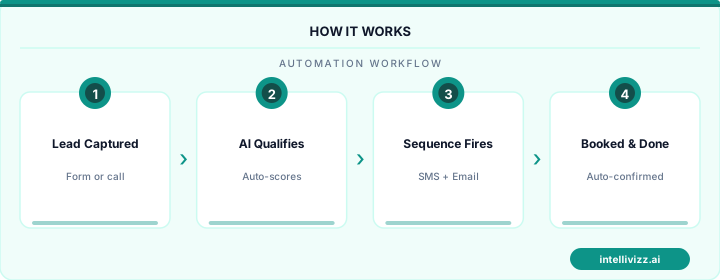
🎓 Keep families engaged with automated communication
See how automation transforms industry operations
4. Financial Management and Tuition
AI-powered financial automation addresses the biggest administrative headache — tuition collection:
- Automated payment reminders reducing late payments by 40-50%
- AI-assisted financial aid processing that evaluates applications consistently
- Predictive budgeting based on enrollment trends and historical data
- Automated vendor payment processing and expense categorization
5. Scheduling and Resource Allocation
Building master schedules, managing substitute teachers, allocating room assignments — these combinatorial problems are where AI truly excels:
- AI-generated master schedules that optimize for student needs, teacher preferences, and room availability simultaneously
- Automated substitute teacher placement based on availability, certification, and past performance
- Facility scheduling that maximizes utilization while preventing conflicts
- Event planning automation that coordinates calendars across divisions and departments
6. Compliance and Reporting
Schools face increasing regulatory requirements across health records, safety drills, special education documentation, and financial reporting. AI helps by:
- Automatically tracking compliance deadlines and sending staff reminders
- Generating required reports from existing data without manual compilation
- Flagging compliance gaps (expired health forms, overdue IEP reviews, missing background checks)
- Maintaining audit-ready documentation with automated record-keeping
7. Student Support Identification
AI analyzes patterns across attendance, grades, behavior, and social-emotional data to identify students who may need additional support — often before teachers or counselors notice the signs:
- Early warning systems that flag declining performance across multiple data points
- Behavior trend analysis identifying students who may need counseling referrals
- Learning gap identification to target interventions effectively
- Social-emotional check-in automation with appropriate routing to counselors
8. Front Desk and Phone Management
School front offices handle an enormous volume of calls — from parents checking on early dismissal to prospective families requesting information. AI phone systems:
- Answer every call instantly, eliminating hold times and missed calls
- Handle routine inquiries (hours, calendar, policies) without staff involvement
- Route urgent calls (student illness, security concerns) to the right person immediately
- Schedule tours and meetings for prospective families in real time
Implementation Strategy for Schools
Schools should prioritize AI adoption by impact and complexity:
| Priority | Application | Complexity | Time to Impact |
|---|---|---|---|
| 1 | Parent communication automation | Low | 2-4 weeks |
| 2 | Enrollment/re-enrollment automation | Medium | 4-8 weeks |
| 3 | Tuition and payment automation | Low | 2-4 weeks |
| 4 | Attendance automation | Medium | 4-6 weeks |
| 5 | AI phone/front desk | Low | 2-3 weeks |
| 6 | Scheduling optimization | High | 8-12 weeks |
| 7 | Student support identification | High | 12-16 weeks |
| 8 | Compliance automation | Medium | 6-10 weeks |
Starting with communication and enrollment — high-impact, low-complexity applications — lets schools see quick wins that build momentum and staff buy-in for more complex implementations.
AI-Assisted Scheduling: Staff, Rooms, and Academic Calendar Management
School scheduling is one of the most computationally intensive administrative functions in K-12 education — a master schedule for a secondary school with 60+ course sections, 40+ teachers, 30+ rooms, and hundreds of student course requests involves thousands of constraint satisfaction decisions that are theoretically tractable but practically overwhelming for manual schedulers working in spreadsheets. AI-assisted scheduling tools that encode teacher certification requirements, student special education service constraints, course sequence dependencies, room capacity and equipment requirements, and administrative period preferences can generate master schedule candidates that satisfy 95%+ of constraints in minutes — a process that historically took experienced schedulers weeks of iterative trial and error. The result is not just time savings; it is measurably better schedules that reduce course conflicts for students, minimize teacher prep period fragmentation, and optimize room utilization across the academic day.
Academic calendar management — the scheduling of standardized testing windows, professional development days, parent-teacher conference blocks, athletic event conflicts, and state-required instructional day counts — is a related challenge where AI assistance creates significant administrative efficiency. An AI system that cross-references the district's instructional day requirements against the state testing calendar, identifies the professional development days that comply with state PD hour mandates, and flags athletic event conflicts that would require excessive student excusals from specific courses can produce a compliant, optimized academic calendar draft that a human calendar committee reviews and refines rather than builds from scratch. This shifts the administrative effort from creation to review — a far more efficient use of skilled administrative time.
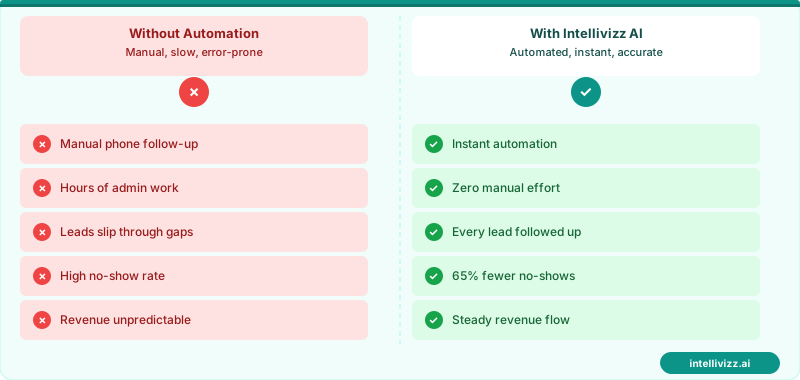
🏫 Master Schedules That Used to Take Weeks — Built in Hours
AI-assisted scheduling satisfies 95%+ of constraints and frees administrators for strategic work
Compliance Reporting and Data-Driven Decision Making
School administrators spend a disproportionate amount of time on compliance reporting — federal, state, and district data submissions that are legally required, time-sensitive, and prone to error when assembled manually from multiple data systems. Special education child count submissions, state assessment participation reports, attendance and graduation rate calculations for state report cards, Title I enrollment verification, and English Learner identification and service documentation all require accurate data aggregation from student information systems, assessment platforms, and service delivery records. AI-assisted compliance reporting automation pulls data from authoritative sources, applies the specific calculation methodologies defined by each reporting requirement, and generates submission-ready reports that administrators review and certify rather than build from scratch.
Beyond compliance, AI is transforming how school leaders use data for strategic decision-making. Predictive analytics applied to early warning indicators — attendance patterns, grade trajectory, discipline referral frequency, and course performance — can identify students at elevated dropout risk 12–18 months before conventional indicators would surface the concern, enabling earlier and more effective intervention. Budget modeling tools that combine enrollment projection data with staffing cost data and state funding formula parameters allow administrators to model the financial implications of enrollment scenarios and staffing decisions before committing resources. These analytical capabilities were previously available only to districts with dedicated data teams; AI-powered tools are making them accessible to single-building administrators with no specialized data science background.
| AI Administrative Function | Manual Time Replaced | Error Risk Reduction | Strategic Value |
|---|---|---|---|
| Master schedule generation | 60–120 hours/cycle | Constraint violation elimination | Better student course access |
| Compliance report preparation | 20–40 hours/report cycle | Automated calculation accuracy | Reduced audit exposure |
| Early warning analytics | Ongoing — not previously possible | N/A (new capability) | Earlier intervention, higher graduation rates |
| Budget modeling | 8–20 hours/scenario | Formula error elimination | Informed resource allocation decisions |
School administrators building a comprehensive AI infrastructure across scheduling, reporting, parent communication, and student support functions will find the practical implementation framework in parent communication automation for schools a valuable companion piece — covering the family-facing automation layer that complements the internal administrative efficiency gains described here.
Professional Development Planning and Staff Evaluation Automation
Human resources administration consumes a substantial portion of school administrator time that could be redirected to instructional leadership if routine HR processes were more systematically automated. Professional development tracking — documenting teacher PD hours, matching completed PD against district and state requirements, generating compliance reports for certification renewal, and surfacing gaps in individual teacher PD completion — is an excellent candidate for automation given its highly structured data requirements and rule-based processing logic. An automated PD tracking system that pulls completion data from the district's professional learning management system, calculates compliance against each teacher's certification renewal requirements, and generates automatic alerts when a teacher is approaching a deficit creates a compliance infrastructure that prevents the last-minute certification crisis that consumes significant administrative and HR time in districts without systematic tracking.
Staff evaluation scheduling and documentation — teacher observation cycles, post-observation conference scheduling, evaluation form completion tracking, and final evaluation delivery deadline management — is similarly structured and amenable to automation. Automated evaluation cycle management tracks each administrator's observation responsibilities against the district's evaluation calendar, sends reminders when observation deadlines are approaching, confirms conference scheduling between evaluators and teachers, and flags incomplete evaluations for principal review. For principals managing evaluation responsibilities for 25–40 teaching staff simultaneously, this tracking automation prevents the documentation compliance failures that create legal exposure for districts when the evaluation record does not support personnel decisions that are subsequently challenged.
Ready to modernize your school's operations? Explore our education automation solutions, AI for Schools in Northern Virginia: How NoVA's Top..., or School Enrollment Automation: Streamlining the....
Relevant AI Automations
AI Review Management
All-in-one review management: automated review requests, AI-powered responses, and review repurposing for web & social — 3 engines in 1.
Missed Call Text-Back
Instantly respond to missed calls from prospective parents with AI-powered SMS, capturing enrollment leads 24/7
AI Voice Agent - Inbound
AI answers calls 24/7, handles FAQs about programs, tuition, availability, and books tours