
Campus Tour No-Shows: Recovery Systems That Convert Absent Parents Into Enrolled Students
The 30% Problem Every Admissions Director Knows But Rarely Measures
Every private school admissions team can tell you how many campus tours they scheduled last fall. Fewer can tell you exactly how many families actually showed up. The ones who track it carefully know that the no-show rate for scheduled campus tours typically runs between 25 and 35 percent — meaning that for every 10 families who committed to a tour appointment, three or four never walked through the door.
The instinctive response is to treat these families as lost: they were not serious, something came up, they chose another school. This instinct is wrong in a significant portion of cases. Research on consumer behavior and scheduling abandonment consistently shows that the majority of no-shows in high-consideration service categories are situational rather than dispositional. The family did not abandon their interest in your school. Their child had a fever, a work meeting ran long, they got confused about the date, they felt guilty about backing out and avoided the awkward rescheduling call. A well-designed recovery system meets them where they are and brings them back.
This guide covers the full recovery architecture: understanding why families no-show, designing reminder sequences that reduce the rate before it happens, building rescheduling automation that makes rebooking frictionless, leveraging virtual tour alternatives to capture families who cannot return in person, and analyzing the signals that distinguish serious prospects from casual browsers — so your admissions staff can focus recovery energy where it will convert.
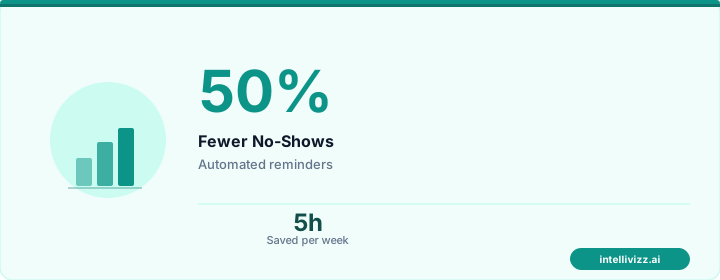
🏫 Recover the Tours That Never Happened
A structured recovery system converts 50%+ of no-show families into rescheduled visits
Why Campus Tour No-Shows Happen: A Motivation Framework
Not all no-shows are created equal. Effective recovery messaging requires understanding the underlying reason a family did not appear, because the same recovery message that resonates with a genuinely interested parent who had a scheduling conflict will feel presumptuous and tone-deaf to a family that has already enrolled their child elsewhere.
The Four No-Show Profiles
| Profile | Estimated Share | Signal Indicators | Recovery Approach |
|---|---|---|---|
| Situational conflict (serious prospect) | 35–45% | Inquiry came through referral or direct search, high-intent inquiry form, prior email engagement | Warm rescheduling outreach within 2 hours; offer specific alternative slots |
| Comparison shopper (evaluating multiple schools) | 25–30% | Multiple form submissions, questions about tuition and financial aid, inquiry came from broad search | Value-differentiation messaging before rescheduling ask; virtual tour as lower-commitment alternative |
| Early-stage researcher (no immediate enrollment timeline) | 15–20% | Enrolled child is an infant or toddler, inquiry for a start date 2+ years out, vague inquiry language | Nurture sequence rather than immediate rescheduling push; waitlist or information packet offer |
| Disengaged (unlikely to convert) | 10–20% | No response to confirmation messages, no prior email engagement, inquiry source unclear | Single recovery attempt; exit into long-term nurture only |
Segmenting your no-show families by profile requires connecting the CRM data you collected at inquiry — source, form responses, prior email engagement — to the no-show event. Schools that have invested in a structured private school admissions CRM can run this segmentation automatically; schools without one must rely on admissions staff judgment, which is inconsistent and time-consuming.
Prevention Before Recovery: The Reminder Sequence That Matters
The most effective no-show recovery strategy begins before the no-show occurs. A well-designed pre-tour reminder sequence reduces the no-show rate from 30–35% to 12–18% — a reduction significant enough to meaningfully increase tour throughput without adding tour slots or staff time.
The Four-Touch Pre-Tour Sequence
- Immediate confirmation (T+0): Sent within 60 seconds of booking. Includes tour date, time, parking and entrance instructions, what to bring, a brief agenda so parents know what to expect, and a one-tap link to reschedule if needed. This message dramatically reduces "I forgot I had this scheduled" no-shows.
- One-week reminder (T-7 days): A warm reminder that builds anticipation. Include something specific about the tour — the classroom they will visit, a student guide profile, a brief video message from the head of school. Ends with a gentle confirmation request and a rescheduling link that requires no phone call to use.
- One-day reminder (T-24 hours): A practical reminder with directions, parking details, and a weather note if relevant. Ask for a simple confirmation reply ("Reply YES to confirm you'll be joining us tomorrow"). Non-response by 8 hours before the tour triggers an additional outreach step.
- Morning-of reminder (T-2 hours): A brief message sent two hours before the tour. Include the specific time, parking entrance, and the name of their admissions contact. "We're looking forward to meeting your family at 10 AM. [Admissions contact name] will be waiting for you at the main entrance." This message alone, for families who would otherwise forget in the chaos of the morning, prevents 5–8% of no-shows.
Families who do not confirm after the one-day reminder should receive a personalized text from the admissions coordinator — not an automated message — asking if they need to reschedule. The human touch at this inflection point converts a significant share of at-risk families before they become no-shows.
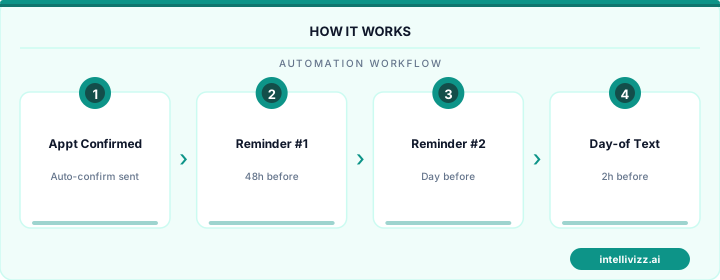
📅 Four Touches, Half the No-Shows
A reminder sequence starting 7 days out cuts no-show rates from 30% to under 15%
The Recovery Window: Speed and Tone
When a family no-shows, the recovery window is narrow. Data from admissions CRMs across independent schools shows that rescheduling rates drop sharply after 48 hours and fall to near zero after seven days. The family has moved on — either to another school's tour, to a renewed sense of inertia, or to a decision to delay enrollment entirely. First contact must happen within two hours of the missed tour.
Recovery Message Tone: What Works and What Backfires
The single most common mistake in tour no-show recovery is a message that implies disappointment or creates guilt. Messages like "We missed you today — we had a tour scheduled for your family at 10 AM" are technically accurate but emotionally positioned in a way that makes parents less likely to engage. They feel judged. They feel they owe you an explanation. Many avoid the conversation entirely.
High-converting recovery messages share three characteristics:
- Assumption of good faith: The message assumes the parent had a legitimate reason for missing without asking them to justify it. "We know schedules can get complicated" rather than "We noticed you weren't able to make it."
- Immediate path forward: The message includes specific alternative tour dates in the body — not a link to a scheduling page that requires multiple steps. "We have tours available Thursday at 9 AM, Thursday at 1 PM, and Saturday at 10 AM. Reply with your preference and we'll confirm you immediately."
- Value reinforcement: A single sentence that reminds the family why the tour matters. "Our admissions team saves our best time for campus visits — it's really the only way to see what makes [School Name] different from what you've read online."
The recovery message should come from the admissions coordinator by name, not from a generic school email address. Personalization at this touchpoint — using the parent's first name, the child's name, the child's grade of interest — increases response rates by 30–40% compared to generic template messages.
Rescheduling Automation: Making Rebooking Frictionless
The greatest barrier to rescheduling after a no-show is not the family's disinterest — it is friction. A family that feels mildly guilty about missing a tour will avoid initiating a phone call to reschedule. They know the admissions coordinator is going to ask what happened. They don't have a good answer. So they don't call.
Automated rescheduling removes this barrier entirely. When a no-show event triggers in the CRM at the scheduled tour time, the system initiates a recovery sequence that offers immediate rescheduling through a self-serve booking link. The parent selects a new time without speaking to anyone. The confirmation arrives instantly. There is no moment of awkward explanation, no guilt-inflecting conversation, no friction.
For schools using enrollment automation at the broader level, the infrastructure for rescheduling automation is typically already in place. The automated enrollment follow-up system covers the full sequence from initial inquiry through enrolled student, with tour rescheduling as one component of the broader workflow. Connecting the no-show trigger to this existing workflow is a configuration change, not a new system build.
Rescheduling Sequence After a No-Show
- T+2 hours — First recovery SMS: Brief, warm, non-judgmental. Offers 2-3 specific available tour slots with a direct booking link. Sent from the admissions coordinator's name.
- T+24 hours — Email follow-up: Slightly longer message with value reinforcement. Includes a virtual tour option for families who cannot reschedule in person. Reiterates available dates.
- T+72 hours — Final rescheduling attempt: Shorter message. Creates soft urgency ("Our spring tour schedule fills quickly, and we want to make sure your family has a chance to see campus before decisions are finalized"). Includes the virtual tour link prominently.
- T+7 days — Nurture pivot: If no rescheduling response, move to long-term nurture. Send enrollment guide, testimonials, student spotlight content. Remove from active rescheduling sequence.
The Virtual Tour Alternative: Capturing Families Who Cannot Return
For a subset of no-show families — those with geographic distance, inflexible work schedules, or childcare constraints — an in-person rescheduled visit is not realistic in the short term. For these families, offering a high-quality virtual tour experience is the difference between maintaining engagement and losing the prospect entirely.
Virtual tours for private school admissions have evolved significantly from the basic video walkthroughs of 2020. The most effective current implementations include:
- Asynchronous video tours: A 15–20 minute structured video tour of key campus areas — classrooms, labs, athletic facilities, performing arts spaces — narrated by a student guide. Families can watch on their own schedule.
- Live virtual sessions: Scheduled 30-minute Zoom sessions with an admissions coordinator that include a screen-shared video tour followed by live Q&A. These convert at 60–70% of the rate of in-person tours for families at the consideration stage.
- Departmental deep-dives: Short recorded sessions featuring department chairs discussing curriculum and student outcomes in specific academic areas. Particularly effective for families with children who have specific academic interests or learning needs.
In the recovery sequence, the virtual tour is not positioned as a consolation prize for families who cannot make it in person. It is positioned as an additional tool: "While nothing replaces walking the campus in person, our virtual session gives you a real sense of our community and lets you ask direct questions to our admissions team without the commute." Many families who complete a virtual tour subsequently schedule an in-person visit — the virtual session raises engagement rather than replacing physical enrollment conversion.
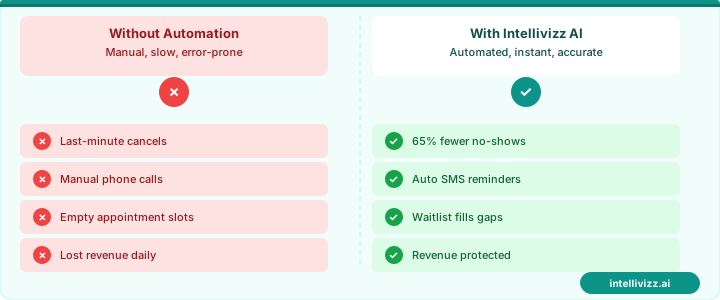
💻 Virtual Tours as a Recovery Bridge
Live virtual sessions convert at 60-70% of in-person tour rates — and often lead back to campus
Conversion Data: Rescheduled Tours vs. Original Tours
A common concern among admissions directors considering investment in tour recovery systems is whether rescheduled tours actually convert. The worry is intuitive: if a family did not show up for their first appointment, perhaps they were never serious enough to enroll. The data from schools tracking this metric carefully tells a more nuanced story.
| Tour Category | Application Rate | Enrollment Rate (of applicants) | Notes |
|---|---|---|---|
| Original tour — attended | 42–55% | 68–75% | Baseline; highest-intent group |
| Rescheduled tour — attended (within 2 weeks) | 35–48% | 65–72% | Nearly comparable; situational no-shows convert well |
| Rescheduled tour — attended (2–6 weeks later) | 28–38% | 60–68% | Slightly lower but still strong ROI on recovery effort |
| Virtual tour only — no in-person visit | 18–25% | 55–65% | Lower application rate; higher enrollment rate among those who apply |
| No recovery contact made | 4–8% | 50–60% | Organic re-engagement only; most families are lost |
The key finding: families who reschedule and attend within two weeks of their original no-show convert at rates 85–90% as high as families who attended their original tour. The recovery effort is not a consolation prize — it is a genuine second-chance conversion opportunity with strong ROI. Schools that systematically recover no-show tours and invest in virtual alternatives are adding 8–15 additional enrolled students per admissions cycle compared to schools that treat no-shows as lost prospects.
Integrating No-Show Recovery With Your Enrollment Funnel
Tour no-show recovery does not exist as a standalone system — it is one component of a broader enrollment funnel automation architecture. Schools that see the highest conversion rates from recovery efforts have connected their no-show recovery to their full enrollment communication system, so that a rescheduled family re-enters the appropriate stage of the enrollment funnel rather than starting over from the beginning.
For schools building this integrated approach, our guides to school enrollment funnel automation and open house follow-up for school enrollment cover the adjacent stages of the enrollment journey that connect to tour recovery. And for schools evaluating CRM platforms that can manage the full admissions sequence — from first inquiry through enrolled student — the private school admissions CRM guide provides a platform comparison framework built specifically for K-12 independent schools.
The bottom line on tour no-show recovery: the 30% of families who miss their campus tour are not a lost cause. They are a recoverable opportunity that most schools leave on the table because they lack the systems to respond quickly, personally, and frictionlessly. Building those systems — a rapid-response recovery sequence, self-serve rescheduling, a quality virtual alternative, and clear segmentation by prospect motivation — is one of the highest-ROI investments an admissions team can make. The marginal cost of recovering one additional enrolled student through tour rescheduling is a fraction of that student's four-year tuition contribution.
Ready to modernize your school's operations? Explore our education automation solutions.
Relevant AI Automations
AI Review Management
All-in-one review management: automated review requests, AI-powered responses, and review repurposing for web & social — 3 engines in 1.
Missed Call Text-Back
Instantly respond to missed calls from prospective parents with AI-powered SMS, capturing enrollment leads 24/7
AI Voice Agent - Inbound
AI answers calls 24/7, handles FAQs about programs, tuition, availability, and books tours