
Failed Tuition Payment Recovery: Automating ACH Declines and Card Failures at Private Schools
Failed Payments vs. Late Payments: Why the Distinction Matters
Every school business office treats overdue tuition balances as a single problem requiring a single solution: send reminders, escalate to the head of school, and eventually involve collections. This approach conflates two fundamentally different situations that require different interventions — and treating them the same way damages family relationships and recovers less revenue.
A late payment is a timing failure: the family has the funds and the intent to pay, but the payment has not been submitted. The appropriate intervention is a reminder sequence that surfaces the obligation and makes payment frictionless.
A failed payment is a technical or financial failure: the payment was attempted and rejected. The family may have the funds available in a different account, or they may be experiencing a temporary cash flow challenge. The appropriate intervention begins with transparency about what happened, moves quickly to alternative payment options, and — where genuine financial hardship is present — provides a pathway to a solution that keeps the student enrolled.
Schools that do not distinguish between these two situations send the same generic overdue balance notices to a family whose ACH transfer failed because of a bank account number update and a family who deliberately withheld payment due to a billing dispute. The former is an administrative error easily resolved; the latter is a relationship challenge that requires different handling. Conflating them wastes administrative time, frustrates families, and reduces collection rates.
💳 Smart Recovery for Failed Tuition Payments
Separate workflows for ACH declines and card failures recover more — and preserve family trust
Understanding Why Payments Fail
Before designing a recovery workflow, it is essential to understand the failure taxonomy. Different failure reasons require different first responses:
| Failure Type | Typical Cause | Recovery Path | Urgency |
|---|---|---|---|
| ACH — Insufficient funds (R01) | Temporary cash flow gap | Retry in 2–5 business days; offer payment plan | High |
| ACH — Account closed (R02) | Account changed, not updated | Request new banking information immediately | High |
| ACH — No account / invalid (R03, R04) | Entry error in account/routing number | Request verified banking details; do not retry | High |
| ACH — Stop payment (R08) | Family placed stop on ACH | Direct human contact required; possible dispute | High |
| Credit card — Declined (insufficient funds) | Credit limit reached | Offer alternative card or ACH; retry in 2–3 days | Medium |
| Credit card — Expired card | Card renewal not updated | Request updated card details immediately | Medium |
| Credit card — Lost/stolen (flagged) | Card cancelled by bank | Request replacement card information | Medium |
| Credit card — Hard decline (fraud) | Issuer fraud flag | Request alternative payment method; no retry | Medium |
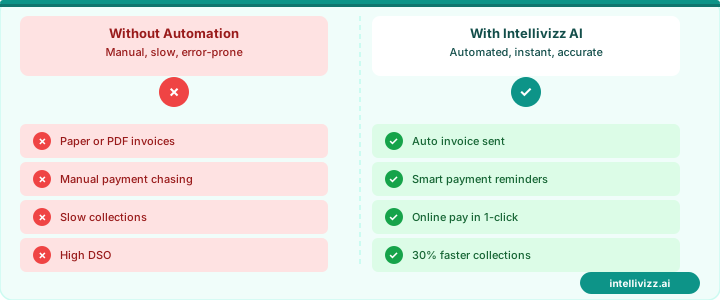
An automated system that treats all failures identically — retrying every failed payment on a fixed schedule regardless of failure code — will waste retry attempts on accounts that should not be retried (closed accounts, invalid account numbers, fraud flags) and miss the urgency differentiation that separates recoverable failures from ones requiring immediate human escalation.
Automated Retry Schedule Design
For failures where retry is appropriate — primarily R01 insufficient funds and soft credit card declines — a structured retry schedule recovers a significant percentage of failed payments without any staff involvement.
The 2-5-10 Retry Framework
The most effective retry schedule for tuition payment failures balances recovery probability against transaction cost and family communication load:
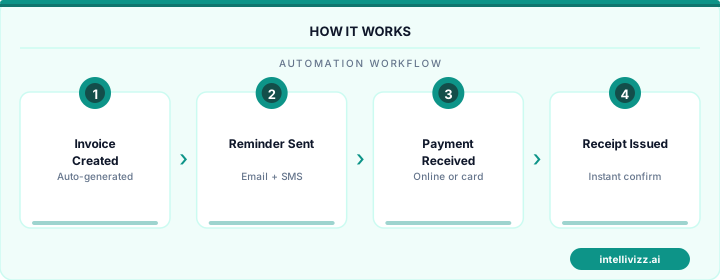
- Retry 1 (T+2 business days): The first retry captures the largest segment of recoverable failures. Insufficient funds situations are often temporary — a payroll deposit, a transfer from savings, or the processing of another transaction resolves the shortfall within 48–72 hours. This retry should be preceded by a notification to the family 24 hours in advance, giving them the opportunity to ensure funds are available or to preemptively provide an alternative payment method.
- Retry 2 (T+5 business days from failure): The second retry captures families who needed slightly more time to resolve their cash flow situation. Before this retry, the automated system should send a second notification including an easy link to update payment method or make an immediate manual payment — some families will choose to pay directly rather than wait for the retry.
- Retry 3 (T+10 business days from failure): The final automated retry. At this point, the family should also receive communication from the business office — either automated with a personal tone or genuinely personal — noting that the balance remains outstanding and presenting the hardship pathway if applicable. After three failed retries, the account moves to active human follow-up.
It is important to note that many payment processors limit the number of retry attempts on ACH transactions (typically two or three retries) and may impose per-retry fees. Your retry schedule should be designed within these constraints, and your payment processor's documentation on retry rules should govern the technical implementation.
🔄 Structured Retries That Respect Family Relationships
The 2-5-10 framework recovers 60–70% of failed payments without staff involvement
Parent Communication: Tone and Substance
The language of failed payment communications is critically important. Many school business offices default to the same billing department language used for overdue invoices — language that implies negligence or bad faith on the part of the family. A failed ACH transfer is not evidence of either; it is, most commonly, an administrative or temporary financial issue.
Principles for Failed Payment Messaging
- Lead with the technical fact, not the consequence: "Your scheduled tuition payment for [Month] was returned by your bank" rather than "Your tuition payment is overdue." The first informs; the second implies blame.
- Provide immediate resolution options: Every failed payment notification should include a direct link to update payment information, make an immediate online payment, or contact the business office. Resolution should require one click, not a phone call.
- Acknowledge the family relationship: A failed payment message from a school the family has trusted with their child's education should feel different from a collections notice from a utility company. Brief personalization — the student's name, a reference to the school year — signals that this is a relationship communication, not a billing department boilerplate.
- Never threaten enrollment status in automated messages: Early-stage failed payment recovery should never reference enrollment consequences. Escalation to enrollment impact is a human conversation, not an automated message, and only appropriate after multiple recovery attempts have been exhausted.
Sample Message Structure
An effective initial failed payment notification follows this structure: (1) a clear statement of what happened and the specific payment that failed, (2) a simple explanation of next steps, (3) direct links to resolve the issue immediately, and (4) a reassurance that the business office is available to discuss any questions. The entire message should be readable in under 60 seconds and actionable with a single click.
For the broader payment reminder system that operates before payments fail — tuition due date notifications, auto-pay confirmation messages, and balance statements — our guide to school payment automation covers the full payment communication lifecycle.
Alternative Payment Method Collection
One of the most impactful components of a failed payment recovery system is the ability to collect a new or alternative payment method without requiring the family to call the business office during business hours.
The automated recovery sequence should include, in every failed payment communication, a secure link to a payment method update form. This form should support:
- New ACH bank account entry (routing number + account number verification)
- New credit or debit card entry (with tokenized storage for future recurring payments)
- One-time manual payment without updating the recurring payment method on file
- A request to speak with the business office about payment arrangement options
Families who update their payment method through the secure link and authorize immediate collection resolve the failed payment within hours without any staff involvement. This is the highest-volume resolution path for failed payments caused by expired cards, updated bank accounts, and similar administrative issues.
Financial Hardship Pathways
A minority of failed tuition payments represent genuine financial hardship rather than administrative issues. For families in this situation, the appropriate response is empathetic and solution-oriented. Attempting to force payment through automated retry sequences and escalating notices from families who cannot pay — rather than will not pay — damages the school community relationship and rarely improves collection outcomes.
The automated failed payment system should include a clear, low-friction pathway to the school's financial hardship process. After the first or second failed payment communication, a message segment should note: "If you are experiencing financial difficulty at this time, our business office is available to discuss flexible payment arrangements. Please contact [name] at [contact] to speak confidentially about your options." This message should be warm, private (not visible to other family contacts), and free of shame-inducing language.
Schools with formal financial assistance programs should include the relevant application link in this pathway. Schools without formal programs should still have a clear internal protocol for payment plan arrangements, partial deferral, or temporary enrollment without full tuition payment — because the alternative is unenrollment, which is far more disruptive and expensive for both the family and the school.
Impact on Re-Enrollment Eligibility
Most private schools have policies governing re-enrollment eligibility for families with outstanding tuition balances. These policies are important — they protect the school's financial sustainability — but their application should be deliberate rather than automatic.
An automated failed payment recovery system should integrate with re-enrollment workflows so that the admissions or enrollment office has real-time visibility into a family's payment status when re-enrollment decisions are being made. However, the decision to condition re-enrollment on payment resolution should remain a human judgment — not an automatic exclusion triggered by the presence of an unresolved payment failure code in the system.
For the full picture of private school payment systems — including auto-pay setup, payment plan management, and the annual billing cycle — see our companion guide to tuition payment automation for private schools in the DMV. And for the enrollment process itself, including how re-enrollment sequences are structured, our guide to school enrollment automation covers the complete pipeline.
🤝 Hardship Pathways Preserve Enrollment and Trust
Families who feel supported through difficulty remain long-term school community members
State Regulations on Tuition Debt Collection
Private schools pursuing unpaid tuition through collections or legal action are subject to state consumer protection laws governing debt collection practices. The Fair Debt Collection Practices Act (FDCPA) applies to third-party collectors; schools collecting their own debts are primarily governed by state law.
Key regulatory considerations for school business offices:
- Written disclosure requirements: Many states require specific disclosures when a debt is referred to a collection agency, including the amount owed, the creditor's identity, and the debtor's right to dispute the debt.
- Communication restrictions: Automated debt collection communications — even those sent by the school directly — may be subject to contact time restrictions, frequency limitations, and mandatory opt-out mechanisms under state and federal law. Schools using automated payment recovery systems should review their communication sequences with legal counsel familiar with state consumer protection law.
- Student privacy considerations: FERPA protections apply to student records, including tuition payment records. Sharing student enrollment or payment status with third parties — including collection agencies — requires compliance with applicable FERPA disclosure provisions.
- Enrollment withholding: Several states have enacted laws restricting schools' ability to withhold student transcripts or records as leverage for tuition debt collection. These restrictions are evolving and vary significantly by state.
The automated recovery system described in this article — retry sequences, parent communication, alternative payment method collection, and hardship pathways — operates entirely within the school-to-family relationship and does not implicate third-party collection regulations. Escalation beyond this system — referral to a collection agency, credit reporting, or legal action — requires legal counsel review specific to your jurisdiction.
Implementation and Expected Outcomes
A well-implemented failed payment recovery system — distinct from the general payment reminder system — typically achieves the following outcomes within the first academic year:
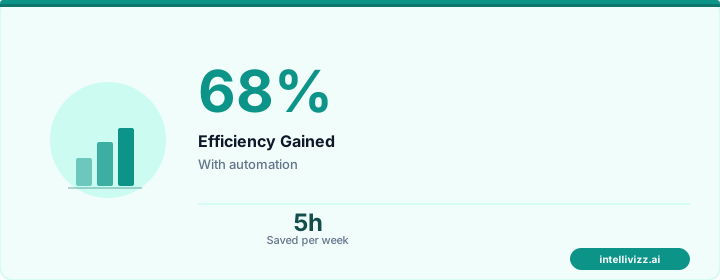
- 60–70% of failed payments resolved through the automated retry and alternative payment collection workflow without staff involvement
- 15–25% resolved through hardship pathway engagements resulting in payment plan arrangements
- 10–15% escalated to human business office follow-up for dispute resolution or extended negotiations
- 5–8% ultimately unresolved and referred to collection or written off
These outcomes represent a significant improvement over manual follow-up systems, where the resolution rate without escalation is typically below 40% and the administrative time cost is substantially higher. The investment in a dedicated failed payment recovery workflow — separate from the general payment reminder automation system — pays for itself within the first semester of implementation.
Ready to modernize your school's operations? Explore our education automation solutions, or read our guide to How to Reduce Late Tuition Payments at Your School: A....