
Payment Reminder Automation: Collecting Faster Without Damaging Client Relationships
The Accounts Receivable Problem Costing Service Businesses Millions
Every service business that invoices clients or patients faces the same fundamental challenge: the work is delivered, the invoice is sent, and then a waiting game begins. Some clients pay immediately. Many pay late. Some pay only after multiple reminders. And a meaningful percentage require escalation — calls, letters, and eventually collections action — before any payment arrives.
The manual management of this cycle is expensive and unpleasant. Staff tasked with chasing payments spend significant time on follow-up calls and emails that are uncomfortable to make and easy to deprioritize. The timing is inconsistent — reminders go out when someone has bandwidth, not on the schedule that maximizes collection rates. Tone is uneven — some staff members are too apologetic, others too aggressive. And the documentation for compliance purposes is incomplete.
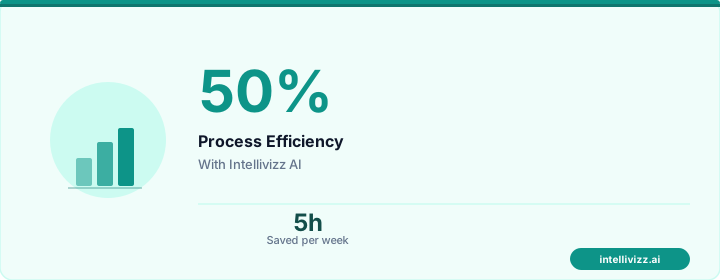
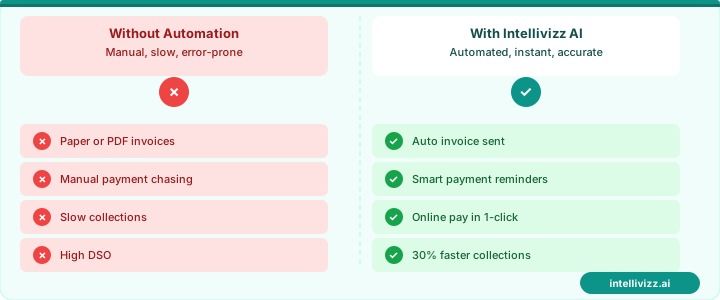
Payment reminder automation solves all of these problems simultaneously: reminders go out on schedule, through the right channels, with calibrated tone progression, and with complete audit trail documentation. Across industries — medical practices, law firms, private schools, accounting firms, home service contractors — automated reminder sequences consistently reduce average days-to-pay by 35–50% compared to manual follow-up processes.
💳 Collect Faster. Preserve Relationships. Automate the Follow-Up.
Systematic reminder sequences that reduce days-to-pay by 35–50%
The Anatomy of an Effective Payment Reminder Sequence
A payment reminder sequence is not a collection of nagging emails — it is a carefully structured communication arc designed to maximize payment without damaging the ongoing client relationship. Every message in the sequence has a specific purpose, timing rationale, and tone calibration.
Stage 1: Pre-Due Reminder (3–5 Days Before Due Date)
The pre-due reminder is the most underutilized element of payment automation. Most businesses send reminders only after an invoice becomes overdue — but research on payment behavior consistently shows that a friendly advance notice significantly increases the percentage of clients who pay on or before the due date. This message is not a collection notice; it is a service communication.
Effective pre-due reminders:
- Reference the invoice number, amount, and due date specifically
- Include a direct link to the payment portal — one click to pay, no login required
- Offer multiple payment methods (credit card, ACH, check) to reduce friction
- Use warm, professional tone: "Just a heads-up that invoice #2847 for $1,450 is due on Friday"
For industries where clients are accustomed to paper bills — particularly healthcare — this reminder serves the additional function of ensuring the client has actually received and processed the invoice, rather than discovering days later that it went to a spam folder or an outdated email address.
Stage 2: Due Date Confirmation
On the invoice due date, a brief confirmation message serves two purposes: it prompts clients who intended to pay today but got distracted, and it begins creating a documented timeline for any future escalation. This message remains warm and assumes good faith — the vast majority of clients who have not paid by the due date simply have not gotten to it, rather than actively avoiding payment.
Stage 3: First Overdue Reminder (3–7 Days Past Due)
The tone of the first overdue reminder should be helpful rather than accusatory. Most late payments at this stage are the result of oversight, administrative delays (particularly in businesses that process invoices through accounts payable departments), or temporary cash flow challenges. The message acknowledges that invoices sometimes slip through the cracks and makes it easy to resolve the situation immediately.
This message should include:
- A clear statement that the invoice is now overdue
- The invoice amount and original due date
- A direct payment link
- An invitation to contact your office if there is an issue: "If you have questions about this invoice or need to discuss a payment arrangement, please reply to this message or call us at [number]"
Stage 4: Second Overdue Reminder (14–21 Days Past Due)
At two to three weeks past due, the tone shifts from helpful to firm. This message is professional but direct: the invoice is overdue, payment is expected, and the client should take action today. The payment link remains prominent. This message also typically introduces the consequences of continued non-payment — late fees if applicable, potential account holds, or the possibility of collections referral.
Stage 5: Final Notice (30–45 Days Past Due)
The final notice in the automated sequence is the last communication before human escalation or collections referral. This message is formal, cites the specific amount and overdue duration, states clearly that the account will be referred to collections or that services will be suspended if payment or a payment arrangement is not made by a specific date, and provides direct contact information for resolution.
📬 Tone Progression That Collects Without Alienating
From friendly pre-due reminder to firm final notice — calibrated at every stage
Channel Optimization: SMS vs. Email vs. Phone
Payment reminder effectiveness varies significantly by channel, and the optimal channel mix differs by industry, client demographic, and invoice stage:
| Channel | Open/Response Rate | Best For | Limitations |
|---|---|---|---|
| SMS/Text | 95% open rate; 45% response rate | First and second overdue reminders; pre-due notice for consumer-facing industries | Opt-in requirements; character limits; not appropriate for formal final notices |
| 28–35% open rate; 8–12% click rate | Detailed invoice information; payment portal links; formal documentation | Spam filtering; lower urgency perception | |
| Automated phone call | High answer rate when unknown numbers answered; 60–70% message delivery | Final notice stage; clients who have not responded to email or SMS | Consumer frustration with robocalls; compliance requirements |
| Physical mail | 95% open rate for physical statements | Healthcare (HIPAA compliance); formal final notice; clients without reliable email access | Delivery lag; printing and postage cost |
The highest-performing reminder sequences use a multi-channel approach: email for the pre-due reminder (detailed, contains payment link), SMS for the first overdue reminder (high visibility, creates urgency), email for the second overdue reminder (formal documentation, late fee notice), and phone plus email for the final notice.
Industry-Specific Considerations
Medical Practices: Patient Balances and HIPAA
Medical billing presents unique challenges in reminder automation. Patient balances emerge at a frustrating time — often weeks after a service when insurance adjudication is complete and the patient responsibility is determined. Many patients do not anticipate the balance amount and may dispute it. HIPAA requirements constrain what information can appear in reminder messages sent to non-secure channels.
Effective medical payment reminder automation addresses these constraints:
- HIPAA-compliant messaging that references "a balance on your account" without including diagnosis or treatment information in SMS messages
- Secure patient portal links for full invoice details and payment processing
- Balance explanation sequences that help patients understand their financial responsibility before the first reminder
- Payment plan options prominently offered for balances above a threshold (typically $200–$500)
For medical practices with significant accounts receivable challenges, our guide to automated patient billing reminders covers the healthcare-specific implementation in depth, including insurance coordination and the balance due communication timeline.
Law Firms: IOLTA, Retainer Replenishment, and Fee Agreements
Legal billing automation must navigate the intersection of ongoing client relationships, trust accounting requirements, and hourly billing cycles. Law firm payment automation typically covers:
- Monthly invoice delivery with payment instructions and statement links
- Retainer balance notifications when the retainer drops below a replenishment threshold
- Outstanding invoice reminders calibrated to client sensitivity (long-standing clients receive different messaging than new clients)
- Matter-close billing sequences ensuring final invoices are collected before matter files are closed
Private Schools: Tuition Installments and Late Fees
Education payment automation covers a structured annual cycle: tuition deposit, enrollment contract execution, installment plan setup, and monthly or quarterly payment collection. School payment reminders have the additional dimension of the ongoing family relationship — a tuition reminder that damages the school-family relationship has costs that extend beyond the individual invoice. See our guide to school payment automation for the education-specific implementation.
Home Services and Contractors: Project Milestone Billing
Service contractors typically use milestone billing — deposits, progress payments, and final balances tied to project completion stages. Reminder automation for contractors covers deposit due date reminders, progress payment triggers at milestone completion, and final balance collection sequences with retention provisions.
Partial Payment Handling
Payment reminder sequences must handle partial payments gracefully. A client who pays $600 on a $1,400 invoice has not ignored the invoice — they are managing cash flow. The automated sequence should:
- Detect the partial payment and update the outstanding balance immediately
- Acknowledge the partial payment in subsequent communications ("Thank you for your payment of $600. Your remaining balance of $800 is due...")
- Offer a payment plan for the remaining balance if the partial payment suggests cash flow constraints
- Reset the urgency tone relative to the partial payment date rather than the original due date
Clients who receive a collections-tone reminder after making a partial payment are far more likely to escalate a dispute or disengage from further communication. The automated system must treat partial payments as positive engagement that warrants reciprocal good faith in subsequent messaging.
Compliance: FDCPA, HIPAA, and TCPA
⚖️ Automate Reminders — Stay Compliant
FDCPA, HIPAA, and TCPA requirements built into every message
Payment reminder automation operates within a complex compliance environment. Key regulatory frameworks include:
- FDCPA (Fair Debt Collection Practices Act): Applies to third-party debt collectors but also informs best practices for first-party collections. Governs contact frequency, permissible hours (8 AM–9 PM local time), required disclosures in collection notices, and prohibited communications. First-party creditors (businesses collecting their own debts) are exempt from most FDCPA requirements but should follow its principles as a risk management matter.
- TCPA (Telephone Consumer Protection Act): Governs automated SMS and voice calls. Requires prior express consent for automated SMS marketing messages. Transactional messages related to existing business relationships (invoices, payment reminders) generally require only implied consent, but written consent is the safest practice.
- HIPAA: For healthcare billing, all patient communications must comply with HIPAA privacy requirements. PHI (Protected Health Information) cannot appear in insecure SMS messages. Secure messaging platforms with patient authorization are required for detailed balance communications.
- State consumer protection laws: Many states have enacted consumer protection laws that are more restrictive than federal standards. California, New York, and Washington have particularly active enforcement environments.
Payment Portal Integration
Every reminder in an automated sequence should include a direct, one-click path to payment. Payment portals that require multiple login steps, do not support mobile payment, or do not save payment method preferences for recurring billing create friction that reduces payment rates even among clients who intended to pay immediately.
High-performance payment portal requirements for service businesses:
- One-click payment from email/SMS link without mandatory account creation
- ACH/bank transfer option (lower processing fees for large invoices)
- Credit and debit card acceptance with digital wallet support (Apple Pay, Google Pay)
- Payment plan selection at the portal level without requiring a phone call
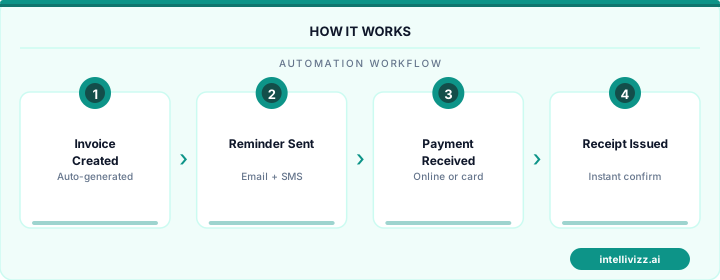
- Immediate payment confirmation with receipt and updated account balance
- Automatic update to the billing system upon payment, stopping the reminder sequence
Effectiveness Benchmarks
| Industry | Manual Follow-Up DSO | Automated DSO | Collection Rate (90 days) |
|---|---|---|---|
| Medical practices | 45–65 days | 28–38 days | 78–85% |
| Law firms | 38–55 days | 22–32 days | 82–90% |
| Private schools | 28–45 days | 14–22 days | 88–94% |
| Accounting/CPA firms | 35–50 days | 20–30 days | 85–92% |
| Home services/contractors | 25–40 days | 12–20 days | 83–91% |
Days Sales Outstanding (DSO) reduction of 30–50% represents a significant improvement in working capital for any service business. For a medical practice with $200,000 in monthly billings, reducing DSO from 52 days to 30 days releases approximately $150,000 in previously locked working capital — cash that was owed but sitting in the receivables pipeline rather than available in the operating account.
For medical practices specifically, our guide to medical practice payment automation covers the complete billing automation stack including insurance coordination, patient responsibility calculation, and payment plan administration. The investment in payment reminder automation consistently delivers the fastest ROI of any operational automation system — because it generates direct, measurable cash return rather than cost reduction or capacity expansion.
Ready to get started with automation? Explore our AI automation solutions, New Client Welcome Sequence Automation: Turn First..., or Automated Client Onboarding: How to Create a Seamless....