
Fitness Class No-Show Automation: How Studios Protect Revenue and Keep Classes Full
The No-Show Problem Is Costing Your Studio More Than You Think
Walk into any yoga studio, cycling boutique, or group fitness gym on a Monday morning and ask the owner what keeps them up at night. Somewhere near the top of the list, alongside member churn and rent, you will almost always find the no-show problem. The class that was booked out three days ago and has a waitlist of seven — but only 14 of the 20 spots show up. The Saturday morning HIIT class that had a perfect roster on Friday evening and opens half-empty when the instructor walks in.
Industry data consistently puts group fitness class no-show rates between 15% and 25%. In practical terms, that means a studio running 40 classes per week with an average class size of 20 spots is losing the equivalent of 2-4 fully-filled classes worth of capacity every single week to people who booked and did not show. In a ten-class pack model where members pay $20 per class, that is $800-$1,600 in weekly capacity loss — $40,000-$80,000 annually — that the studio is technically "selling" but not actually delivering.
The compound damage is worse than the direct math suggests. Every no-show represents a member on the waitlist who genuinely wanted that spot and did not get it. That waitlisted member, turned away enough times, starts to lose faith that they can actually get into the classes they want. They start to disengage. Eventually they cancel their membership for a studio that seems less impossible to book. The no-show rate is not just a revenue loss — it is a member retention risk that amplifies over time.
Studios that overbooking to compensate for expected no-shows risk the opposite problem: when no-shows are lower than expected, the class is overcrowded, equipment is short, and the member experience suffers. Automation that reduces no-show variance — making attendance more predictable — allows studios to right-size bookings without either emptying or overcrowding classes.
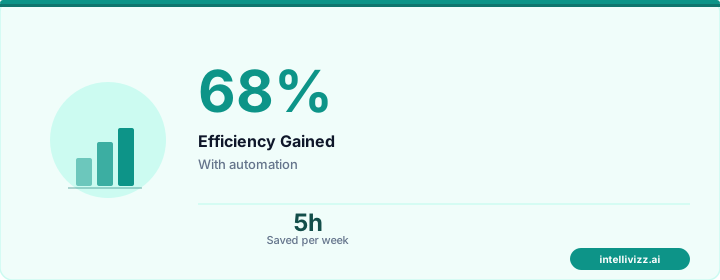
🏋️ Retention starts with consistent engagement
Smart technology, better results
Why Members No-Show: Understanding the Root Causes
Before designing an automation solution, it is worth understanding why members no-show in the first place. The reasons cluster into three categories, and each requires a different intervention.
Forgetting. The most common reason for no-shows, especially in studios where members book several days in advance. Life happens, the class slips out of awareness, and by the time they remember it is too late to cancel gracefully. Reminders address this directly and are the highest-ROI intervention for this category.
Reluctance to cancel. Many members know they cannot make a class but do not cancel because the process feels too complicated, they are not sure if it is too late, or they feel vague social guilt about canceling. Reducing cancellation friction — making it one tap from a text message, eliminating judgment from the cancellation confirmation — converts reluctant no-shows into advance cancellations that allow waitlist backfill.
Last-minute conflicts. These happen regardless of reminder cadence. Someone's meeting runs long, childcare falls through, or they simply feel unwell at 6:30 AM when their 7:00 AM class starts. A well-designed late-cancellation window and automated waitlist cascade can convert these last-minute cancellations into filled spots before the class begins.
The Multi-Touch Reminder Sequence
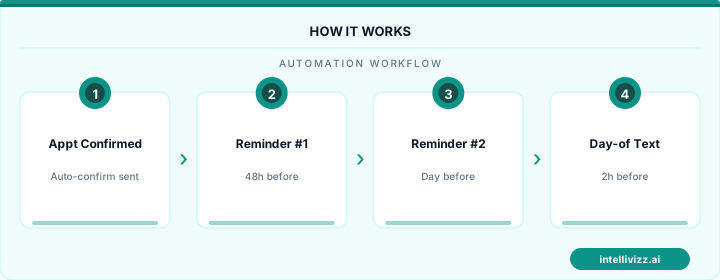
The foundation of fitness class no-show reduction is a multi-touch reminder sequence that creates multiple opportunities for the member to either confirm their attendance or cancel in time for the waitlist to fill the spot. The sequence design varies by class format and booking window, but the following structure is effective for most group fitness studios.
24-Hour Email Reminder
An email reminder 24 hours before the class is the first formal reminder in the sequence. For classes booked days or weeks in advance, this is often the first time a member re-engages with the booking since they made it. The email should include class name, instructor, time, and location (important for multi-location studios), a clear cancellation link, and — if the class requires equipment — a preparation note. Including a brief description of what the class entails ("Tomorrow's HIIT class with Coach Maria focuses on upper body and core — bring your resistance bands") adds value and reinforces the member's desire to attend.
2-Hour SMS Reminder
Two hours before class is the sweet spot for an SMS reminder. It is close enough to create urgency — close enough that a member who realizes they cannot make it has exactly the right window to cancel and allow a waitlisted member to be notified and arrive on time. Keep the SMS short: class name, time, and a one-tap link to cancel. Nothing more. Members appreciate brevity in pre-class reminders. A 200-word SMS with studio promotions and policy information will not be read at 5 AM when someone is deciding whether to get out of bed.
30-Minute Push Notification
For studios with a mobile app, a push notification 30 minutes before class serves as the final pre-class touchpoint. At this stage, the primary goal is reminding members who may have simply lost track of time — they are already dressed and planning to attend, they just need a nudge that class is starting soon. The cancellation link is still present but secondary at this point; someone canceling 30 minutes out is unlikely to be replaced by a waitlisted member who needs to travel to the studio.
Waitlist Backfill Automation
A reminder sequence without waitlist backfill captures only half the value. When a member cancels — whether in response to a reminder or on their own initiative — the automation job is to immediately convert that cancellation into a filled spot from the waitlist before the class time arrives.
Effective waitlist backfill cascades work as follows: when a cancellation is received, the system immediately sends an SMS to the first waitlisted member with the class details and a time-limited acceptance window (typically 30-60 minutes, shortened as class time approaches). If the first waitlisted member does not respond within the window, the offer advances to the second on the waitlist — and so on until the spot is filled or the acceptance window closes too close to class time to be meaningful.
The acceptance window should shrink as class time approaches. A cancellation received 24 hours out can offer a 60-minute response window comfortably. A cancellation received 2 hours before class needs a 20-minute window at most. Cancellations received 30 minutes before class may have a response window too narrow to be workable for members who need travel time — the system should still notify the waitlist (as a courtesy and to manage expectations) but should not create false urgency with an unreachable deadline.
For studios that want to extend revenue recovery thinking to other session formats, cancellation backfill automation covers this framework in depth across appointment-based businesses. And for the broader challenge of recovering revenue from missed client interactions, cancelled appointment revenue recovery provides strategies applicable to studio membership contexts.
🏋️ Retention starts with consistent engagement
The data speaks for itself
Late Cancellation and No-Show Policies
Technology alone cannot solve the no-show problem if the studio's policy framework creates no consequences for repeated no-shows. The most effective studios pair their automation with clear, fairly enforced policies that make the cost of no-showing visible to members.
Cancellation Windows and Fees
The industry standard for group fitness cancellation windows ranges from 4 to 12 hours before class, with the sweet spot around 8 hours for most studio formats. Cancellations outside the window carry no penalty; cancellations inside the window forfeit the class credit (for class pack members) or trigger a late cancel fee (typically $5-$15 for unlimited membership holders). No-shows — where the member neither cancels nor attends — typically incur a higher penalty than late cancellations, both because they provide no opportunity for waitlist backfill and because the behavior is more disruptive to class management.
Booking Restrictions for Repeat Offenders
Members who no-show repeatedly — three or more times in a rolling 30-day period, for example — can be automatically flagged in your booking system for a temporary booking restriction. Common implementations include a 24-hour booking hold (the member cannot book any new class for the following day after a no-show) or a maximum booking window restriction (limited to booking 24 hours in advance rather than seven days, until their attendance record improves). These restrictions feel consequential without being punitive enough to drive cancellations, and they protect your best members who actually show up by ensuring class capacity is not perpetually occupied by non-attendees.
Communicating Policy With Empathy
How you communicate your cancellation policy matters as much as what the policy is. Studios that frame their late cancel and no-show policies around fairness to the community — "Our late cancel fee exists because every empty spot could have gone to a member on the waitlist who wanted to attend" — generate far less pushback than studios that frame the same policy as a punitive charge. Include the policy rationale in your onboarding communications, your booking confirmation, and your reminder messages so that by the time a fee is ever assessed, the member understands the context.
Gamification: Attendance Streaks and Rewards
The most effective long-term no-show reduction strategies do not rely solely on penalties — they also reward attendance consistency in ways that reinforce the member's identity as a committed, reliable participant. Gamification elements that have proven effective in fitness studio contexts include:
- Attendance streaks: Tracking and celebrating consecutive weeks of showing up for booked classes. "You have attended 8 consecutive weeks without a no-show — that is incredible consistency!" messaging via push notification or email creates positive reinforcement without any financial component.
- Monthly attendance milestones: Celebrating members who hit 12, 16, or 20+ classes in a month with recognition in class, a badge in the app, or a small reward (water bottle, class credit, merchandise discount).
- Community leaderboards: For studios with the right culture, displaying the studio's collective attendance record — "Our members showed up for 94% of their booked classes this week" — creates community accountability around attendance norms.
- Recovery streaks: Celebrating members who had a no-show period and have now attended consistently for the past X weeks, reinforcing that a past stumble does not define their relationship with the studio.
The key is using gamification to reward the identity you want members to have — "I am someone who shows up" — rather than primarily as a mechanism to reduce a metric that members may resent being measured on.
Class Pack and Membership Usage Nudges
A significant driver of no-shows in class pack models is the "I have lots of classes left, I can miss this one" psychology. Members with an abundance of remaining credits feel less urgency to use individual sessions and more likely to no-show without guilt. Automated usage nudges that create gentle urgency around expiring credits — without being pushy or manipulative — can materially improve both attendance rates and pack renewal rates.
When a member has credits expiring within 30 days, an automated email sequence that highlights upcoming class opportunities, makes it easy to book specific upcoming sessions, and reminds them of the expiration date converts members who would otherwise let credits expire (and feel vaguely negative about the studio experience) into active bookers. Framing these as helpful reminders rather than upsell attempts — "You have 6 classes remaining before your pack expires on March 31 — here are the best slots available this week" — maintains the helpful tone that keeps members feeling valued rather than pressured.
Integration With Booking Platforms
| Platform | Automation Capabilities | Best For |
|---|---|---|
| Mindbody | Automated reminders, waitlist management, late cancel fees, attendance tracking, API for custom integrations | Mid-to-large studios, multi-location operators |
| Glofox | Branded app, push notifications, automated communications, class management, member app engagement | Boutique studios focused on member app experience |
| WellnessLiving | Multi-channel reminders, reward programs, referral automation, reporting, client app | Studios seeking all-in-one marketing and operations |
| Gymdesk | Membership management, class booking, automated billing, attendance reports, simple communications | Martial arts studios, crossfit boxes, independent gyms |
| Pike13 | Staff scheduling, client management, automated reminders, visit tracking, franchise management | Franchise fitness concepts, multi-location independent operators |
Most modern fitness studio management platforms include basic reminder automation out of the box. The differentiation comes in how deeply you customize the timing, content, and channel mix of those reminders, and whether you pair the platform's native capabilities with external communication tools (like an SMS platform or a dedicated email marketing system) for more sophisticated sequencing than the platform natively supports.
Measuring the Impact
No-show reduction automation should be evaluated against a clear set of metrics tracked before and after implementation. Key metrics include overall no-show rate by class type and day-of-week, waitlist conversion rate (percentage of waitlisted members who receive and accept an opening), late cancellation rate versus true no-show rate (improving the ratio means your reminders are working — members are canceling instead of ghosting), and class fill rate (the percentage of available spots that are actually occupied by attending members).
For most studios implementing a complete reminder-plus-waitlist-backfill system, no-show rates drop 40-60% within the first 60-90 days. The reduction is not uniform across all members — the most committed members continue attending regardless, and the chronically disengaged may not respond to reminders either. The automation captures the middle band: members who are reasonably committed but need a nudge, and members who want to cancel but need a frictionless path to do so rather than defaulting to a no-show.
For studios that also struggle with missed incoming calls from prospective members — a common problem during staffed hours — AI receptionist for gyms covers how automated call handling can capture new member inquiries around the clock. For a broader look at how no-shows cost businesses across different service categories, how much missed calls cost a business quantifies the compounding revenue impact of routine operational gaps. And for studios focused on re-engaging members who have drifted away from regular attendance, client reactivation campaign automation provides proven frameworks for winning back lapsed members before they cancel entirely.
The fitness studio business is built on transformation — helping members become healthier, stronger, more capable versions of themselves. The irony is that operational friction, empty class spots, and frustrated waitlisted members undermine that mission at the most fundamental level. When your best members cannot get into the classes they want because non-attenders are holding spots, you have a problem that transcends revenue — it erodes the community and accountability that make group fitness compelling in the first place. No-show automation is not just a revenue tool. It is a community health intervention.