
Medical Practice Payment Automation: Collect More, Chase Less, Improve Patient Experience
Patient payment collection is the most uncomfortable part of running a medical practice — for staff and patients alike. The traditional process of paper statements, phone calls, and collection letters is slow, expensive, and damages the patient relationship. Automated patient billing reminders replace manual follow-up, while insurance claim denial follow-up automation recovers revenue that would otherwise be written off. Practices using payment automation collect 20-35% more of patient responsibility revenue while spending 60% less staff time on billing tasks.
The Patient Payment Problem
With high-deductible health plans now covering 55% of employer-sponsored workers, patient out-of-pocket responsibility has never been higher. The average patient responsibility per encounter has increased 47% over the past five years. Yet medical practices collect only 50-70% of patient responsibility balances at the point of service, and collection rates drop to 30-40% once the patient leaves the office.
The result: practices are carrying $50,000-$200,000 in patient A/R at any given time, with much of it aging into uncollectability.
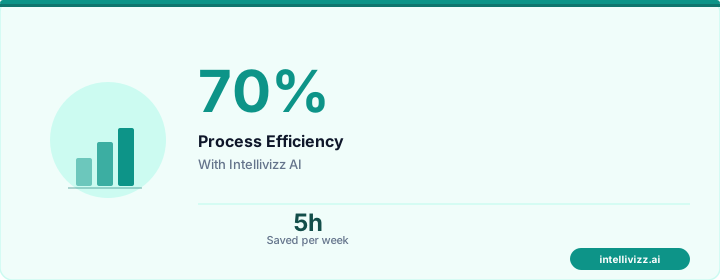
💰 Get paid faster with automated billing workflows
See how automation transforms industry operations
The Automated Payment Workflow
Pre-Visit: Cost Transparency
Payment automation starts before the appointment: automated eligibility verification confirms coverage and benefits 48 hours before the visit, cost estimates are sent to patients via text/email ("Based on your insurance, your estimated cost for tomorrow's visit is $45. We accept major credit cards and offer payment plans."), and pre-payment options allow patients to pay their copay or estimated balance before arrival.
Practices offering pre-visit payment options collect 25-30% of patient responsibility before the patient walks in the door.
Point of Service: Frictionless Collection
At the visit: digital check-in tablets display the patient's estimated responsibility, card-on-file programs allow automatic charging of copays and known balances, text-to-pay links sent during checkout ("Tap to pay your $45 copay: [payment link]"), and Apple Pay / Google Pay acceptance for contactless payments. Reducing friction at checkout increases point-of-service collection rates by 15-20%.
Post-Visit: Automated Billing Sequence
For balances not collected at the visit, automation replaces the traditional 30-60-90 day statement cycle:
- Day 3 (after insurance adjudication): Text + email with balance and payment link: "Your insurance has processed your recent visit. Your balance is $[amount]. Pay now: [link]. Questions? Reply here."
- Day 14: Reminder with payment plan option: "Friendly reminder about your $[amount] balance. Pay in full or set up a payment plan: [link]."
- Day 30: More urgent tone: "Your balance of $[amount] is now 30 days old. Please pay or contact us about payment options: [phone]."
- Day 45: Final automated notice before human follow-up: "This is our final automated reminder about your $[amount] balance. Please contact our billing office at [phone] to resolve."
- Day 60+: Escalation to staff for personal outreach or collections decision.
This automated sequence collects 60-75% of outstanding balances before the 60-day mark — compared to 30-40% with paper statements alone.
Payment Plan Automation
For larger balances ($200+), automated payment plans increase collection rates dramatically: patients self-select their preferred payment plan (3, 6, or 12 months) via a digital link, credit card is stored securely for automatic recurring charges, patients receive a confirmation and payment schedule, automated reminders before each charge, and automatic notifications if a payment fails (with retry logic).
Practices offering automated payment plans see a 35-45% increase in collection of balances over $200.
Technology Requirements
- Payment processing: HIPAA-compliant payment gateway (Stripe, Square, or healthcare-specific like Phreesia, Collectly)
- Patient communication: Two-way SMS/email platform with secure payment links
- PMS/billing integration: Real-time balance data from your practice management or billing system
- Card-on-file management: PCI-compliant tokenized storage for recurring payments
- Reporting: A/R aging, collection rates by channel, payment plan performance
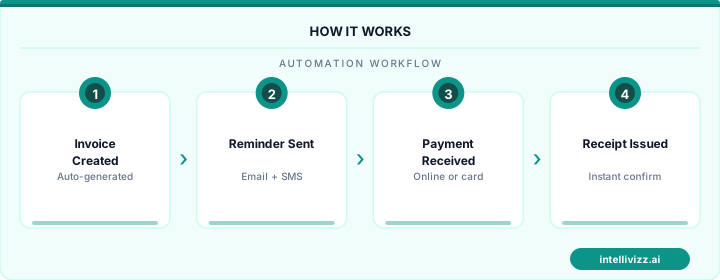
💰 Get paid faster with automated billing workflows
From manual processes to automated excellence
Measuring Impact
Track these metrics monthly: patient collection rate (target: 85%+ of patient responsibility), days in A/R (target: under 30 days for patient balances), point-of-service collection rate (target: 70%+), digital payment adoption rate, payment plan enrollment and completion rates, and staff hours spent on billing calls and follow-up.
Payment automation transforms the patient billing experience from adversarial to convenient — and transforms your revenue cycle from unpredictable to reliable. Book a free consultation to see how payment automation integrates with your existing billing workflow.
Patient Payment Plans and Financing Integration
Medical practices that offer structured payment plan options at the point of care — rather than sending a single statement for the full patient responsibility amount and waiting — consistently achieve higher collection rates on high-balance accounts. The economics are straightforward: a patient presented with a $1,200 balance after insurance adjudication who has no immediate ability to pay the full amount will not pay the full amount. That same patient, offered a $200/month payment plan initiated during the billing conversation, will frequently accept and complete the plan. Automated payment plan management handles the enrollment conversation, structures the installment schedule, obtains digital consent, and executes recurring charges — requiring no manual follow-up from billing staff as long as the plan remains in good standing.
Third-party medical financing integration extends this capability to patients who need longer-term installment options beyond what the practice can carry internally. Platforms such as CareCredit and Alphaeon offer instant approval workflows that can be integrated into the patient-facing billing portal: a patient who sees their estimated responsibility during check-in can apply for financing in under two minutes, receive an instant decision, and apply the approved credit line to their account — all before they leave the building. The practice receives full payment immediately; the financing risk transfers to the lender. For procedures with predictable patient responsibility (elective procedures, high-deductible surgical cases), pre-visit financing conversations triggered automatically by the scheduling system can eliminate the post-visit collection challenge entirely.
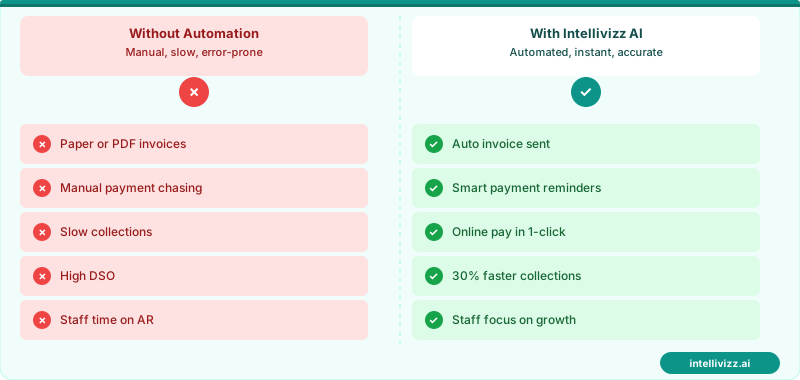
💳 Present the Plan Before the Bill Becomes a Problem
Automated payment plans collect 40–60% more on high-balance patient accounts
Denial Management Automation and ERA Reconciliation
Claim denials represent one of the most significant and addressable revenue leakages in medical practice billing. Industry data consistently shows that 5–10% of all submitted claims are initially denied, and that practices recover only 35–50% of denied claims through follow-up — meaning a substantial portion of the clinical work performed generates no payment, not due to eligibility or medical necessity issues, but due to administrative errors that are correctable with systematic follow-up. Denial management automation addresses this by categorizing every denial by reason code the moment the ERA (Electronic Remittance Advice) is received, assigning the appropriate resolution action, and routing the claim to the correct resolution workflow without requiring manual review of each explanation of benefits. For a deeper dive into point-of-service collections, see our guide on copay collection automation.
Common denial categories — timely filing, missing modifier, coordination of benefits, duplicate claim — each have defined resolution paths. Automated denial management applies the resolution action immediately upon denial receipt: resubmitting with the corrected modifier, updating coordination of benefits sequence, or initiating an appeal for clinical denials with supporting documentation. ERA reconciliation automation matches each payment to the original claim, identifies underpayments against contracted rates, and flags contractual adjustments that exceed the negotiated allowable — generating a payer audit trail for contract compliance review. The combination of faster denial resolution and systematic underpayment identification typically recovers 8–15% of previously uncollected revenue within the first 90 days of implementation.
| Denial Category | Frequency | Automated Resolution | Avg. Recovery Time |
|---|---|---|---|
| Timely filing | 15–20% of denials | Resubmit with proof of timely submission | 14–21 days |
| Missing/incorrect modifier | 18–25% | Auto-correct and resubmit | 7–14 days |
| Coordination of benefits | 10–15% | Update COB sequence, resubmit | 14–30 days |
| Medical necessity | 12–18% | Clinical documentation request + appeal | 30–60 days |
Medical practices building a complete automation infrastructure around the revenue cycle — from prior authorization through payment posting and denial management — will benefit from reviewing the broader framework in patient payment plan automation, which covers the patient-facing collection workflows that complement the payer-facing billing automation described here.
Patient Financial Experience and Transparency Automation
Medical practice revenue cycle automation is increasingly evaluated not just on collection efficiency but on patient financial experience — a dimension that directly affects satisfaction scores, online reviews, and long-term patient retention. Patients who are surprised by unexpected bills, unable to understand their explanation of benefits, or uncertain about their payment options are more likely to dispute charges, delay payment, and ultimately disengage from the practice. Automated financial transparency tools address this by providing patients with clear, pre-visit cost estimates, real-time benefit information, and flexible payment options presented in plain language rather than insurance industry terminology.
Pre-visit cost estimation automation — using the patient's insurance eligibility data, the practice's contracted rates, and the planned procedure codes — generates an estimated patient responsibility amount that is delivered to the patient 24–48 hours before their appointment. This estimate is not a guarantee (final charges depend on actual services rendered), but it sets an accurate expectation that dramatically reduces billing surprise at statement delivery. Practices that implement pre-visit cost estimates see a measurable reduction in billing dispute rates (typically 30–40% fewer disputes per 1,000 statements) and a meaningful improvement in same-day collection rates at checkout, as patients who already know their approximate responsibility are more prepared and willing to pay at the point of service rather than waiting for a statement.
Ready to modernize your practice? Explore our healthcare automation solutions.