
Patient Payment Plan Automation: Make Large Balances Easy for Patients and Predictable for Your Practice
When a patient owes $500-$2,000 after insurance, the traditional options are stark: pay in full (which many patients can't afford) or enter a payment plan that requires staff to manually track payments, make collection calls, and manage defaults. Automated patient billing reminders keep patients on track with their payment schedule without any staff follow-up. Pairing payment plans with insurance claim denial follow-up automation maximizes revenue recovery on both self-pay and insured balances. The result is predictable: 40-50% of large patient balances eventually go to collections or write-off without a structured system.
Automated payment plans change this equation by making enrollment frictionless for patients and management effortless for practices — increasing collection rates on large balances by 35-45%.
Why Payment Plans Need Automation
Manual payment plan management fails for specific, predictable reasons: staff forget to follow up when payments are missed, patients forget when payments are due, there's no standardized enrollment process (each plan is negotiated ad hoc), tracking is done in spreadsheets that become outdated, and the overhead of managing plans often exceeds the revenue recovered.
Automation eliminates every one of these failure points.
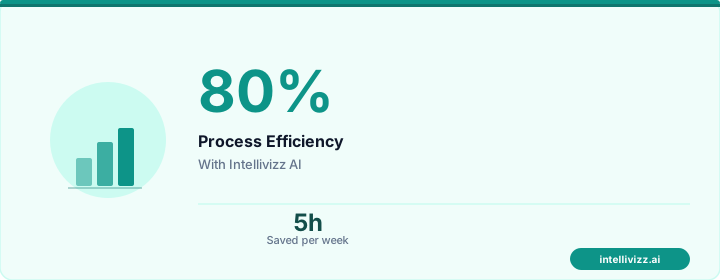
💰 Get paid faster with automated billing workflows
Smart technology, better results
The Automated Payment Plan Workflow
Step 1: Trigger and Enrollment
When a patient's balance exceeds your threshold ($200-$500 is typical), the system automatically offers a payment plan option via text: "Your balance at [Practice] is $[amount]. Would you like to set up a payment plan? Choose your option: [3 months - $X/mo] [6 months - $X/mo] [12 months - $X/mo]. Tap to enroll: [link]."
The enrollment link opens a mobile-friendly page where the patient: reviews the plan terms, enters (or confirms) their payment method, agrees to automatic recurring charges, receives an instant confirmation with the full payment schedule, and gets the plan details saved to their patient portal.
Step 2: Recurring Payments
On each payment date, the system: charges the stored payment method automatically, sends a receipt via text and email, updates the balance in your billing system, and sends a remaining balance notification ("Payment of $X received. Remaining balance: $X. Next payment: [date].").
Step 3: Failed Payment Handling
When a payment fails (expired card, insufficient funds, declined), automation handles the recovery: immediate notification to the patient with an update-payment link ("Your payment of $X was declined. Please update your payment method here: [link] to keep your plan active."), automatic retry 3 days later, second notification at 5 days with a stronger call to action, and escalation to staff at 10 days if still unresolved.
Automated failed-payment recovery resolves 70-80% of failures without any staff involvement.
Step 4: Completion and Follow-Up
When the plan is paid in full: celebratory notification ("Congratulations! Your balance at [Practice] is paid in full. Thank you!"), the account is marked as settled in your billing system, and if the patient has been a good payer, a prompt to schedule their next appointment.
Configuration Best Practices
Plan Structures
Offer 2-3 standard plans rather than custom-negotiating each one: Short-term (3 months, 0% interest) for balances $200-$500, Medium-term (6 months, 0% interest) for balances $500-$1,500, Extended (12 months, may include a small service fee) for balances $1,500+. Standardization simplifies enrollment and sets clear expectations.
Payment Method Requirements
Require a credit or debit card on file (not bank account, which has higher failure rates for recurring payments). Store the token securely using a PCI-compliant payment processor. Require the patient to update their payment method if the current card expires during the plan period.
Terms and Compliance
Ensure your payment plan agreements include: clear disclosure of all terms (payment amount, frequency, total cost), any service fees or interest charges, what happens if a payment fails, the practice's right to send to collections if the plan defaults, and patient rights to pay off early without penalty. Consult your state's healthcare lending regulations — some states have specific requirements for medical payment plans.
Integration Requirements
Your automated payment plan system should integrate with: your payment processing platform for secure recurring charges, your practice management / billing system for real-time balance updates, your patient communication platform for notifications and reminders, and your financial reporting for cash flow forecasting.
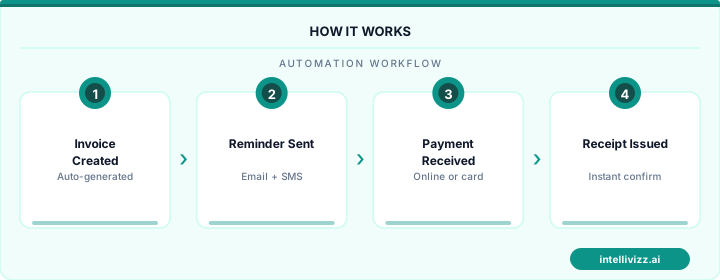
💰 Get paid faster with automated billing workflows
The data speaks for itself
Expected Results
- Enrollment rate: 40-60% of patients offered a plan enroll (vs. 15-20% with manual enrollment).
- Completion rate: 80-90% of automated plans are paid to completion (vs. 50-60% for manually tracked plans).
- Staff time savings: 5-10 hours/week eliminated from payment plan management.
- Collection improvement: 35-45% more revenue collected from balances over $200.
- Patient satisfaction: Payment plan patients report higher satisfaction than those pressured to pay in full.
Automated payment plans are a win-win: patients get affordable, dignified payment options, and your practice gets predictable, reliable revenue collection. Book a free consultation to see how automated payment plans can work with your billing system.
Designing Payment Plan Offers That Patients Actually Accept
The acceptance rate for patient payment plan offers is heavily influenced by presentation design — specifically, the timing, framing, and installment structure of the offer. Payment plan offers presented at the point of care, before the patient has received a statement and processed the financial surprise of an unexpected balance, convert at significantly higher rates than offers presented retroactively via statement or collection contact. A patient sitting in the exam room who is told "your estimated out-of-pocket today will be approximately $480 — we can set up a three-month payment plan of $160/month if you'd like" is in a fundamentally different psychological state than a patient who receives a $480 bill 45 days later and a phone call offering the same arrangement. The same economics, dramatically different response rate.
Installment structure design matters equally. Research on payment plan acceptance in healthcare consistently shows that patients respond to payment plans based on the monthly amount, not the total balance. A patient who would resist a $600 balance will frequently accept a $100/month six-month plan without negotiation — the $100 monthly payment fits within their mental model of a manageable expense even when the total is unchanged. Automated payment plan systems that calculate and present the lowest psychologically accessible monthly payment (within the practice's cash flow tolerance for extended plans) consistently achieve higher acceptance rates than systems presenting a standard two or three plan options without individual calibration. Pre-authorization of recurring card charges — completing the payment authorization at the time of plan enrollment rather than re-authorizing each installment — reduces mid-plan drop-off by eliminating the monthly friction of payment re-confirmation.
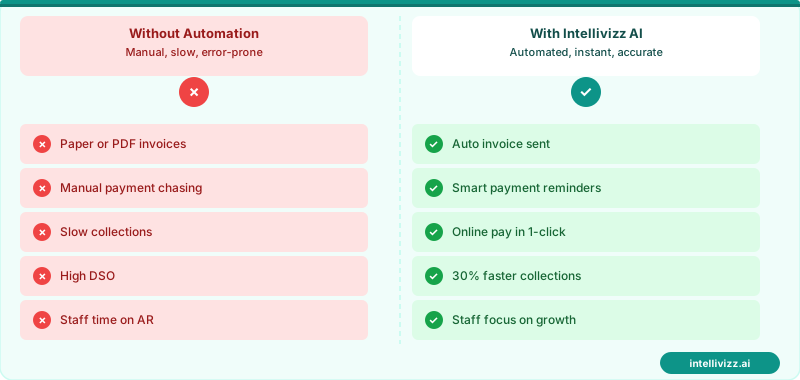
💳 Present the Plan at the Right Moment — Acceptance Rates Double
Point-of-care payment plan offers convert at 2–3x the rate of post-statement collection outreach
Delinquency Management and Recovery Automation
Even well-designed payment plans experience delinquencies — life events, financial hardship, card expirations, and changed contact information produce a baseline failed payment rate of 8–15% in most medical practice payment plan portfolios. Manual delinquency management — staff calling each failed payment patient, documenting the contact attempt, attempting to re-establish a modified payment arrangement, and tracking the follow-up — is extraordinarily time-intensive relative to the dollar amounts involved. A single failed payment on a $50 monthly installment can consume 20–30 minutes of billing staff time across multiple contact attempts, representing a labor cost that approaches or exceeds the balance itself.
Automated delinquency management addresses this economics problem by handling the routine failed payment recovery process without staff intervention. When a payment fails, the system immediately attempts a retry (card network best practice is to retry 3–5 business days after initial decline), sends a patient notification explaining the payment failure and providing a self-service link to update payment information, and schedules a follow-up outreach if the payment is not resolved within 7 days. Patients who update their payment information through the self-service portal are automatically re-enrolled in the plan with their next installment date adjusted. Patients who do not respond within a defined window (typically 21–30 days) are flagged for manual outreach — at which point staff intervention is focused on genuinely difficult accounts rather than routine failed payments that the automation has already resolved.
| Payment Plan Stage | Automated Action | Staff Involvement | Expected Outcome |
|---|---|---|---|
| Plan enrollment (at care) | Offer presentation + authorization | 10 min to setup | 35–55% offer acceptance rate |
| Recurring installment | Auto-charge + receipt delivery | Zero per successful payment | 85–92% first-attempt success rate |
| Failed payment (retry cycle) | Auto-retry + patient notification | Zero for self-resolved | 60–70% recovery without staff contact |
| Unresolved delinquency (21+ days) | Staff escalation flag | Direct outreach | 15–25% recovery of escalated accounts |
Medical practices seeking to build a comprehensive revenue cycle automation program — connecting front-end eligibility verification through payment plan enrollment and delinquency recovery — will find the upstream billing workflow context in medical practice payment automation directly relevant, covering the claim submission and denial management processes that determine the patient responsibility balances that payment plan automation is designed to collect.
Integrating Payment Plans with Patient Financial Counseling
Payment plan automation performs best when it is integrated with a broader patient financial counseling program rather than deployed as a standalone collection tool. Patients who understand their bill — what the insurance paid, what the contractual adjustment was, why their specific out-of-pocket amount is what it is — are more likely to engage with payment plan offers and complete their plans once enrolled. Automated financial education content, delivered at the same time as the payment plan offer, reduces billing confusion and the "I'll call to dispute this" response that delays collection and consumes billing staff time. A patient who receives an explanation of how their deductible works, why their co-insurance applies, and what the remaining balance represents is a patient who can make an informed payment decision rather than one who is confused and resistant.
For high-balance patients and those presenting with financial hardship indicators, automated financial counseling pathways can connect patients with charity care programs, pharmaceutical manufacturer assistance programs (for medication-related balances), and government assistance enrollment — reducing the balance that requires payment plan collection while improving the practice's relationship with a patient population that would otherwise disengage from care due to financial barriers. Practices that systematically integrate financial assistance screening into their payment plan automation workflow report lower bad debt write-off rates and meaningfully higher patient retention among the low-income and underinsured patient populations where financial barriers to care engagement are most acute.
Ready to modernize your practice? Explore our healthcare automation solutions.