
School Communication Automation in Maryland: Meeting State Requirements While Keeping Parents Engaged
Maryland's Unique Communication Requirements
Maryland schools operate under COMAR (Code of Maryland Regulations) requirements that mandate specific communication standards for attendance reporting, emergency notifications, health communications, and parent engagement. Schools across the border can explore our guide to AI for schools in Northern Virginia for a complementary regional perspective. For private schools, while some regulations are relaxed, parent expectations in Montgomery County, Howard County, and Prince George's County remain exceptionally high.
The challenge: meeting regulatory requirements while also delivering the personalized, multi-channel communication that Maryland families — particularly in the affluent Bethesda-Potomac-Columbia corridor — expect from their schools.
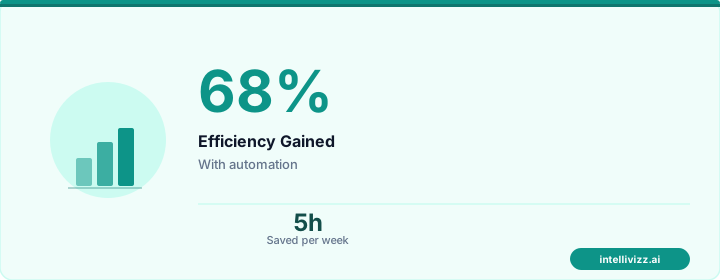
🎓 Keep families engaged with automated communication
From manual processes to automated excellence
Compliance-Driven Automation
Attendance Communication
Maryland requires schools to notify parents of unexcused absences within specific timeframes. Automated absence reporting ensures:
- Instant parent notification when a student is marked absent
- Automated follow-up for unreported absences within 2 hours
- Chronic absenteeism tracking aligned with Maryland's Early Warning System
- Automated monthly attendance reports to district and state systems
Emergency and Safety Notifications
Maryland's emergency communication requirements include specific protocols for weather closures, lockdowns, and health emergencies. Automated systems deliver:
- Multi-channel emergency alerts (text, email, phone, app) within 60 seconds
- Automated integration with Maryland Emergency Management Agency (MEMA) alerts
- Multilingual emergency communications (critical in diverse Maryland communities)
- Post-incident follow-up communications and documentation
Health Communications
Maryland requires specific health-related communications for immunization compliance, communicable disease notifications, and school health program updates. Automated tracking ensures:
- Automated reminders for incomplete immunization records
- HIPAA-compliant health notifications to affected families
- School nurse visit notifications to parents
- Medication administration consent tracking and renewals
Engagement-Driven Automation
Beyond compliance, Maryland families expect proactive communication that keeps them connected to their child's education:
- Weekly digests: Automated compilation of the week's activities, homework, and upcoming events — personalized per student
- Academic progress alerts: Real-time notifications when grades are posted or assignments are missing
- Conference scheduling: Automated parent-teacher conference scheduling with self-service time selection
- Event promotion: Multi-channel campaigns for school events, fundraisers, and community activities
Technology Considerations for Maryland Schools
- FERPA compliance: All student data communications must comply with federal FERPA requirements
- Maryland student data privacy: The Maryland Student Data Privacy Act imposes additional requirements beyond FERPA
- Accessibility: Communications must meet ADA accessibility standards, including screen reader compatibility and alt text for images
- Multilingual capability: Montgomery County alone has families speaking 100+ languages — automated translation is essential
Schools already using parent communication automation platforms typically find that Maryland-specific compliance features are available as configuration options, not requiring separate systems.
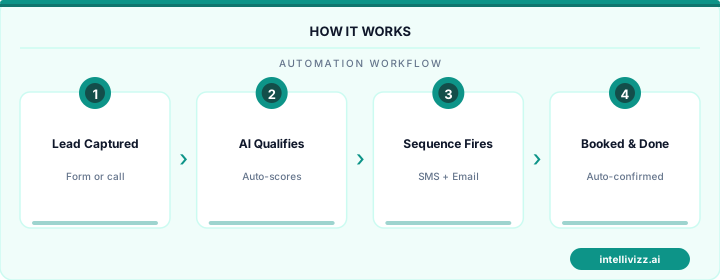
🎓 Keep families engaged with automated communication
See how automation transforms industry operations
Results from Maryland Schools
- Compliance audit findings related to communication reduced 90%
- Parent engagement (email open rates, event attendance) increases 35-50%
- Admin time on communication tasks decreases 55-70%
- Emergency notification delivery time drops from 15-30 minutes to under 60 seconds
- Enrollment inquiries from digitally engaged families increase 20-30%
Maryland School Communication: Regulatory Environment and Parent Expectations
Maryland's public school systems — particularly Montgomery County Public Schools (the largest in the state at 160,000+ students), Prince George's County Public Schools, and Howard County Public Schools — operate under some of the most demanding parent communication expectations in the country. The state's high household income and educational attainment levels (Maryland consistently ranks in the top 5 states for education spending per pupil) create a parent culture that expects institutional-grade communication responsiveness from even small private schools.
Maryland private schools face MSDE (Maryland State Department of Education) non-public school regulations that include specific requirements around family communication during enrollment, special education services, and emergency notifications. Schools that automate their communication workflows must ensure their platforms comply with these state-specific requirements alongside federal FERPA obligations. The good news: most reputable school communication automation platforms have Maryland-specific configurations and can document compliance for MSDE review if required.
The growth corridor from Bethesda and Chevy Chase through Silver Spring and into Columbia and Ellicott City has produced a wave of new private school openings in the past decade — micro-schools, Montessori programs, and specialty STEM academies — many of which operate with 2-4 administrative staff serving 100-300 students. These lean operations benefit disproportionately from automation, as a single administrative coordinator with AI tools can match the communication output of a 5-person administrative team.
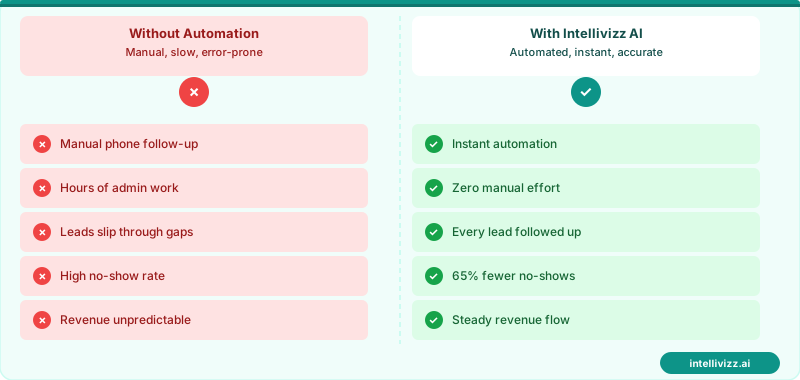
🏫 Maryland parents expect school-quality communication — automation delivers it
Lean private schools using automation match the communication output of schools with 3x the staff.
Multi-Channel Communication Strategies for Maryland Schools
Maryland's diverse school communities require multi-channel communication strategies. In Montgomery County, where 160+ languages are spoken across the school district, automated communication systems must support translation to reach non-English-speaking families effectively. Spanish, Amharic, Chinese, Vietnamese, and Korean are among the most commonly needed languages in Maryland's largest districts. Schools that communicate only in English are effectively excluding a significant portion of their community and creating equity gaps in parent engagement.
Effective multi-channel automation for Maryland schools uses channel preferences identified during enrollment to deliver each communication type optimally. Emergency notifications (school closures, lockdowns, health alerts) go via SMS and automated voice call simultaneously — the two channels with the fastest open/response rates. Academic updates and progress reports go via email (higher detail tolerance). Event reminders go via the channel with the highest parent engagement (usually SMS, but varies by demographic). Re-enrollment and tuition communications are sent via email with a certified-mail equivalent — tracked delivery confirmation stored for administrative records.
| Communication Type | Best Channel | Backup Channel | Open Rate |
|---|---|---|---|
| Emergency alerts | SMS + Voice | 98% | |
| Weekly progress | App notification | 64% | |
| Event reminders | SMS | 78% | |
| Tuition reminders | SMS | 72% | |
| Re-enrollment campaigns | Email sequence | Phone call | 58% (cumulative) |
Technology Integration with Maryland School Management Systems
Maryland private schools most commonly use Blackbaud (FACTS and RenWeb), TADS, Smart Tuition, and Gradelink for student information and tuition management. Each of these platforms supports varying degrees of communication automation — some natively, others through third-party integrations. Blackbaud's ecosystem, dominant in larger independent schools, offers robust automation through its Marketing and Communications module, allowing email campaign automation, event management, and alumni/development communications from a single platform. For smaller schools on TADS or Smart Tuition, third-party communication tools like Mailchimp, ActiveCampaign, or Constant Contact integrate via API to pull enrollment data and trigger automated sequences.
The key integration requirement is bidirectional data flow: the communication platform must be able to read current enrollment status, tuition payment status, and grade data from the SIS, and write back engagement metrics (email opens, RSVPs, form completions) that administrators can use to identify disengaged families before they withdraw. Schools that use siloed tools — a separate email platform with no connection to their SIS — miss this early warning signal. Combining communication automation with tuition payment automation for DMV private schools creates a fully integrated financial and communication management system.
Building a Communication Calendar for Maryland Schools
Effective school communication automation is built on a structured communication calendar that schedules all routine communications in advance and triggers event-based communications automatically. A well-designed Maryland private school communication calendar includes: the annual re-enrollment campaign (January–March), financial aid cycle communications (November–April), summer program marketing (March–May), school year preparation sequences (July–August), and holiday and break schedule notifications at predictable intervals throughout the year.
Event-based triggers add another layer: enrollment application submission confirmation, financial aid award notification, tuition payment confirmation and receipt, report card availability notice, parent-teacher conference scheduling and reminder sequences, and field trip permission and logistics communications. Each of these is a known, recurring communication need that can be automated based on data events — a financial aid award recorded in the system triggers the award communication automatically, with no staff action required beyond completing the award calculation.
Maryland schools that map their complete communication calendar before implementing automation achieve 40% faster implementation and significantly better outcomes than those that automate communications reactively. The mapping process itself is valuable independent of technology: it reveals gaps in existing communication (situations where families should be receiving information they aren't getting), redundancies (multiple overlapping communications about the same event), and opportunities for better sequencing. Many schools discover during this process that their communication strategy has evolved haphazardly over the years, with different staff members managing different channels without coordination. The automation implementation is an opportunity to rationalize and improve the entire communication strategy while adding the efficiency benefits of automation.
Sustaining Communication Quality Over Time
Implementing communication automation is the beginning of a continuous improvement journey, not a one-time project. Maryland schools that sustain strong communication quality over time do so by establishing a regular review cadence: monthly analysis of open rates, click rates, and response rates by communication type; quarterly review of communication calendar completeness; and annual strategic review of the overall communication program against enrollment, retention, and satisfaction goals. Schools that establish this cadence prevent the gradual drift that affects automation programs when no one is actively monitoring performance -- messages that once had 65% open rates can decline to 40% if content becomes stale or delivery timing falls out of sync with school year rhythms. Treat your communication automation program like any other strategic function: staff it appropriately, review it regularly, and iterate based on data. The programs that do this consistently outperform those that deploy automation and assume the work is done.
Ready to modernize your school's operations? Explore our education automation solutions, or read our guide to School Emergency Communication Systems: Mass....
Relevant AI Automations
AI Review Management
All-in-one review management: automated review requests, AI-powered responses, and review repurposing for web & social — 3 engines in 1.
Missed Call Text-Back
Instantly respond to missed calls from prospective parents with AI-powered SMS, capturing enrollment leads 24/7
AI Voice Agent - Inbound
AI answers calls 24/7, handles FAQs about programs, tuition, availability, and books tours