
School Absence Reporting Automation: From Paper Call-Ins to Real-Time Digital Tracking
The Manual Attendance Problem
Every morning, school office staff face the same routine: check which students are absent, cross-reference against parent call-ins, make phone calls to families who haven't reported, log excused vs. unexcused absences, and file the required reports. Absence reporting is one pillar of a broader school communication automation strategy, and high absenteeism can also affect enrollment retention by signaling disengagement. For a school of 500 students, this daily process consumes 1.5-2 hours of staff time — roughly 8-12 hours per week dedicated solely to attendance management.
And it's error-prone. Studies show that manual attendance processes miss 15-20% of unreported absences, meaning students can be marked present when they're not in the building — a safety concern that's unacceptable in today's environment.

🎓 Keep families engaged with automated communication
Smart technology, better results
What Automated Absence Reporting Looks Like
Parent-Initiated Reporting
Instead of calling the office (and getting a busy signal or voicemail), parents report absences through a digital portal:
- Text message: "Reply ABSENT [StudentName] [Reason]" — the most convenient option for busy parents
- Mobile app: One-tap absence reporting with reason selection and expected return date
- Web form: Pre-populated with student information, takes 30 seconds to complete
- AI phone: For parents who prefer calling, an AI system captures the absence report and logs it automatically
Automated Follow-Up
When a student is marked absent without a parent report:
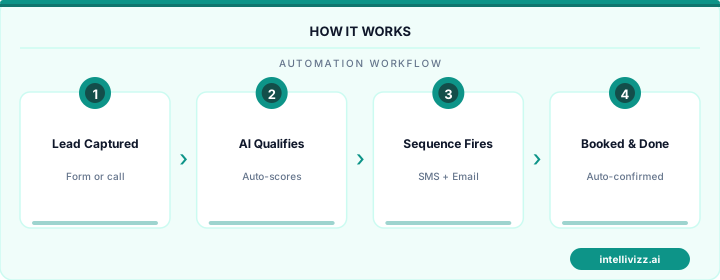
- 8:15 AM: Automated text to parent — "[StudentName] was not in attendance this morning. If this is expected, reply OK. Otherwise, please call the office immediately."
- 9:00 AM: If no response, automated phone call to primary contact
- 9:30 AM: If still no response, alert to office staff for personal follow-up and notification to secondary contact
This tiered approach resolves 85% of unreported absences without staff involvement, while escalating the genuine concerns quickly.
Compliance and Reporting Benefits
State and district attendance reporting requirements are becoming more stringent. Automated systems maintain:
- Real-time attendance records with timestamps and audit trails
- Automatic categorization (excused, unexcused, tardy, early dismissal)
- Chronic absenteeism tracking with alerts at state-defined thresholds (typically 10% of school days)
- Automated generation of required state/district attendance reports
- Documentation of all parent communications for legal compliance
Chronic Absenteeism Early Warning
One of the most powerful features of automated attendance is pattern detection. The system identifies:
- Students approaching chronic absenteeism thresholds (before they cross them)
- Day-of-week patterns (student absent every Monday → potential concern)
- Cluster absences (multiple students from same bus route absent → transportation issue)
- Seasonal patterns (increased absences before/after holidays → potential engagement issue)
Early warning allows counselors and administrators to intervene proactively — connecting with families, offering support, and addressing root causes before a student's attendance record becomes a crisis.
🎓 Keep families engaged with automated communication
The data speaks for itself
Implementation Steps
- Week 1-2: Configure digital reporting channels (text, app, web form). Collect parent contact information and communication preferences.
- Week 3: Set up automated follow-up sequences and escalation rules. Define absence categories and coding.
- Week 4: Pilot with one grade level. Collect parent feedback on ease of use.
- Week 5-6: School-wide rollout with parent communication about new system. Maintain phone reporting as a backup.
Schools already using parent communication automation can add absence reporting as an extension of their existing platform, minimizing the need for a separate tool.
Impact on School Operations
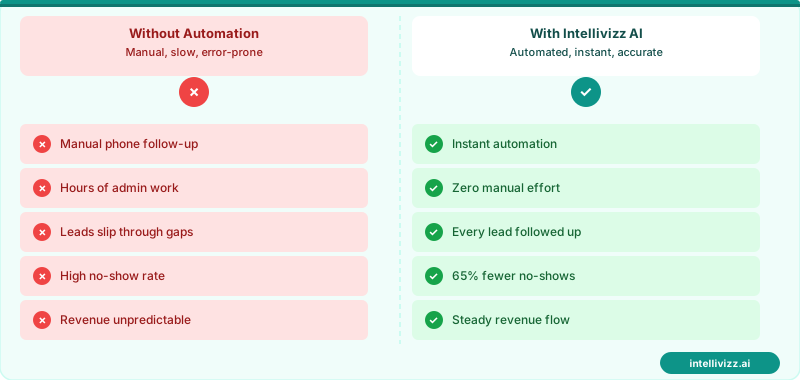
- Staff attendance management time reduced from 8-12 hours/week to 1-2 hours/week
- Unreported absences decrease from 15-20% to under 3%
- Parent satisfaction with attendance communication increases 40%
- Chronic absenteeism interventions begin 2-3 weeks earlier
- State reporting compliance improves to near-100% accuracy
Frequently Asked Questions
What about schools that require doctor's notes for excused absences?
Automated systems can accept photo uploads of doctor's notes via text or app, which are attached to the absence record. This eliminates lost paper notes and creates a searchable digital archive.
How do you handle partial-day absences (late arrival, early dismissal)?
The system supports multiple absence types: full day, tardy, early dismissal, and period-specific (for secondary schools). Each has its own reporting workflow and categorization rules.
Automated Absence Pattern Detection and Early Intervention
The most significant long-term value of school absence reporting automation extends beyond administrative efficiency to chronic absenteeism identification and prevention. Research consistently shows that students who miss more than 10% of school days — approximately 18 days in a standard 180-day academic calendar — face measurably worse academic outcomes: lower literacy rates by third grade, higher dropout risk in middle and high school, and reduced post-secondary enrollment. The challenge for school administrators is that chronic absenteeism develops incrementally: a student misses one day here, two days during an illness, a week for a family trip. Without systematic tracking and pattern detection, no single absence triggers concern — but the cumulative pattern crosses the intervention threshold without anyone noticing until it is well-established.
Automated absence systems that track cumulative attendance against district thresholds can surface early-warning flags automatically. A student who has missed 8 days by October is on pace to exceed 18 for the year — a fact that an automated threshold alert can communicate to the counselor and attendance administrator in real time, triggering an early outreach to the family before the pattern is entrenched. The system distinguishes between excused and unexcused absences, flags patterns that correlate with known risk indicators (Monday-Friday specific absences suggesting family schedule conflicts, absences clustering around the same period suggesting a specific class avoidance issue), and generates summary reports for administrator review. This pattern intelligence is simply not possible at scale through manual attendance review.
📋 Catch Chronic Absence Patterns Before They Define an Academic Year
Automated threshold alerts surface at-risk students weeks before the pattern becomes critical
Multi-Language Communication and Compliance Documentation
Schools serving linguistically diverse communities face a compounding absence reporting challenge: families who are not fluent in English may be less likely to engage with phone-based absence reporting systems, may miss written communications sent in English, and may be less likely to respond to follow-up contacts from the school. The result is a disproportionate rate of unexcused absences in multilingual student populations — not because of greater actual absence, but because the reporting and communication infrastructure is not accessible. Automated absence systems with multi-language support address this directly by detecting the family's preferred language from enrollment data and delivering all absence notifications, reporting instructions, and follow-up communications in that language.
Compliance documentation is equally important. Schools in most states are required to maintain specific records of absence notification attempts, family responses, and escalation steps for truancy referral purposes. Automated systems generate a timestamped, auditable communication log for every student absence — noting when the initial outreach was sent, when family acknowledgment was received, when escalation was triggered, and what resolution was documented. This log satisfies legal discovery requirements and district audit standards without requiring administrators to reconstruct contact histories from email threads and phone logs.
| Absence Type | Automated Action | Compliance Record | Escalation Trigger |
|---|---|---|---|
| Single-day unexcused | SMS + email within 30 min | Outreach log + response | None (first occurrence) |
| 3+ unexcused in 30 days | Counselor flag + family call | Full contact history | Attendance plan initiation |
| 5+ unexcused in semester | Administrator alert + home visit trigger | District-mandated documentation | Truancy referral consideration |
| 10%+ cumulative (any type) | Chronic absenteeism flag + support team notification | Intervention record | Family meeting scheduling |
Schools implementing full parent communication automation — covering absence reporting, event notifications, grade updates, and emergency communications — will find the comprehensive framework in parent communication automation for schools applicable as a broader infrastructure reference for the systems that make absence reporting a component of a unified family engagement platform.
State Reporting Integration and District Compliance Automation
School districts in most states are required to submit attendance data to state education agencies on specific schedules — daily, weekly, or monthly — using prescribed data formats that must reconcile with the district's student information system records. Manual state reporting involves exporting attendance data, formatting it according to state specifications, validating for errors, and submitting through the state education agency's data portal within required deadlines. The process is tedious, error-prone, and has real consequences for non-compliance: late or inaccurate state attendance reporting can affect state funding calculations, trigger audit reviews, and in chronic cases result in corrective action plans that consume substantial administrative time.
Automated state attendance reporting integrates directly with the district's student information system and the state education agency's data submission portal, running the export, formatting, validation, and submission process on the required schedule without manual intervention. Validation rules built into the automation catch common errors — student enrollment status mismatches, duplicate records, missing attendance codes — before submission, rather than generating a state rejection that requires reprocessing. Submission confirmation receipts are automatically logged and filed, providing the district with an auditable record of compliance without requiring staff to maintain manual submission logs. For multi-building districts where attendance data must be consolidated from multiple school-level systems before state submission, the automation handles the consolidation and reconciliation process that would otherwise require a central office administrator to manually pull and merge reports from each building.
Ready to modernize your school's operations? Explore our education automation solutions.
Relevant AI Automations
AI Review Management
All-in-one review management: automated review requests, AI-powered responses, and review repurposing for web & social — 3 engines in 1.
Missed Call Text-Back
Instantly respond to missed calls from prospective parents with AI-powered SMS, capturing enrollment leads 24/7
AI Voice Agent - Inbound
AI answers calls 24/7, handles FAQs about programs, tuition, availability, and books tours