
How Much Do No-Shows Cost Your Dental Practice? The Data Behind Empty Chairs
An empty dental chair isn't just an inconvenience — it's a direct hit to your bottom line. The American Dental Association reports that the average no-show rate across dental practices is 10-15%, with some practices experiencing rates as high as 23%. When you calculate the cost of provider time, staff overhead, lost production, and the downstream scheduling disruption, each no-show costs between $150 and $400.
For a busy dental practice, that adds up to $80,000-$150,000 in lost annual revenue sitting in empty chairs. This article breaks down exactly where those costs come from and what evidence-based strategies reduce no-shows by 30-60%.
The True Cost Per No-Show
The cost of a no-show is not simply the fee for the missed procedure. It includes:
- Lost production: The procedure that would have been performed. Average dental production per hour: $300-$600 depending on the procedure mix.
- Provider idle time: Dentist salary/overhead continues during empty chair time. Typical cost: $150-$300 per hour.
- Staff overhead: Hygienists, assistants, and front desk staff are paid regardless of whether the patient shows. Partial cost: $50-$100 per hour.
- Scheduling disruption: An empty slot that could have been filled by another patient represents opportunity cost. If your practice runs a waitlist, the cost is partially offset — but most practices don't backfill efficiently.
- Follow-up costs: Staff time spent calling, rescheduling, and managing the missed appointment creates additional administrative overhead.
Conservative estimate per no-show: $200
Realistic estimate per no-show: $300-400
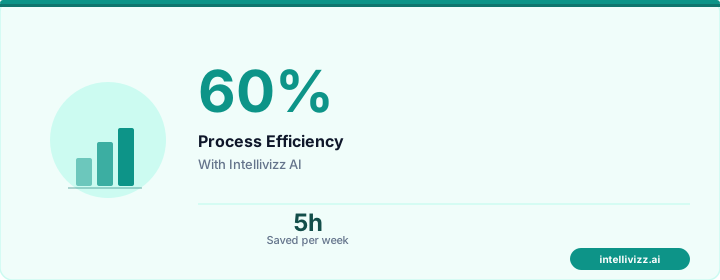
📱 Reduce no-shows by 30-40% with smart reminders
Smart technology, better results
Annual Impact: Worked Example
A 2-provider dental practice with 3 hygienists:
- Total scheduled appointments per month: 600
- No-show rate: 12% → 72 no-shows per month
- Cost per no-show: $250 (blended average across hygiene and restorative)
- Monthly cost: 72 × $250 = $18,000
- Annual cost: $18,000 × 12 = $216,000
Even cutting the no-show rate in half — from 12% to 6% — would recover $108,000 per year. That's significant revenue recaptured without adding a single new patient to the practice.
Why Dental Patients No-Show
Understanding the root causes helps target your reduction strategies:
- Forgot (45%): The most common reason. Life gets busy, and a dental appointment booked 3-6 months ago is easy to forget.
- Anxiety/fear (20%): Dental anxiety affects an estimated 36% of the population. These patients book with good intentions but avoid following through.
- Schedule conflict (15%): Work meetings, childcare issues, or transportation problems that arise after booking.
- Financial concerns (10%): Patients who discover they can't afford the expected copay or aren't sure about insurance coverage.
- Perceived low urgency (10%): Preventive appointments (cleanings, check-ups) feel deferrable. "I'll reschedule next month" becomes "I'll go next year."
Evidence-Based No-Show Reduction Strategies
Strategy 1: Multi-Channel Appointment Reminders
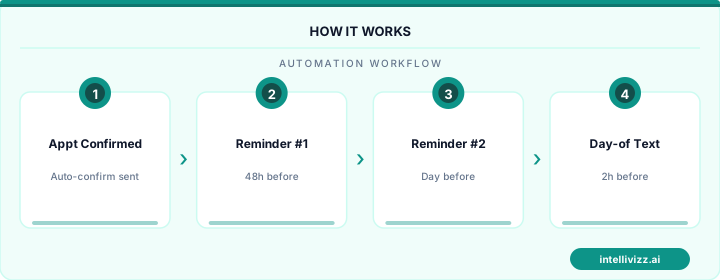
The simplest and most effective intervention. Send reminders at three points:
- 7 days before: Email with appointment details and preparation instructions
- 2 days before: SMS with confirmation request ("Reply Y to confirm or R to reschedule")
- Day of, 2 hours before: Final SMS reminder
Impact: Multi-channel reminders reduce no-shows by 25-40%. The confirmation request at 2 days gives you time to fill the slot if the patient reschedules.
Strategy 2: Automated Waitlist Backfill
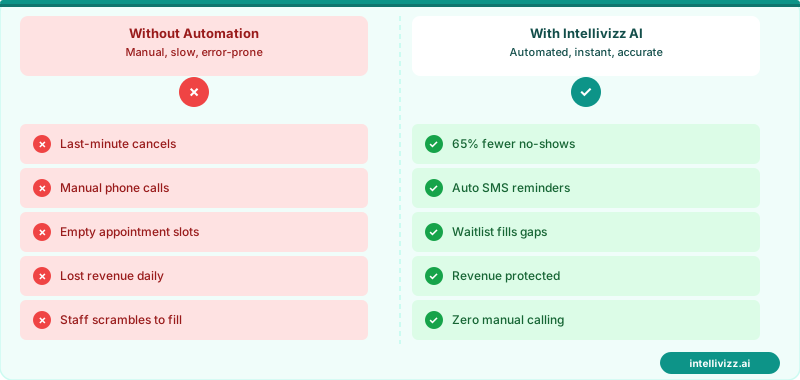
When a patient cancels or doesn't confirm, automatically notify patients on your waitlist. An automated system sends a text: "A preferred appointment time just opened up at [Practice] on [Date] at [Time]. Would you like it? Reply YES to claim it."
Impact: Backfills 30-50% of cancelled/no-show slots, recovering revenue that would otherwise be lost.
Strategy 3: Pre-Appointment Engagement
For new patients and anxious patients, send a "what to expect" message 3 days before: "We're looking forward to seeing you! Here's what your visit will look like: [brief description]. Our office is at [address] with free parking in the back lot."
Reducing uncertainty reduces anxiety-driven no-shows. This simple message can cut first-time patient no-shows by 20%.
Strategy 4: Financial Transparency
Send a pre-appointment text that addresses financial concerns: "Your upcoming appointment on [Date] has an estimated patient portion of [$XX] based on your insurance. If you have questions about coverage, reply here or call us."
When patients know the cost in advance, financially-motivated no-shows drop significantly.
Strategy 5: Easy Rescheduling
Make rescheduling as easy as texting "R" to a reminder. Patients who can't make an appointment are more likely to reschedule than no-show if the process is frictionless. A cancelled-and-rescheduled appointment is infinitely better than a no-show.
📱 Reduce no-shows by 30-40% with smart reminders
The data speaks for itself
Technology Stack for No-Show Reduction
The strategies above work best when automated. A practice management system integration (Dentrix, Eaglesoft, Open Dental) connected to an automation platform handles:
- Automated multi-channel reminders at configurable intervals
- Confirmation tracking with automatic waitlist notification
- Pre-appointment engagement sequences
- Post-no-show reactivation (automatic follow-up to reschedule)
The ROI calculation is straightforward: if automation costs $200-300/month and reduces no-shows by 30% (recovering ~$5,000-$10,000/month in production), the payback period is less than one week.
Empty chairs are the most expensive problem in dentistry that nobody talks about. The practices that automate their no-show reduction in 2026 will recapture tens of thousands in revenue that their competitors leave sitting in empty operatories.
Related Reading
- Average No-Show Rate for Dental Offices
- How to Reduce No-Shows at Your Dental Office
- Cancelled Appointment Revenue Recovery
- AI Receptionist for Dental Offices
💸 The true cost of a dental no-show is almost always higher than your front desk thinks.
Calculate your actual no-show cost — then build the system to recover it.
The Real Cost Beyond the Missed Appointment
The obvious cost of a dental no-show is the revenue from the missed appointment. But the full cost is larger and often invisible in standard accounting. When a hygiene patient no-shows, the hygienist's time is paid regardless. The operatory was cleaned and prepared. If it was a restorative appointment, the lab case may have already arrived. And the slot — particularly for a dentist operating at near-full capacity — is nearly impossible to fill same-day. Add those costs together and the true cost of a no-show is often 1.4–1.8x the appointment's production value.
For practices tracking production per hour (PPH), a no-show during a peak morning slot costs more than a no-show during a slow Thursday afternoon. Revenue management systems that weight no-show cost by slot value — and prioritize filling high-value slots from the waitlist first — recover significantly more production than practices that treat all slots equally.
No-Show Cost Calculator for Dental Practices
To calculate your practice's actual no-show cost, use this formula: (Monthly no-show rate × monthly scheduled appointments) × average production per appointment × 1.5 (overhead multiplier for wasted prep and staff time). For a practice seeing 400 appointments per month at a 12% no-show rate and $380 average production, the monthly no-show cost is approximately $27,360 — over $328,000 annually.
Quick benchmark: most dental practices operate at an 8–15% no-show rate. Best-in-class practices with automated reminder systems operate at 3–5%. The gap between these rates, multiplied by your average production value, is your automation ROI opportunity.
| Practice Size | Monthly No-Shows (12% rate) | Annual Revenue at Risk | Recoverable with Automation |
|---|---|---|---|
| Solo (200 appts/mo) | 24 | $109,000 | $65,000–$82,000 |
| Small group (400 appts/mo) | 48 | $218,000 | $131,000–$164,000 |
| Multi-provider (700 appts/mo) | 84 | $381,000 | $228,000–$286,000 |
For a deep dive on reactivating patients who've already lapsed, see our guide on dental patient reactivation strategies.
Ready to modernize your practice? Explore our healthcare automation solutions.
Relevant AI Automations
AI Review Management (HIPAA-Compliant)
All-in-one HIPAA-compliant review management: automated review requests, AI-powered responses, and review repurposing for web & social.
HIPAA-Compliant AI Voice Agent — 24/7 Patient Call Handling
HIPAA-compliant AI voice agent answers every patient call 24/7 — triages urgency, books appointments, and sends encrypted follow-ups
Website Live Chat → Patient Booking Funnel
AI-powered live chat on the practice website engages visitors, answers questions about services/insurance, collects cont