
Dental Practice Automation in Fairfax, VA: How Northern Virginia Dentists Are Modernizing Operations
Fairfax County is home to over 500 dental practices serving 1.1 million residents — making it one of the most competitive dental markets in the country. For dental practices in Fairfax, Falls Church, Vienna, Arlington, and the broader NoVA corridor, automation isn't a nice-to-have — it's the operational backbone that separates thriving practices from those losing patients to more responsive competitors.
The Fairfax County Dental Landscape
Fairfax County dental practices face a specific set of market dynamics: an affluent, well-insured patient base with high expectations for service quality and convenience, intense competition along major corridors (Route 50, Route 29, Route 123, Fairfax City center), a tech-savvy population that expects online scheduling, text communication, and digital experiences, significant commuter traffic that makes appointment timing and accessibility critical, and high operating costs (commercial real estate, staff salaries 15-25% above national average) that demand operational efficiency.
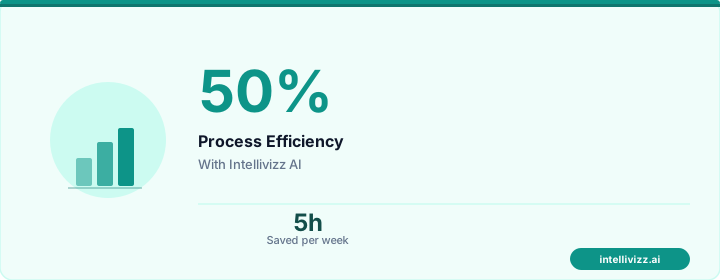
🏥 Patients expect instant responses — automation delivers
Smart technology, better results
Automation Solutions for Fairfax-Area Dental Practices
AI Phone Handling
With patient call volumes of 60-100 per day and front desk staff juggling check-ins, insurance verification, and treatment coordination, missed calls are inevitable — and costly. An AI receptionist for dental offices ensures every call is answered, every scheduling request is processed, and every new patient inquiry is captured.
For Fairfax practices, the after-hours coverage is particularly valuable. Many patients work in DC or Tysons Corner and can only call during commuting hours (6-8 AM, 6-9 PM). Without after-hours coverage, these inquiries are lost.
Automated Patient Communication
Multi-channel communication automation addresses the Fairfax market's expectations: text-based appointment reminders that reduce no-shows by 30-50%, automated marketing campaigns for hygiene recall, treatment follow-up, and seasonal promotions, post-visit review requests that build the Google review profile critical for local search visibility, and two-way texting for convenience-focused patients who prefer texting over calling.
Review and Reputation Automation
In a market with 500+ dental practices, Google reviews are the primary differentiator in local search. Automated reputation management generates consistent review volume, responds to feedback quickly, and builds the 4.7+ star profile that captures "dentist near Fairfax" searches.
Billing and Payment Automation
With the high cost of living in Fairfax County, even insured patients can face significant out-of-pocket costs for dental work. Automated billing with text-to-pay links and payment plan options improves collections while reducing the friction that causes patient attrition.
Local Integration Considerations
Fairfax-area dental practices commonly use Dentrix, Eaglesoft, or Open Dental. Automation tools should integrate seamlessly with these platforms. Multi-location practices (common in NoVA with offices in Fairfax, Chantilly, and Centreville) need automation that handles location-specific scheduling and routing.
Getting Started
Whether your practice is on Main Street in Fairfax City, in the Mosaic District, or along Route 50, the automation journey typically starts with phone handling and reminders (highest immediate ROI), then expands to marketing automation and billing within 3-6 months.
Ready to modernize your Fairfax-area dental practice? Book a free consultation to see a demo tailored to Northern Virginia dental operations.
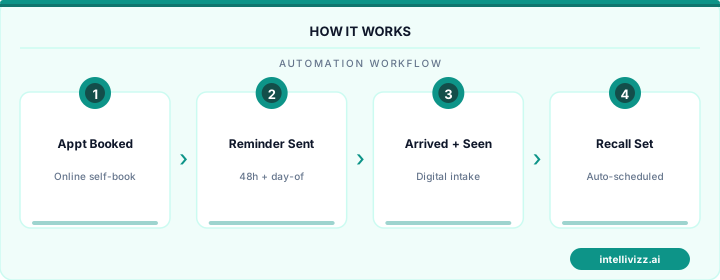
🏥 Patients expect instant responses — automation delivers
The data speaks for itself
Fairfax County's Dental Market: Competitive Density and Patient Demographics
Fairfax County has one of the highest concentrations of dental practices per capita in the United States, a product of high household incomes, extensive private dental insurance coverage, and a large federal government and defense contractor workforce with comprehensive FEHB benefits. The Route 50 corridor, Mosaic District area, Kingstowne, and Reston Town Center are particularly competitive sub-markets, each with 15-25 dental practices within a 3-mile radius. In this environment, operational excellence and patient experience are the primary differentiators — outcome quality is assumed to be high across the board.
The Fairfax patient demographic skews heavily toward dual-income professional households with children. This creates predictable demand patterns: school-year appointment clustering (summer is the busiest season for pediatric work, driven by sports physicals and back-to-school timing), strong demand for extended evening hours (practices with 7 a.m. or 7 p.m. slots fill faster than competitors), and high sensitivity to scheduling friction. A Fairfax family managing two adults' and two children's dental care will switch practices for a smoother scheduling experience — the cost of changing dentists is low when perceived quality across local options is high.
The growing Chantilly, Centreville, and South Riding corridors along Route 28 and Route 29 represent a significant opportunity for practices willing to deploy technology that reaches these geographically dispersed patients. Evening and weekend AI phone coverage captures working parents who cannot call during business hours, a particularly high-value demographic in the tech-heavy Dulles corridor.
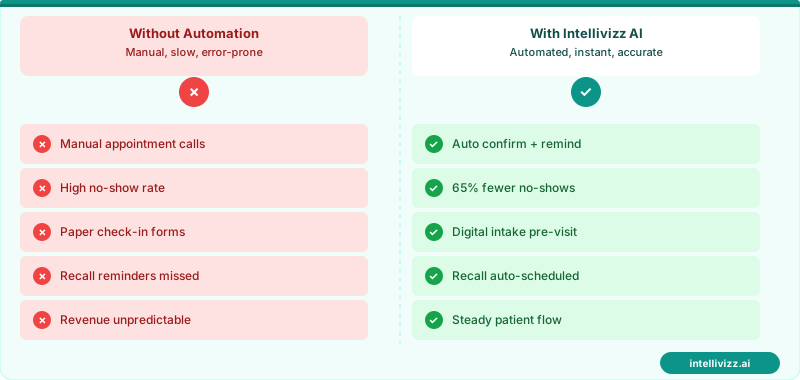
🦷 Fairfax families switch dentists for convenience — automation makes you the easiest choice
Dental practices in Fairfax County using automation fill 23% more appointment slots monthly.
Automation Implementation Roadmap for Fairfax Dental Practices
Implementing dental practice automation in a Fairfax context requires phasing to avoid workflow disruption. The recommended sequence for a practice with 2-4 dentists and 2-3 front desk staff is: Phase 1 (weeks 1-2) — deploy AI phone receptionist for after-hours coverage only, allowing staff to maintain control during business hours while capturing the 35-40% of calls that arrive outside office hours. This phase alone typically produces an immediate 15-20% increase in new appointment bookings.
Phase 2 (weeks 3-6) — expand AI handling to peak overflow hours (8-10 a.m. and noon-2 p.m.), when front desk staff are managing in-office patient flow and cannot reliably answer phones. Configure AI to handle scheduling for established patients and basic new patient intake, routing complex insurance questions and clinical inquiries to staff callback. Phase 3 (weeks 7-12) — integrate insurance verification automation, recall reminder sequences, and treatment plan follow-up communications. This is when the ROI accelerates significantly, as the practice begins recovering revenue from overdue recare patients and reducing no-shows through systematic reminder sequences.
| Implementation Phase | Timeline | Key Metrics Improved | Typical Monthly Revenue Impact |
|---|---|---|---|
| After-hours AI coverage | Weeks 1–2 | New patient capture, missed call rate | +$3,000–$6,000 |
| Peak overflow handling | Weeks 3–6 | Schedule utilization, staff productivity | +$2,000–$4,000 |
| Insurance + recall automation | Weeks 7–12 | No-show rate, collections cycle, recare | +$5,000–$12,000 |
Technology Integration with Northern Virginia Dental Practice Management Systems
Fairfax dental practices predominantly use Dentrix, Eaglesoft, and Open Dental for practice management, with a smaller segment using Curve Dental (cloud-based) and Carestream Dental. Each platform has different integration capabilities with third-party automation tools. Dentrix, the most common in the Fairfax market, offers a robust API that allows AI scheduling tools to access real-time provider schedules, operatory availability, and patient records. Eaglesoft requires bridge integrations, while Open Dental is open-source with extensive community-developed connectors.
When evaluating automation vendors, Fairfax practices should verify specific integration compatibility with their existing PMS before committing to a platform. The best automation implementations have zero impact on existing workflows — staff continue using the same PMS they know, while AI handles the front-end phone and communication layer. New bookings appear in Dentrix or Eaglesoft exactly as if a staff member had entered them manually. For practices also managing the business development side of growth, pairing dental automation with AI receptionist strategies used by Arlington VA dental practices provides a complete Northern Virginia competitive playbook.
Staff Adoption and Change Management in Fairfax Dental Practices
Technology adoption in dental practices is most successful when staff understand how automation affects their day-to-day work — specifically, that it reduces their administrative burden rather than threatening their roles. Fairfax dental practices that involve front desk staff in the configuration process (asking them which types of calls are most disruptive, which manual tasks they find most tedious, what information they most commonly need to give callers) achieve faster adoption and more useful configurations than those that implement top-down technology mandates. Staff who feel ownership over the system's design are advocates rather than resisters.
The transition period (typically the first 4–8 weeks of full deployment) requires active management. Staff should have a clear escalation path when they encounter AI interactions that don't match expectations — a simple form or shared log where they can flag unusual call outcomes for the practice manager to review and use as configuration improvement inputs. Regular brief team meetings (15 minutes weekly during the first month) to discuss what's working well and what needs adjustment build shared understanding and prevent frustration from accumulating.
The Fairfax market's high staff competition — dental assistants and front desk coordinators in Northern Virginia command premium wages due to high demand — makes automation particularly valuable for retention as well as efficiency. When front desk staff spend less time on repetitive phone calls and paperwork, they report higher job satisfaction and engage more meaningfully with the clinical environment and patient relationships that drew them to healthcare in the first place. Practices in Fairfax that use automation to create better working conditions consistently report lower voluntary turnover than the market average, a significant competitive advantage in a tight labor market.
Fairfax dental practices that commit to technology-forward operations today are positioning themselves for market leadership as the Northern Virginia dental market continues to consolidate and compete on operational excellence. The investment is modest relative to the returns. The implementation risk is low with proven platforms and phased rollout strategies. The competitive advantage compounds over time as automation improves patient experience, staff satisfaction, and practice economics simultaneously. The window for first-mover advantage in specific Fairfax corridors and neighborhoods remains open -- but not indefinitely. Practices that move now build the automation infrastructure during a period when competitors are still catching up, securing patient panel advantages that are difficult to overcome once established.
Fairfax County Dental Market Landscape and Local Demand Drivers
Dental practice automation in Fairfax County, Virginia operates within a uniquely competitive local market shaped by demographics, geography, and community institutions that differentiate it from neighboring jurisdictions like Arlington, Alexandria, or Prince William County.
Fairfax County Dental Association events — including continuing education seminars, peer study clubs, and annual membership meetings — provide networking opportunities where local dentists share technology adoption experiences. Practices that present automation case studies at FCDA events report receiving 5-10 peer referrals for complex cases from colleagues who trust their operational sophistication. The association's study club format, where groups of 8-12 dentists meet monthly to discuss clinical and business topics, accelerates technology diffusion: when one practice in a study club demonstrates measurable results from AI scheduling or automated recall, adoption across the group typically follows within 6-12 months.
Northern Virginia Community College's dental hygiene program, based at the Medical Education Campus in Springfield, produces 30-40 new dental hygienists annually who enter the Fairfax County job market. Practices that establish clinical rotation partnerships with NOVA's program gain first-access hiring advantages for new graduates — a significant competitive edge in a market where dental hygienist vacancies average 45-60 days to fill. Automated onboarding workflows can streamline the transition from student extern to full-time employee, reducing the ramp-up period from 4-6 weeks to 2-3 weeks by pre-loading credential verification, radiation safety certification, CPR compliance, and practice management software training into a structured digital checklist.
Tysons Corner patient demographics drive specific automation requirements. The Tysons area — encompassing Tysons Corner Center, Tysons Galleria, and the surrounding office towers housing Booz Allen Hamilton, SAIC, Deloitte, and Capital One — generates a patient population that is affluent, time-constrained, and digitally sophisticated. These patients expect online booking, text-based communication, digital intake forms, and Apple Pay or Google Pay acceptance. Practices near the Tysons Metro stations (Silver Line) draw commuter patients who book early-morning or lunch-hour appointments and have zero tolerance for wait times exceeding 10 minutes. Automated scheduling that accounts for provider pace, hygiene-to-doctor handoff timing, and buffer slots for emergency patients is not a luxury in Tysons — it is a baseline competitive requirement.
The Fair Oaks Mall area in western Fairfax County serves a different patient demographic: families with school-age children who schedule appointments around school hours and summer breaks. Practices in the Fair Oaks corridor (Route 50 and Interstate 66) experience extreme seasonal scheduling variations — summer months are 40-60% busier than the school year for pediatric and family dentistry — and automated waitlist management, cancellation backfill, and recall campaign timing must account for this seasonality. The retail foot traffic from Fair Oaks Mall and the surrounding shopping centers also generates walk-in and impulse-inquiry traffic that AI receptionist systems can capture and convert into booked appointments.
The Mosaic District in Merrifield has emerged as a health and wellness corridor, with dental practices positioned alongside orthodontic offices, dermatology clinics, and wellness studios. The mixed-use development's pedestrian-friendly layout encourages cross-referral relationships between healthcare providers — a dental practice can automate referral tracking from neighboring orthodontists, periodontists, and oral surgeons, attributing new patient sources and generating reciprocal referral acknowledgments that strengthen the professional network. Mosaic's demographic skews younger (25-40) and more ethnically diverse than other Fairfax submarkets, requiring multilingual automation capabilities (Spanish, Korean, Vietnamese, and Arabic are the most-requested languages) and digital-first communication preferences.
Burke Centre, a planned residential community in southern Fairfax County, generates steady family dentistry demand from its 6,000+ townhome and single-family households. The community's HOA-driven communication channels (newsletters, community Facebook groups, Nextdoor) are high-converting referral sources that automated review generation can amplify — a five-star Google review from a Burke Centre resident who mentions the neighborhood by name drives disproportionate local appointment requests. Reston Town Center, in the county's northwestern quadrant, anchors a professional district where dental practices compete for the corporate employee population of Leidos, Google's Reston office, and numerous government contractors. These patients prioritize practices that integrate with their employer-provided dental insurance networks (MetLife, Delta Dental Federal, GEHA) and offer evening or Saturday hours that accommodate classified-facility work schedules where employees cannot make personal calls during business hours. Automated insurance verification and after-hours AI receptionist systems are particularly high-value in the Reston market because they solve the specific access barriers that defense and intelligence community employees face.
Ready to modernize your practice? Explore our healthcare automation solutions, or read our guide to AI Receptionist for Dentist in Tysons Corner, VA: Why....