
Dental Practice Marketing Automation: Attract, Convert, and Retain Patients on Autopilot
Marketing for dental practices has traditionally been a feast-or-famine cycle: invest in ads, get a rush of new patients, struggle to retain them, then invest in ads again. Marketing automation breaks this cycle by creating self-sustaining systems that attract, convert, and retain patients continuously — without requiring constant manual effort from you or your team.
The Five Marketing Automation Pillars for Dental
1. Reputation and Review Engine
Your Google Business Profile is your most powerful marketing asset. Automated reputation management builds it systematically: post-visit review requests sent via text with a direct Google review link, response automation for both positive and negative reviews, review monitoring across all platforms (Google, Healthgrades, Yelp, Facebook), and monthly reporting on review velocity, average rating, and sentiment trends.
Dental practices implementing automated review generation see review volume increase 300-500% within 3 months. For "dentist near me" searches, this review growth directly translates to higher rankings and more clicks.
2. New Patient Lead Nurture
When a prospective patient contacts your office but doesn't book, they enter an automated nurture sequence: immediate acknowledgment (text + email) within 5 minutes, follow-up at 24 hours with a booking link and current promotion, a "meet the team" email at day 3 with provider bios and office photos, social proof at day 7 (patient testimonials and reviews), and a final offer at day 14 ("We'd love to meet you — here's a special offer for new patients").
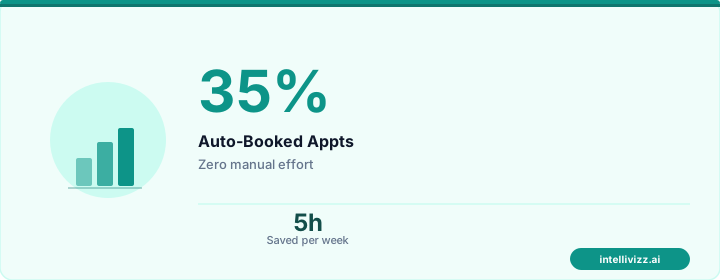
This nurture sequence converts 25-35% of initially uncommitted leads into booked patients — prospects who would otherwise be lost to a competitor who followed up faster.
3. Patient Reactivation Campaigns
Every dental practice has hundreds of patients who haven't been seen in 12+ months. Automated reactivation campaigns systematically re-engage them: identify patients overdue for hygiene (6+ months since last visit), send a personalized "We miss you" message with a scheduling link, follow up at 7 and 14 days with increasing urgency, offer incentives for long-lapsed patients (free whitening with cleaning, etc.), and flag patients who don't respond after 30 days for a personal phone call.
Reactivation campaigns typically recover 15-25% of lapsed patients — representing significant revenue from an audience that already knows and trusts your practice.
4. Referral Program Automation
Word-of-mouth referrals are the highest-converting lead source for dental practices. Automation systematizes this: after a positive visit (signaled by a high satisfaction score or positive review), send a referral request with a unique referral link, track when the referred patient books and completes their visit, automatically reward both the referrer and the new patient, and send periodic reminders to your happiest patients about the referral program.
5. Seasonal and Campaign Marketing
Automated campaigns aligned with dental seasons: January "New Year, New Smile" (teeth whitening, cosmetic consultations), spring "Spring Cleaning" (hygiene appointments for patients overdue), summer "Back to School" (children's checkups and sports mouthguards), and holiday "Holiday Smile" (gift certificates, cosmetic promotions).
These campaigns are built once and run automatically each year, keeping your practice top-of-mind during key decision-making periods.
🏥 Patients expect instant responses — automation delivers
From manual processes to automated excellence
The Technology Stack
A dental marketing automation stack typically includes: a dental CRM/patient communication platform (Weave, RevenueWell, Lighthouse 360, or Swell), your practice management system (Dentrix, Eaglesoft, Open Dental) as the data source, an AI receptionist for phone-based lead capture and after-hours coverage, and analytics connecting marketing spend to actual production revenue.
ROI Benchmarks
- Review generation: 3-5x increase in monthly reviews, lifting average rating 0.2-0.5 stars within 6 months.
- Lead nurture: 25-35% conversion of uncommitted leads → booked appointments.
- Patient reactivation: 15-25% of lapsed patients return, each worth $500-$1,500/year in production.
- Referral program: 10-20% of active patients generate at least one referral per year.
- Overall impact: 20-40% increase in new patient volume and 15-25% improvement in retention within the first year.
Ready to put your dental marketing on autopilot? Book a free consultation to see how automation can transform your practice growth.
🏥 Patients expect instant responses — automation delivers
See how automation transforms industry operations
Reactivation Campaigns: Recovering Lapsed Dental Patients
Every dental practice carries a pool of patients who completed their last appointment 18–36 months ago and have not responded to standard recall. These lapsed patients are among the most valuable reactivation targets available — they already trust the practice, their insurance is often still active, and their clinical need has grown in direct proportion to the time elapsed since their last visit. A systematic reactivation campaign, automated across multiple channels, can recover 15–25% of lapsed patients in a 90-day window at a cost per reactivation far below new patient acquisition.
An effective dental patient reactivation sequence operates across three phases. The first phase uses email — a soft, value-forward message acknowledging the gap in care and emphasizing the clinical risk of skipped preventive appointments (elevated decay incidence, periodontal progression, missed early-stage findings that are more costly to treat when detected later). The second phase escalates to SMS with a direct appointment offer and a limited-time incentive if appropriate for the practice model. The third phase deploys a personalized voicemail drop referencing the patient's name and last visit date — a level of personalization that differentiates the contact from generic office communications and generates meaningfully higher callback rates. Patients who do not respond across all three channels are flagged for annual re-engagement rather than continuous contact, protecting deliverability and patient relationship quality.
🦷 Recover Lapsed Patients Before They Find Another Practice
Automated reactivation sequences recover 15–25% of lapsed patients in 90 days
Review Generation and Reputation Management Automation
Google reviews are the primary trust signal for dental practice selection. The average patient deciding between two dental practices in proximity will choose based on Google rating and review recency before any other factor. Practices with 4.8+ ratings and reviews posted within the past 30 days consistently outperform competitors with strong clinical reputations but weaker review profiles in local search conversion. This advantage is compoundable — it grows as the review count increases — but it requires a systematic review generation process rather than relying on satisfied patients to spontaneously post reviews.
Dental marketing automation drives review volume through precisely timed post-appointment requests. A text message sent 2–4 hours after a completed appointment — when the patient's experience is fresh and positive affect is highest — generates substantially higher review completion rates than requests sent the following day. The message is brief, direct, and includes a single tap link to the practice's Google Business Profile. For practices using patient satisfaction surveys, the automation filters survey respondents: patients who rate their experience 4–5 stars receive the Google review prompt; patients who rate 3 or below receive an internal resolution pathway, protecting the public review profile from dissatisfied outliers.
| Automation Type | Avg. Monthly Impact | Staff Time Saved | ROI Timeframe |
|---|---|---|---|
| Recall/hygiene reminders | +8–12% recall fill rate | 3–5 hrs/week | Month 1 |
| Reactivation campaigns | +6–15 recovered patients/quarter | 4–6 hrs/campaign | Month 2–3 |
| Review generation | +10–25 new Google reviews/month | 1–2 hrs/week | Month 1 |
| New patient follow-up | +12–18% second-visit rate | 2–3 hrs/week | Month 2 |
Dental practices looking to extend automation beyond marketing into clinical operations will find the guide on patient appointment reminder automation directly applicable — covering the reminder timing sequences and no-show reduction frameworks that apply across dental, medical, and optometry settings.
New Patient Acquisition Through Digital Advertising Automation
Beyond retention and reactivation, dental marketing automation extends into new patient acquisition through systematic digital advertising management. Google Local Services Ads (LSA), Google Search Ads targeting high-intent dental queries, and Facebook/Instagram ads targeting specific geographic and demographic profiles all generate new patient leads — but the leads themselves are only the beginning. An automated new patient lead nurture sequence that contacts an inquiry within 5 minutes, qualifies the patient's insurance and service need, answers common pre-appointment questions, and confirms the scheduled appointment before the patient has time to book elsewhere is the infrastructure that converts advertising spend into seated patients at high efficiency.
The economics of new patient advertising are significantly improved when automation handles lead response and nurture. The industry average for dental practice lead response time exceeds 24 hours; practices with automated instant-response achieve contact-to-appointment conversion rates of 35–50% versus 15–25% for practices with manual follow-up. For a practice spending $2,000/month on new patient advertising generating 40 monthly inquiries, improving conversion from 20% to 40% means 8 additional new patients per month at no additional advertising cost — roughly $3,200–$5,600 in additional production per month from the same ad spend, funded entirely by automation efficiency rather than budget increase. This economics profile makes new patient lead automation one of the highest-return investments available to dental practices currently running paid advertising without automated follow-up.
Patient referral automation rounds out the dental marketing automation ecosystem by making the referral request systematic rather than opportunistic. Patients who have just received a positive clinical update, celebrated a milestone (completing orthodontic treatment, achieving a cavity-free checkup for the first time in years, completing a cosmetic procedure with excellent results) are at peak enthusiasm for the practice and at peak receptivity to a referral prompt. Automated referral request sequences that deploy at these high-sentiment moments — with a direct, easy-to-complete referral link and a simple explanation of the referral incentive program if one exists — generate referral activity at 3–5x the rate of passive "tell your friends" messaging. Referrals from existing patients convert to scheduled patients at rates of 60–75%, dramatically outperforming cold advertising-generated leads, and they begin the practice relationship with an existing trust disposition that improves retention from the first appointment.
Ready to modernize your practice? Explore our healthcare automation solutions.