
AI Receptionist for Dentist in Tysons Corner, VA: Why DMV Dental Practices Are Making the Switch
The Tysons Corner Dental Market: The Most Competitive 3-Mile Radius in Virginia
Tysons Corner sits at the epicenter of one of the most competitive dental markets in the United States. Within a 3-mile radius of Tysons Corner Center, there are over 80 dental practices — from solo general dentists and boutique cosmetic studios to multi-specialty DSO groups — all competing for the same pool of affluent, digitally savvy patients. The average dental practice in this corridor pays $45–$65 per square foot for office space and $22–$28 per hour for front-desk staff, creating overhead pressure that demands operational efficiency at every level.
For practices along Route 7, Leesburg Pike, the Dulles Toll Road corridor, and adjacent to the Silver Line Metro stations, the math is clear and unforgiving: every missed call is a missed patient worth $1,200–$3,500 in first-year revenue. And with 35–45% of new patient calls arriving during lunch hours or after 5 PM — precisely when front-desk staff are unavailable or overwhelmed — the revenue leak is both predictable and preventable. The question for Tysons area dentists in 2026 is not whether to automate phone handling, but how quickly to do it before competitors do.
This guide breaks down exactly how an AI receptionist for dental offices works in the Tysons market: the specific call workflows it manages, the practice management systems it integrates with, the multilingual capabilities that matter locally, and the ROI numbers that Tysons-area practices are actually seeing.
💡 Automation handles the routine — you handle the growth
Smart technology, better results
How AI Receptionists Work for Tysons Corner Dentists
An AI dental receptionist is not an interactive voice response (IVR) phone tree or a chatbot — it is a conversational AI system that understands natural language, accesses your scheduling system in real time, and can complete entire front-desk transactions without human involvement. When a patient calls — whether at 2 PM on Tuesday or 9 PM on a Sunday — the AI answers naturally, recognizes what the patient needs, and acts on it immediately.
Appointment Scheduling and Real-Time Calendar Access
The AI integrates directly with your practice management system to read live availability and book appointments without double-booking or violations of your scheduling rules. For the three dominant PMS platforms in the Tysons market:
- Dentrix: Full two-way integration via Dentrix Enterprise API. The AI reads provider columns, procedure durations, and operatory assignments in real time.
- Eaglesoft: Integration through Patterson's Eaglesoft API layer, with support for multi-provider practices and hygiene-specific scheduling logic.
- Open Dental: Native API integration supports both cloud and on-premise installations common in the NoVA market.
- Curve Dental and Carestream: Supported for cloud-native practices, increasingly common among new practice startups in the Tysons corridor.
When a patient calls to book a crown preparation, the AI knows that procedure requires 90 minutes with Dr. Smith on a day when the lab pick-up is after 4 PM. It doesn't just find open time — it finds the right open time. For hygiene scheduling, it respects recall intervals, flags patients overdue for their bitewing series, and asks whether they'd like to pre-book their 6-month return while they're on the call.
Insurance Pre-Screening and PPO Verification
Tysons Corner's patient demographics skew heavily toward employer-sponsored PPO plans. The major employers in the area — government contractors (Leidos, SAIC, Booz Allen Hamilton), technology companies (Amazon Web Services, Microsoft, Appian), law firms, and financial services — all offer robust dental benefits through Delta Dental Premier, MetLife, Cigna DPPO, Aetna DMO/PPO, and United Concordia.
The AI captures insurance carrier, group number, and member ID during the initial call, then cross-references against your accepted plans to confirm in-network status before ending the conversation. This eliminates the dreaded scenario where a patient drives 25 minutes down I-66, checks in at your front desk, and discovers their plan isn't accepted. That interaction costs you one full appointment slot, a frustrated non-patient, and potentially a negative Google review. AI pre-screening reduces day-of insurance surprises by 70–85% according to practices that have deployed it in comparable suburban markets.
For out-of-network patients, the AI captures full insurance data, quotes an estimate based on your UCR fees and standard out-of-network reimbursement rates, and sets appropriate expectations before the patient commits to booking. This separates window-shoppers from genuine patients and reduces new-patient no-shows substantially.
After-Hours Patient Capture
The Tysons Corner workforce is defined by long commutes and demanding schedules. Many of your potential patients are on Metro's Silver Line, sitting in traffic on I-495 or Route 7, or finishing late meetings in Reston or Fairfax when they finally have a moment to think about making a dental appointment. If they reach voicemail at your practice, they move to the next result in their Google search.
After-hours dental answering automation captures these calls — booking hygiene appointments, new patient exams, and cosmetic consultations outside business hours. Practices in the Tysons market that have deployed 24/7 AI reception report 25–40 additional appointments per month booked during hours when their office is closed. At an average production value of $350–$500 per appointment, that is $8,750–$20,000 per month in production that would otherwise be lost to voicemail.
Emergency Triage Protocol
Dental emergencies don't follow office hours, and handling them poorly — either missing a genuine emergency or routing a minor toothache to your on-call dentist at midnight — creates both clinical and relationship risk. The AI uses a structured triage protocol that categorizes inbound emergency calls:
- Urgent (same-day): Broken tooth with sharp edges, post-extraction complications, lost crown on a prepared tooth, significant abscess with facial swelling. AI books the first available emergency slot and sends a confirmation.
- Pain management (next available): Tooth sensitivity, mild toothache without swelling. AI captures details, books the next available appointment, and provides OTC pain management guidance per your approved protocol.
- True emergency (on-call): Trauma, severe swelling with fever, signs of spreading infection. AI routes to your on-call dentist or, if configured, to an oral surgery emergency line, with a complete log of the call for your records.
Every emergency interaction is logged in your PMS with timestamp, caller information, presenting complaint, and resolution — creating a complete record for continuity of care.
Tysons-Specific Market Advantages
Multilingual Capability in a Diverse Market
The Tysons Corner trade area encompasses some of the most linguistically diverse zip codes in Virginia. Significant Korean-speaking communities are concentrated in Centreville, Chantilly, and along Route 29. Vietnamese-speaking patients are numerous in the Seven Corners, Annandale, and Falls Church corridors, a short drive from Tysons. Spanish is the primary language for a large portion of the workforce in Fairfax County's service and construction industries. The AI handles all three fluently, along with Farsi, Mandarin, Tagalog, and over 40 additional languages.
The commercial reality: a multilingual patient who calls your practice and is greeted in their preferred language is 3x more likely to book than one who reaches an English-only staff member or, worse, voicemail. Practices in the Tysons market that have activated multilingual AI reception report noticeable increases in bookings from Korean and Vietnamese-speaking households within 60 days of deployment.
Commuter Patient Conversion
A significant share of patients in the Tysons market work locally but live in Loudoun County, Prince William County, or elsewhere in NoVA — meaning they want appointments that align with their work schedule, not their home-market dental options. These commuter patients are high-value: they often have employer-sponsored PPO benefits, tend to have higher household incomes, and frequently bring their families if they have a positive first experience. Capturing them requires answering the phone when they call — often during their morning commute or at lunch — and booking them immediately rather than asking them to call back during office hours.
Competitive Differentiation in a Crowded Market
When a patient searches "dentist near Tysons Corner" and calls the top three results, the practice with the AI receptionist answers instantly while competitors send callers to voicemail. In a market where 80+ practices are competing for the same patients, first-contact advantage is decisive. The cost of a missed dental call in a high-competition market like Tysons is not just the value of that patient — it is the patients they would have referred and the production they would have generated over years of loyalty.
No-Show Reduction Through Automated Reminders
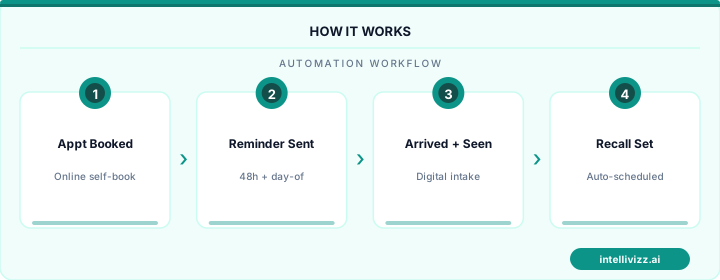
Tysons traffic is unpredictable. A patient who planned to leave work at 3:30 for a 4 PM appointment may be stuck in a meeting until 3:50. Without an easy way to reschedule quickly, they simply don't show — and your operatory sits empty. AI receptionists send automated appointment reminders via SMS at 48 hours and 2 hours before each appointment, with a one-tap link to reschedule. When a patient reschedules, the AI immediately offers their slot to patients on the cancellation waitlist.
Practices implementing this system in similar suburban markets report 20–35% reduction in no-show rates. For a busy Tysons practice producing $80,000–$120,000 per month, a 25% reduction in a 15% no-show rate recovers approximately $12,000–$18,000 in monthly production. That is one of the highest single-intervention ROIs available to a dental practice without adding a single clinical hour.
Implementation: A Realistic Timeline for Tysons Practices
Many practice owners assume that deploying AI reception requires months of technical work and disruption to daily operations. The reality is a phased, low-disruption rollout that typically completes in four weeks:
Week 1: Integration and Configuration
The technical team connects to your PMS via API, maps your scheduling rules (which providers see which procedures, minimum time between appointments, block scheduling for hygiene), and builds your practice knowledge base (services offered, insurance plans accepted, office hours, parking, new patient paperwork process). Your front-desk team reviews the call flow but continues working normally.
Week 2: After-Hours Deployment
The AI goes live for all calls outside business hours — evenings and weekends. Your team continues handling calls during the day while you collect data on after-hours call volume and the AI's booking performance. Most practices are surprised to discover exactly how many calls were going to voicemail after 5 PM.
Week 3: Overflow Integration
The AI activates for daytime overflow — calls when all front-desk lines are occupied or the team is with a patient. Staff continue to handle the calls they answer; the AI handles the calls that would otherwise ring out. You begin seeing the combined impact of after-hours plus overflow coverage.
Week 4 and Beyond: Optimization
Review call recordings and analytics. Refine the AI's responses based on common questions that weren't in the initial knowledge base. Expand to additional workflows: recall reminders, hygiene reactivation campaigns, and patient satisfaction follow-ups. Most practices reach full optimization within 60–90 days and never look back.
💡 Automation handles the routine — you handle the growth
The data speaks for itself
ROI Benchmarks for a Tysons Corner Dental Practice
| Metric | Before AI Reception | After AI Reception |
|---|---|---|
| Calls answered (including after hours) | 65–72% | 100% |
| After-hours appointments booked/month | 0 | 25–40 |
| No-show rate | 14–18% | 7–10% |
| New patient acquisition cost | $350–$500 | $150–$250 |
| Front-desk overtime hours/week | 8–12 hrs | 0–2 hrs |
| Insurance surprises at check-in | 8–15/month | 1–3/month |
| Monthly production impact | — | +$15,000–$28,000 |
| System cost | — | $500–$1,500/month |
The math is straightforward: a Tysons practice spending $800/month on AI reception and capturing 30 additional appointments at an average of $450 production each generates $13,500 in incremental monthly production — a 16x return on the investment. And this ignores the downstream value of those patients' recall visits, restorative needs, and referrals over a multi-year relationship.
Why Tysons Dentists Choose AI Over Traditional Answering Services
Traditional dental answering services charge $1.50–$3.00 per call, cannot access your scheduling system, take messages that must be returned the next morning (by which time the patient has booked elsewhere), and provide an impersonal experience that signals to patients they've reached an external service rather than your practice. The cost for a busy Tysons practice receiving 60–80 after-hours calls per month runs $1,800–$5,000 at per-call rates — and the revenue recovery from message callbacks is typically 20–30% because patients have already moved on.
An AI receptionist costs a predictable flat monthly rate regardless of call volume, books appointments directly rather than taking messages, and provides a seamless experience that is indistinguishable from a well-trained human receptionist. For practices managing Tysons-level overhead pressure, replacing a variable, high-cost answering service with a flat-rate, higher-performing AI system is one of the few technology decisions that is genuinely easy to make.
For practices that are also dealing with recall gaps and patient reactivation, combining AI reception with cancellation backfill automation and no-show recovery workflows creates a comprehensive operational system that addresses revenue leakage at every point in the patient journey.
Ready to modernize your practice? Explore our healthcare automation solutions, Dental Practice Automation in Fairfax, VA: How..., or AI Receptionist for Dental Offices in Arlington, VA:....