
After-Hours Answering Service for Medical Offices: Why AI Outperforms Traditional Services
35% of patient calls to medical offices happen outside business hours. That's more than one in three — and for most practices, these calls go to voicemail or a traditional answering service that takes a message and promises "someone will call you back tomorrow." Understanding how much missed calls cost a business makes the scale of this problem clear. In an era where patients expect instant service, this after-hours gap is losing you patients to competitors who are available when you're not.
The Traditional After-Hours Service Problem
Traditional medical answering services have significant limitations: operators take messages but can't schedule appointments, hold times during peak after-hours periods (6-9 PM) can reach 5-10 minutes, quality varies dramatically between operators and shifts, per-minute billing creates unpredictable costs ($800-$3,000/month), operators lack context about your practice's specific protocols, and HIPAA compliance is only as strong as the operator's training.
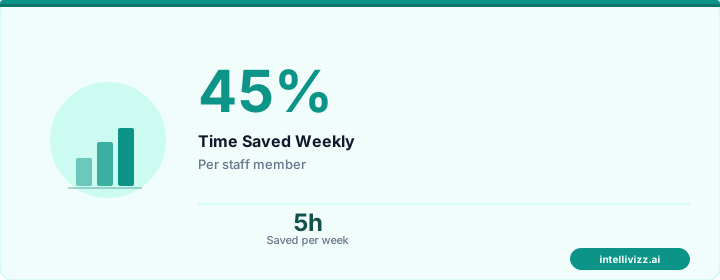
🏥 Patients expect instant responses — automation delivers
Smart technology, better results
How AI After-Hours Service Works Differently
Instant Response, Zero Hold Time
The AI answers within 2 rings — whether the patient calls at 7 PM or 3 AM. No hold queue, no transfers, no "please hold while I find your information." The patient experience is consistent and immediate.
Direct Appointment Scheduling
The biggest differentiator: AI doesn't just take a message. It schedules appointments directly in your EHR/PMS. A patient calling at 8 PM to schedule a follow-up walks away with a confirmed appointment — no callback needed. This alone converts 30-40% more after-hours inquiries into booked appointments compared to message-based services.
Intelligent Triage
For clinical calls, the AI follows your practice's HIPAA-compliant triage protocols: assesses urgency through structured questioning, directs emergencies to 911 or the nearest ER, pages on-call providers for urgent issues, and schedules next-day appointments for non-urgent concerns.
Complete Information Access
The AI has access to your practice knowledge base: accepted insurance plans, provider availability, office locations and directions, pre-appointment instructions, and common clinical question answers. Operators at traditional services typically have a one-page FAQ sheet at best.
Cost Comparison
| Factor | Traditional Service | AI Service |
|---|---|---|
| Monthly cost | $800-$3,000 | $200-$600 |
| Pricing model | Per-minute (unpredictable) | Flat rate |
| Scheduling capability | Message only | Direct EHR booking |
| Triage quality | Varies by operator | Consistent protocols |
| Multi-language | Limited/extra cost | Built-in (10+ languages) |
| Hold time | 30 sec - 10 min | Zero |
After-Hours Call Patterns
Understanding when patients call helps optimize your coverage: 5-8 PM: 45% of after-hours calls (highest volume — patients calling after work), 8-10 PM: 25% (parents calling after kids' bedtime), 10 PM - 6 AM: 15% (urgent concerns, anxiety-driven), and weekends/holidays: 15% (all-day coverage needed).
The 5-8 PM window is critical — these are your highest-value calls from working professionals who couldn't call during business hours. A traditional service takes their message; AI schedules their appointment.
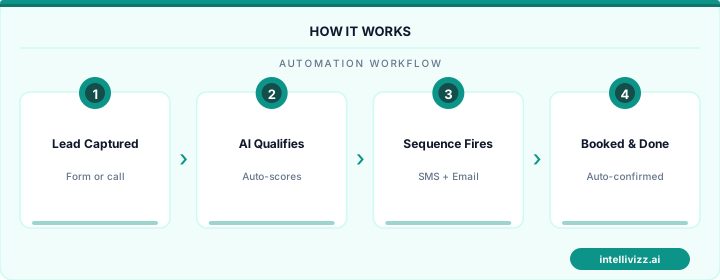
🏥 Patients expect instant responses — automation delivers
The data speaks for itself
Impact for Medical Practices
- New patient capture: 25-35% of new patient inquiries come after hours. AI converts these into booked appointments immediately.
- Patient satisfaction: 92% of patients prefer instant AI service over leaving a voicemail (per patient survey data).
- Cost savings: 50-80% reduction compared to traditional answering services.
- Revenue impact: $3,000-$15,000/month in recovered after-hours patient revenue.
An AI after-hours receptionist eliminates the missed-call problem entirely by answering every call and booking appointments around the clock. Practices in Washington, DC can also explore our guide to after-hours answering services for doctors in DC. Ready to upgrade your after-hours coverage? Book a free consultation to see AI after-hours service in action for your practice.
After-Hours Call Volumes: What the Data Shows
Contrary to the assumption that after-hours calls are primarily urgent clinical concerns, data from medical practices with AI after-hours coverage shows that the majority of after-hours calls are administrative. Analysis of call logs from primary care and multi-specialty practices reveals the following distribution: appointment scheduling requests (32-38%), appointment confirmations and reminders (12-18%), prescription refill requests (15-20%), general practice information (hours, location, accepted insurance) (10-15%), clinical questions appropriate for staff (8-12%), and urgent clinical concerns requiring physician escalation (8-12%). Only that last category — approximately 1 in 10 after-hours calls — truly requires physician involvement. The other 88-92% can be handled by an AI system without any physician time.
This distribution has profound implications for how practices configure their after-hours systems. A well-configured AI answering service handles the 88-92% majority autonomously, freeing the on-call physician to focus on the 8-12% that genuinely require clinical judgment. Without automated handling, on-call physicians may be responding to scheduling requests and insurance questions at 10 p.m. — an unsustainable situation that contributes to physician burnout and dissatisfaction. With automation, on-call responsibilities become genuinely clinical rather than administrative, improving both physician wellbeing and the quality of after-hours clinical coverage.
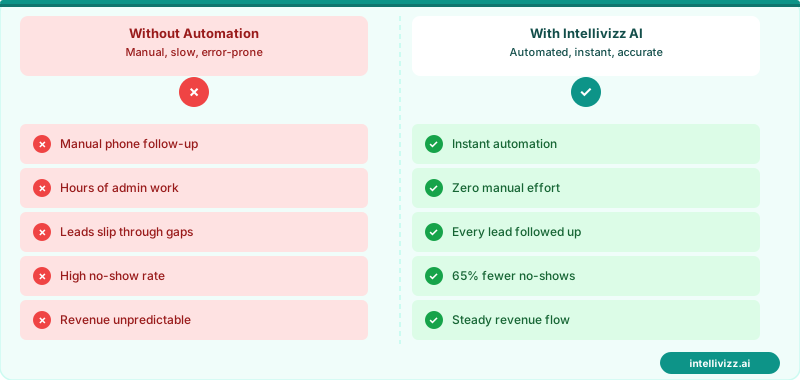
🌙 90% of after-hours medical calls are administrative — AI handles them so physicians don't have to
After-hours AI coverage improves physician wellness while capturing revenue that voicemail loses.
Configuring Escalation Protocols by Specialty
The clinical urgency threshold for after-hours escalation varies significantly by specialty, and AI after-hours systems must be configured to reflect these specialty-specific protocols. A primary care practice might define escalation triggers as: chest pain, difficulty breathing, high fever in children under 3 months, significant injury, or any symptom the patient describes as "worse than ever before." A cardiology practice adds: palpitations with dizziness, implanted device alarms, sudden shortness of breath. A pediatric practice adds: inconsolable crying in infants, significant changes in feeding, rash with fever. An OB/GYN practice adds: vaginal bleeding in pregnancy, decreased fetal movement, signs of preeclampsia in third-trimester patients.
These specialty-specific protocols are programmed into the AI's decision tree, allowing it to ask the right clarifying questions when a caller presents with a potential concern. The AI is not diagnosing — it is triaging, using predetermined physician-approved criteria to determine whether the call requires immediate physician contact or can wait for morning staff. This triage function, even when imperfect, dramatically reduces inappropriate escalations (urgent physician calls for administrative matters) and ensures that genuinely concerning presentations are reliably escalated.
| Specialty | Standard Escalation Triggers | AI-Handleable Calls (%) |
|---|---|---|
| Primary Care | Chest pain, breathing difficulty, high fever <3mo | 90–92% |
| Cardiology | Palpitations + dizziness, device alarms, SOB | 82–86% |
| Pediatrics | Inconsolable infant, high fever, severe rash + fever | 85–88% |
| OB/GYN | Bleeding in pregnancy, decreased fetal movement | 80–84% |
| Mental Health | Suicidal ideation, acute crisis, safety concerns | 75–82% |
Regulatory Requirements for After-Hours Medical Coverage
Physicians and practices have regulatory obligations around after-hours coverage that vary by state and specialty. In Virginia, Maryland, and DC, the general standard is that practices must provide patients with access to emergency assistance and must have protocols for directing patients to appropriate care after hours — but these requirements are more flexible than commonly assumed. The obligation is not to have a physician personally available at all times; it is to have a reliable system that directs patients appropriately. An AI after-hours system that directs emergencies to 911, escalates urgent concerns to an on-call physician, and handles administrative calls autonomously fulfills this standard.
Malpractice considerations also apply. Practices should consult with their malpractice carrier before deploying any after-hours answering system (AI or human) to ensure the system configuration is consistent with their coverage terms. Most carriers have explicit guidance on acceptable after-hours coverage systems and will review the escalation protocols as part of their risk assessment. Practices that document their AI configuration, escalation protocols, and regular testing procedures are in the best position to demonstrate reasonable care. This pairs naturally with the broader AI automation for medical practices framework that addresses the full administrative automation lifecycle.
Integrating After-Hours AI with Your Daytime Workflow
The most effective after-hours medical answering services function as a seamless extension of the practice's daytime workflow rather than as a standalone system. When the practice closes at 5 p.m., the transition to AI answering should be transparent to patients — the same phone number, the same professional quality, the same ability to accomplish the same tasks (scheduling, information, urgent escalation). When the practice reopens the next morning, the AI's overnight activity should be immediately visible to staff: appointments booked, messages received, and urgent escalations logged in a review queue ready for morning action.
Achieving this integration requires thoughtful configuration at the transition points. Outgoing voicemail greetings should be replaced with the AI answering service for after-hours handling, rather than asking patients to leave a message and wait. Morning handoff reports should be generated automatically and delivered to the practice manager's email before staff arrive. Any urgent escalations should be marked as high priority and appear at the top of the morning queue. Appointments booked after hours should appear in the scheduling system exactly as daytime bookings do, ready for confirmation call staff review or automated pre-visit communications.
The business case for integrated after-hours coverage becomes clearest when practices quantify their after-hours missed call volume. A practice that receives 75 calls per day and has 35-40% after-hours call volume is missing 26-30 calls every day outside business hours. At a 30% new patient inquiry rate among missed calls (8-9 missed new patient inquiries daily) and a 60% booking conversion rate, the practice is losing 5 new patient bookings every day to unanswered phones. Over a 250-day working year, that represents 1,250 lost new patient bookings — at any reasonable new patient lifetime value, a figure that makes after-hours AI investment obviously justified.
Ready to modernize your practice? Explore our healthcare automation solutions, or read our guide to What Is an AI Receptionist for Medical Offices?....