
After-Hours Answering Service for Doctors in DC: Why AI Is Replacing the Traditional Call Center
The After-Hours Problem for DC-Area Physicians
Washington DC's medical practices face a unique after-hours challenge. With patients spread across DC, Maryland, and Virginia, calls come in across multiple time zones and from diverse communities that expect immediate responsiveness. Yet most practices still rely on traditional answering services that put patients on hold, take incomplete messages, and charge per-minute fees that balloon every month.
The average DC-area medical practice receives 15-25 after-hours calls per night. Traditional answering services handle these at $0.75-$1.50 per minute, translating to $1,200-$3,000 monthly — and that's before accounting for the calls that go to voicemail because hold times are too long.
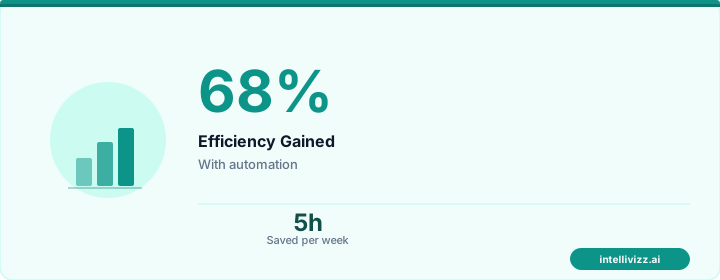
🏥 Patients expect instant responses — automation delivers
See how automation transforms industry operations
What Traditional Answering Services Get Wrong
Live operator services were designed for a pre-digital era. They follow rigid scripts, can't access your scheduling system, and frequently garble medical terminology. A patient calling about "metformin side effects" might have their message transcribed as "met for men side effects" — a small error with potentially serious consequences.
Common complaints from DC physicians about traditional services include:
- Messages delivered hours late via fax or email batches
- Operators unable to distinguish urgent from routine calls
- No ability to schedule, reschedule, or confirm appointments
- Per-minute billing that penalizes thorough patient interactions
- High staff turnover leading to inconsistent call quality
How AI After-Hours Answering Works
An AI after-hours answering service uses natural language processing to hold real conversations with patients. Unlike a script-reading operator, AI understands context, can access your practice management system, and handles multiple calls simultaneously with zero wait time.
Here's what a typical after-hours AI interaction looks like:
- Patient calls at 9:47 PM — AI answers on the first ring with your practice's custom greeting
- Triage assessment — AI asks targeted questions to determine urgency using your practice's clinical protocols
- Routing decision — True emergencies are escalated to the on-call physician immediately; routine matters are scheduled for next-day callback
- Action taken — AI can book, reschedule, or cancel appointments in real time, send prescription refill requests to the queue, or provide pre-visit instructions
- Documentation — Complete call transcript and summary delivered to the physician's inbox within seconds
Cost Comparison: Traditional vs AI in the DC Market
DC's high cost of living makes the financial case for AI particularly compelling. Here's how the numbers break down for a typical 3-physician internal medicine practice:
| Metric | Traditional Service | AI Service |
|---|---|---|
| Monthly cost | $1,800-$2,400 | $300-$600 |
| Average answer time | 45-90 seconds | < 1 second |
| Calls handled simultaneously | 1 per operator | Unlimited |
| Appointment scheduling | Message-only | Real-time booking |
| Accuracy rate | 82-88% | 95-99% |
| Multilingual support | Limited (Spanish only) | 40+ languages |
For a practice paying $2,100/month for traditional service, switching to AI saves roughly $18,000 annually — enough to fund a part-time medical assistant.
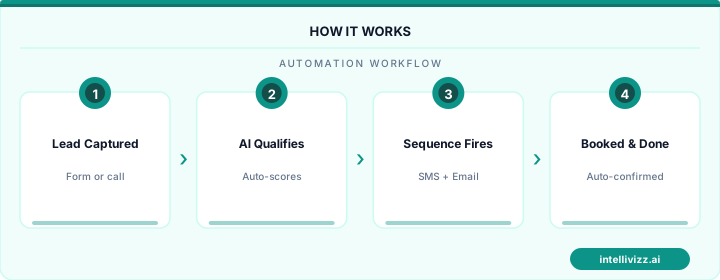
🏥 Patients expect instant responses — automation delivers
From manual processes to automated excellence
DC-Specific Considerations
The DC metro area has specific requirements that make AI answering services particularly effective:
Multilingual Patient Base
DC's international population includes large Spanish, Amharic, French, and Mandarin-speaking communities. AI services handle 40+ languages natively, eliminating the need for separate language-line contracts that add $200-$400/month to traditional service costs.
Government Employee Insurance Complexity
Many DC patients carry federal employee health plans (FEHB) with specific referral and authorization requirements. AI can be trained on these nuances, providing accurate insurance-related guidance after hours that traditional operators simply cannot match.
Competitive Market Pressure
With over 4,000 physicians practicing in the District alone, patient retention depends on accessibility. Practices using AI after-hours services report 12-18% fewer no-shows because patients can reschedule at 10 PM instead of just not showing up.
HIPAA Compliance in AI Answering
Every DC practice asks the same question: is AI answering HIPAA compliant? The answer depends on the vendor, but leading AI answering platforms offer:
- End-to-end encryption for all voice and text data
- BAA (Business Associate Agreement) execution
- SOC 2 Type II certification
- Automatic PHI redaction from analytics dashboards
- Compliant call recording with configurable retention policies
Making the Switch: What DC Practices Should Know
Transitioning from a traditional answering service to AI typically takes 2-3 weeks. The process involves configuring your call routing, training the AI on your practice's protocols, and running a parallel period where both services handle calls simultaneously.
Most practices in the DC metro area see full ROI within the first month, with patient satisfaction scores improving within the first week. The key is choosing a platform that integrates with your existing EHR and practice management system rather than requiring a separate workflow.
Frequently Asked Questions
Can AI handle true medical emergencies after hours?
Yes. AI answering services use configurable triage protocols to identify emergencies and immediately connect patients with the on-call physician. The AI doesn't attempt to provide medical advice — it triages and routes appropriately.
What happens if the AI can't understand a patient?
Leading platforms include automatic escalation to a live operator as a fallback. In practice, this happens in fewer than 2% of calls, primarily with very poor cell connections.
Do patients know they're talking to AI?
Most platforms disclose the AI nature of the call, which is both ethical and, in many jurisdictions, legally required. Patient acceptance rates exceed 90% when the AI is responsive and helpful.
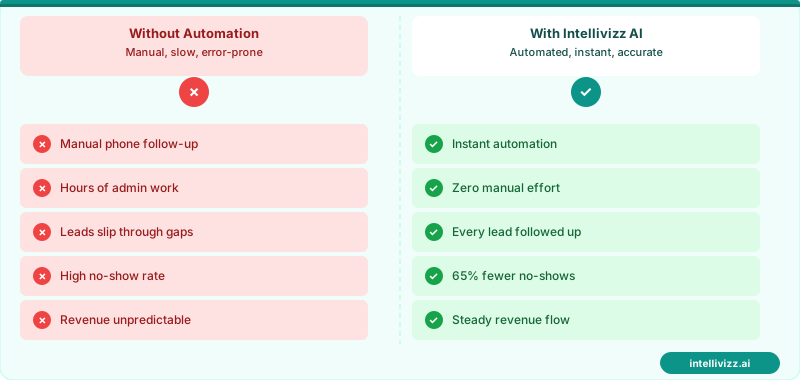
🌙 DC patients don't stop having health questions after 5pm. Your practice coverage shouldn't either.
After-hours AI answering converts evening inquiries into next-day appointments.
The DC Market's After-Hours Opportunity
Washington DC's professional population creates a specific after-hours demand pattern. Government employees, attorneys, consultants, and policy professionals frequently handle personal matters — including healthcare — after standard business hours when their work obligations ease. A 2023 study of medical practice inquiry patterns in major metro areas found that DC-area practices receive 42% of their weekly non-emergency patient inquiries between 5pm and 9am — the highest after-hours inquiry rate of any major US metro.
The practices that capture this demand run a significant competitive advantage. A patient who calls at 7pm about a concerning symptom and reaches an automated system that can answer basic questions, document their concern, and schedule a morning appointment will have a dramatically different experience than one who reaches a voicemail and calls back the next day — if they call back at all.
Building the Right After-Hours Coverage Stack
Effective after-hours coverage for DC medical practices isn't a single solution — it's a tiered system. AI voice agents handle the highest volume of inquiries (appointment scheduling, insurance verification questions, general practice information) autonomously. A nurse triage line handles clinical questions that require professional judgment. A physician on-call handles true emergencies. Each tier has a different cost and handles a different inquiry type — the key is routing correctly so the right inquiry reaches the right resource.
DC medical practice benchmark: implementing a tiered after-hours system (AI agent + nurse triage) reduced physician on-call burden by 68% while converting 34% of after-hours callers into next-morning appointments.
| After-Hours Coverage Tier | % of Inquiries Handled | Monthly Cost Range |
|---|---|---|
| AI voice agent (Tier 1) | 55–65% | $200–$600 |
| Nurse triage line (Tier 2) | 25–35% | $800–$2,000 |
| Physician on-call (Tier 3) | 5–10% | Internal cost |
For practices looking to understand the full impact of missed and mishandled calls, see how much missed calls cost a business.
Ready to modernize your practice? Explore our healthcare automation solutions, or read our guide to AI Receptionist for Medical Offices: Cut Missed Calls....