
AI Appointment Scheduling for Medical Offices: Beyond the Online Booking Widget
Online booking widgets have been available for years, but they handle only the simplest scheduling scenarios — a patient clicks a time slot and books. Real medical scheduling is far more complex: matching the right patient to the right provider at the right time, with the right appointment type, at the right location, while respecting clinical constraints, provider preferences, and insurance requirements.
AI-powered scheduling handles this full complexity, whether the patient is booking online, calling the office, or being scheduled by a referral coordinator.
Why Basic Online Booking Falls Short
Standard booking widgets create problems that outweigh their convenience:
- Inappropriate self-scheduling: Patients book 15-minute follow-up slots for what should be a 45-minute new patient exam.
- Provider mismatch: A patient needing a procedure books with a provider who doesn't perform that procedure.
- Insurance gaps: Patients book with providers who don't accept their insurance, creating rework and patient frustration.
- Overbooking: Multiple patients grab the same slot before the system updates.
- Underutilization: Complex rules and restrictions limit the slots shown online, leaving most of the schedule unbookable through the widget.
🏥 Patients expect instant responses — automation delivers
See how automation transforms industry operations
How AI Scheduling Works Differently
Intelligent Appointment Type Detection
When a patient interacts with the AI (via phone call, chat, or enhanced online booking), the system determines the correct appointment type through conversation: "Are you a new or returning patient?" → determines exam vs. follow-up, "What brings you in?" → maps symptoms to appointment types and durations, "Which provider do you see?" → confirms continuity of care or finds the right match, and validates the appointment type against clinical rules before booking.
Provider Matching
AI scheduling considers multiple factors when matching a patient to a provider: the patient's existing provider relationship (continuity of care), the specific service needed and which providers offer it, insurance acceptance (real-time eligibility when possible), provider availability and workload balancing, patient location preference (for multi-location practices), and language preferences.
Complex Rule Engine
Medical scheduling has rules that basic booking systems can't handle:
- Pre-visit requirements: "This appointment requires a referral on file" — AI checks for the referral before booking.
- Appointment dependencies: "Lab work must be completed 7 days before this consultation" — AI schedules labs first and the consultation after.
- Provider constraints: "Dr. Smith only does procedures on Tuesdays and Thursdays" — AI respects provider-specific templates.
- Room and equipment availability: Procedures requiring specific rooms or equipment are scheduled only when both the provider and resource are available.
- Insurance pre-authorization: "This procedure requires pre-auth" — AI flags the requirement and can initiate the auth process.
Waitlist and Backfill Management
AI scheduling includes built-in waitlist intelligence: patients can request preferred dates/times when none are available, when cancellations create openings, the system automatically offers the slot to waitlisted patients based on preference match, the first to confirm gets the slot — no staff phone calls needed, and unbooked cancellation slots are filled within hours instead of remaining empty.
Channel-Agnostic Scheduling
Unlike widget-only booking, AI scheduling works across every channel:
- Phone: The AI phone answering service handles scheduling during calls naturally — "I'd like to see Dr. Patel next week" → AI finds availability and books.
- Web: Enhanced online booking with AI-guided flows that ensure correct appointment types.
- Text/Chat: "Book me an appointment" via text triggers a brief AI conversation to gather details and confirm.
- Referral: Incoming referrals are automatically matched to appropriate providers and the patient is contacted to schedule.
EHR Integration Depth
AI scheduling requires deep PMS integration to be effective: reading real-time availability including blocks, holds, and templates, writing appointments with correct type codes, durations, and provider associations, accessing patient records for insurance verification and care history, and updating appointment status (confirmed, waitlisted, cancelled) bidirectionally.
🏥 Patients expect instant responses — automation delivers
From manual processes to automated excellence
Measurable Outcomes
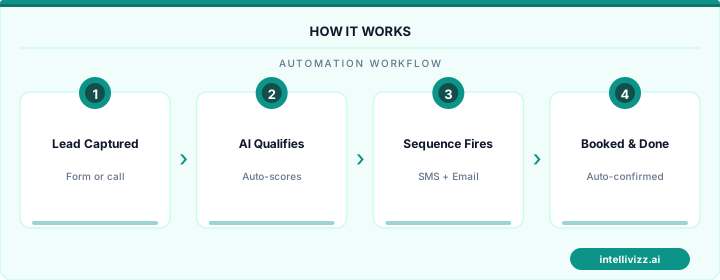
Practices implementing AI scheduling report: 30-40% reduction in scheduling-related phone calls, 50-60% decrease in booking errors (wrong type, wrong provider), 25-35% improvement in provider utilization (fewer gaps, better distribution), 40-60% of cancelled slots recovered through automated backfilling, and 15-20% increase in new patient capture (from after-hours and overflow scheduling).
AI scheduling transforms appointment management from a manual, error-prone bottleneck into a seamless, always-available system that maximizes provider utilization and patient satisfaction.
Ready to upgrade your scheduling? Book a free consultation to see AI scheduling in action with your practice's specific rules and workflows.
Appointment Type Routing and Provider Preference Logic
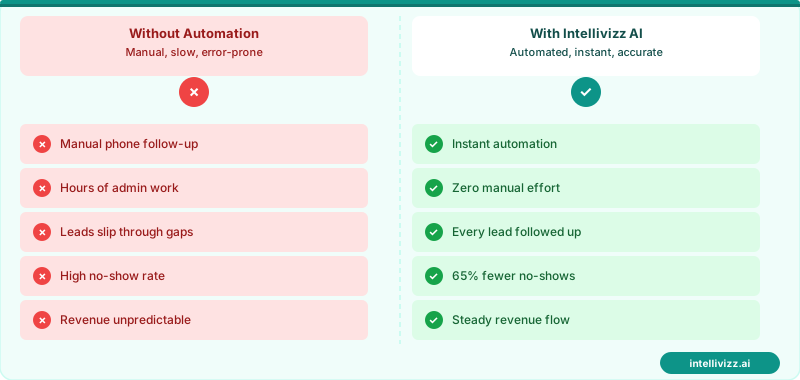
AI appointment scheduling for medical offices creates its deepest operational value when it accurately routes appointment requests to the appropriate appointment type, duration, and provider — not just finding the next available open slot. A new patient calling with a "chest pain" chief complaint should not be routed to a 20-minute new patient physical slot; the system should identify the symptom urgency, offer a same-day or next-day acute visit slot if available, and escalate to a clinical triage line if the symptom presentation suggests immediacy. A patient calling to "follow up" on lab results requires a different appointment type than one requesting a new-complaint evaluation. Getting this routing right autonomously — without requiring the patient to navigate complex phone tree options or the front desk to manually assess appointment type — is the core intelligence challenge in medical office AI scheduling.
Provider preference logic adds another dimension. Most practices have implicit routing preferences that are currently managed through staff institutional knowledge: certain providers prefer certain appointment types, some providers see pediatric patients while others do not, some have afternoon-only availability for new patients, and patient-provider continuity preferences should be respected where possible to maintain relationship-based care. AI scheduling systems that encode these preferences explicitly — and apply them consistently across every scheduling interaction regardless of which staff member (or AI) handles the request — eliminate the routing inconsistencies that create scheduling friction and patient dissatisfaction. The encoding of these rules is a one-time setup investment; the consistent application is an ongoing operational dividend.
🗓️ Right Appointment Type. Right Provider. Right Time — Automatically.
AI routing logic encodes practice preferences consistently across 100% of scheduling interactions
Scheduling Analytics and Capacity Optimization
AI-powered scheduling systems generate a secondary benefit that manual scheduling cannot: a structured data layer that enables meaningful scheduling analytics and capacity optimization. Every scheduling interaction produces data: which appointment types are most requested, what time slots fill fastest, which provider schedules have the highest cancellation rates, what days of the week generate the most patient-initiated contacts, and where the gap between appointment availability and patient demand creates friction. This data, aggregated across thousands of interactions, enables practice administrators to make evidence-based decisions about schedule template design — decisions that have direct financial impact.
A practice that discovers through scheduling analytics that 35% of new patient appointment requests occur between 7–9 AM but that it offers no appointment slots before 9 AM has identified an actionable revenue opportunity: opening early morning slots (or offering telehealth for routine new patient consultations in that window) directly addresses demonstrated demand. A practice that identifies a 22% same-day cancellation rate for one provider on Monday mornings — versus a 7% rate across the rest of the schedule — has the data to investigate the root cause (a known pattern issue? a provider schedule change?) and implement a targeted solution. These insights are available only when scheduling data is systematically captured and analyzed, which manual scheduling workflows cannot support at the level of detail that AI scheduling systems provide by default.
| Scheduling Analytics Metric | Operational Implication | Potential Revenue Impact |
|---|---|---|
| Peak request time vs. slot availability gap | Template redesign opportunity | +5–15% new patient capture |
| Provider-specific no-show rate variation | Overbooking strategy adjustment | Recover 3–8 slots/provider/month |
| Appointment type mismatch rate | Routing logic refinement | Reduce rework bookings 20–30% |
| Lead time to book by appointment type | Waitlist priority calibration | Reduce access wait-time dissatisfaction |
Medical offices implementing AI scheduling alongside a full patient communication automation stack will benefit from reviewing the workflow in patient appointment reminder automation — which covers the post-scheduling touchpoints that maintain schedule integrity and minimize last-minute cancellations that compromise the capacity utilization gains from AI scheduling.
Patient Self-Scheduling Adoption and Change Management
The most sophisticated AI scheduling system in the market creates no value if patients do not use it. Patient self-scheduling adoption — the percentage of appointments booked through digital channels versus phone — varies enormously across practice types and patient demographics, but it consistently responds to specific adoption strategies when those strategies are implemented deliberately. Practices that achieve 40–60% self-scheduling rates have typically combined three elements: prominent placement of the self-scheduling link across all patient touchpoints (website, email communications, appointment reminders, post-visit communications, Google Business Profile); an onboarding sequence for new patients that specifically demonstrates the self-scheduling tool during the initial enrollment process; and periodic reminders to existing phone-scheduling patients about the digital option, framed around convenience rather than practice cost savings.
Staff change management is equally important for AI scheduling adoption. Front desk staff who feel that self-scheduling threatens their job security will, consciously or unconsciously, route patients to phone scheduling by providing the number rather than the self-scheduling link. Practices that successfully implement self-scheduling position the technology as a capacity expansion tool — freeing front desk staff from routine booking calls to handle the more complex, relationship-intensive patient interactions that require human judgment — rather than as a replacement. Staff who understand that self-scheduling handles the 60% of calls that are pure scheduling transactions, leaving them to focus on the 40% that genuinely require their expertise and relationship with the patient, typically become advocates for the system rather than resistors.
Ready to modernize your practice? Explore our healthcare automation solutions, or read our guide to AI Patient Scheduling in Alexandria, VA: How DC-Area....