
AI for Dental Office Management: A Practical Guide to Smarter Practice Operations
Dental office management has more moving parts than most healthcare specialties: multi-provider scheduling with complex procedure durations, insurance verification across hundreds of plans, treatment plan presentation and follow-up, hygiene recall management, and the constant balance between clinical production and patient experience. AI brings intelligence to each of these areas.
AI-Powered Scheduling Optimization
Traditional dental scheduling relies on a template that rarely matches actual demand. AI scheduling analyzes your practice data to: optimize appointment type distribution (balancing hygiene, restorative, and new patient slots), predict cancellations and pre-build overbooking recommendations, dynamically adjust availability based on real-time demand, and match appointment complexity with provider skill sets and preferences.
An AI receptionist for dental offices handles the scheduling conversations themselves — booking, rescheduling, and managing cancellations across phone, text, and online channels.
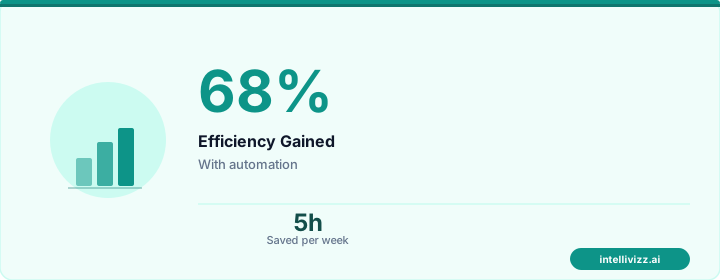
🏥 Patients expect instant responses — automation delivers
The data speaks for itself
Intelligent Patient Communication
AI transforms how dental offices communicate with patients across the entire lifecycle:
- Pre-appointment: Smart reminders that include procedure-specific prep instructions, insurance benefit reminders, and driving directions.
- Treatment follow-up: Automated outreach to patients with unscheduled treatment: "Dr. [Name] recommended a crown for tooth #14 during your last visit. Ready to schedule? Here are available times: [link]."
- Hygiene recall: Multi-touchpoint recall campaigns that reactivate lapsed patients and keep active patients on schedule.
- Post-procedure: Automated check-ins after extractions, implants, and other procedures: "How are you feeling after today's procedure? Any questions? Reply here or call us."
Production Forecasting and Analytics
AI analytics give dental practice owners visibility they've never had before: daily production forecasting based on scheduled appointments and historical conversion rates, identification of production leaks (unscheduled treatment, hygiene holes, case acceptance gaps), provider performance benchmarking with actionable improvement recommendations, and patient lifetime value analysis to prioritize retention and acquisition spending.
Insurance and Billing Intelligence
AI streamlines the dental insurance workflow: automated eligibility and benefits verification before each appointment, treatment plan cost estimation based on patient-specific coverage, claim submission optimization (correct coding, required attachments), and denial pattern analysis to prevent future rejections.
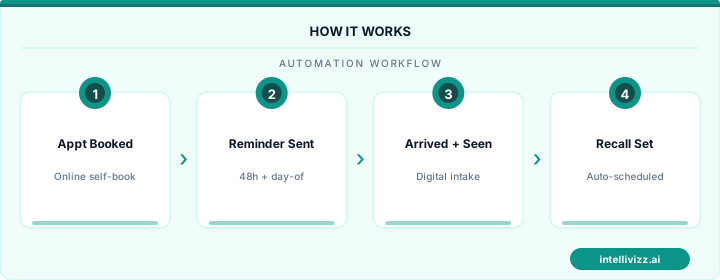
🏥 Patients expect instant responses — automation delivers
Smart technology, better results
Staff Management
AI helps manage the human side of dental practice operations: scheduling staff based on predicted patient volume and procedure mix, identifying training needs based on production data and patient feedback, tracking key performance indicators by team member, and predicting turnover risk based on engagement patterns.
Getting Started
The highest-ROI AI implementations for dental offices: start with marketing and communication automation (reviews, recall, treatment follow-up), add AI phone handling for call capture and after-hours coverage, layer in scheduling optimization as data accumulates, and implement production analytics for strategic decision-making.
Each layer builds on the data from the previous one, creating an increasingly intelligent management system that grows smarter over time.
Ready to bring AI to your dental practice management? Book a free consultation for a demo tailored to dental operations.
The Complete Dental Office Automation Stack
Dental office management involves a higher administrative burden per patient than almost any other healthcare specialty. A single new patient visit generates: a new patient intake form, insurance verification, benefit eligibility check, treatment planning documentation, clinical notes, billing codes submission, explanation of benefits processing, and follow-up recall scheduling. Multiply this across 20-30 patients per day in a busy practice, and the administrative overhead becomes overwhelming — front desk staff spend an average of 3.5 hours per 8-hour day on administrative tasks rather than patient-facing work.
AI dental office management addresses this through a layered automation stack. The phone layer (AI receptionist) handles inbound calls, appointment scheduling, and basic patient inquiries. The intake layer (AI-powered forms) automates new patient paperwork, medical history collection, and insurance information gathering before the patient arrives. The financial layer (AI billing assistant) automates insurance claims submission, payment plan communications, and outstanding balance follow-ups. The recall layer (AI reminder system) manages hygiene recare, overdue appointment follow-ups, and treatment plan reminders.
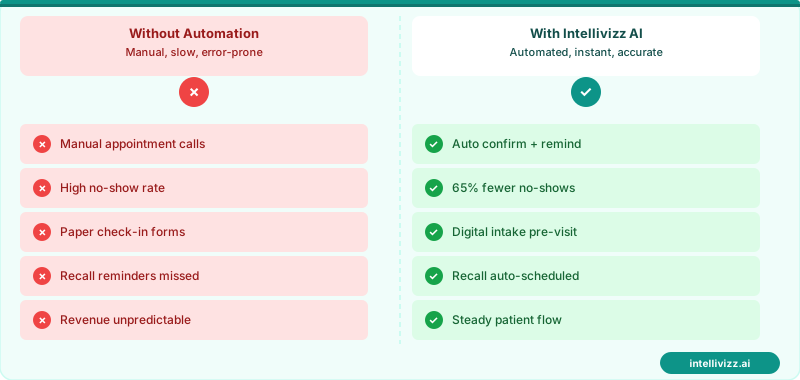
🦷 Front desk staff spend 43% of their day on tasks AI can handle
A complete dental automation stack frees your team to focus on patient experience — not paperwork.
Insurance Workflow Automation in Dental Practices
Dental insurance is among the most complex billing environments in healthcare, with hundreds of payers, varying fee schedules, annual maximums, waiting periods, and frequency limitations (e.g., X-rays covered once per year, not per visit). Manual insurance verification for new patients typically takes 15-25 minutes per patient — a task that AI can complete in under 2 minutes via automated eligibility checks through clearing houses like Availity, Change Healthcare, and Dentrix's insurance module.
Beyond eligibility verification, AI automates the entire claim cycle: generating procedure codes from treatment plans (with human review flagging), submitting claims to primary and secondary insurers simultaneously, tracking claim status and following up on delayed payments, posting EOBs (Explanation of Benefits) to patient accounts, and generating patient balance statements automatically when the insurance portion is settled. Practices that implement full insurance workflow automation report reducing their average collections cycle from 45-60 days to 18-25 days — a significant improvement in cash flow.
| Dental Admin Task | Manual Time | Automated Time | Monthly Hours Saved |
|---|---|---|---|
| Insurance eligibility check | 20 min/patient | 2 min | 36 hours |
| Appointment reminders | 3 min/patient | 0 min | 15 hours |
| Recall/recare outreach | 5 min/patient | 0 min | 25 hours |
| Claims submission | 8 min/claim | 1 min (review only) | 28 hours |
Patient Journey Mapping: From First Call to Lifetime Patient
Understanding the full patient journey reveals where manual processes create dropout risk — and where automation provides the biggest lift. New dental patients follow a predictable path: discovery (Google search, referral, insurance directory), first contact (phone call or online form), scheduling, new patient intake, first appointment, treatment planning, recall scheduling, and ongoing relationship. Each transition between these stages represents a potential dropout point where patients slip away to competitors or simply disengage.
AI management systems create continuity across the entire journey. A new patient who finds your practice via Google and submits an online inquiry at 7 p.m. on a Tuesday receives an immediate AI-generated response with scheduling options. After booking, they receive automated new patient paperwork links. Their insurance is verified automatically before arrival. Post-appointment, they receive treatment plan follow-up communication and recall scheduling. An AI-managed dental patient has 60% higher long-term retention than one managed through manual processes alone. Learn more about how patient referral program automation can extend this journey by turning satisfied patients into active referral sources for your practice.
Measuring ROI Across Your Dental Automation Stack
Measuring the return on investment from dental automation requires tracking metrics across all automated functions simultaneously, since the cumulative effect of multiple automations is greater than the sum of individual components. Key metrics to establish before implementing any automation (as baseline) and track monthly afterward: new patient monthly volume, no-show rate, recare recall rate (percentage of due hygiene patients who schedule within 60 days of due date), collections per patient visit, staff overtime hours, and front desk staff satisfaction scores.
Practices typically see metric improvements unfold in sequence: new patient volume improves first (within 30 days, as after-hours phone coverage and faster scheduling response capture previously-lost inquiries), no-show rate improves within 45–60 days (as reminder sequences establish themselves), recall rate improves within 90 days (as systematic recare outreach replaces ad-hoc staff efforts), and collections metrics improve within 120 days (as insurance verification automation and payment plan communication streamline the financial cycle). Staffing benefits — reduced overtime, lower administrative burden — are typically evident by 60 days and continue improving as the practice eliminates manual workarounds that automation has replaced.
A well-implemented dental automation stack in a two-physician practice generating $1.2–1.8 million annually typically produces net annual benefits of $80,000–$200,000 — driven roughly equally by revenue recovery (new patients, reduced no-shows, improved recall) and cost reduction (administrative labor efficiency, reduced overtime). At typical automation platform costs of $600–$1,500 per month, the payback period is measured in weeks, not months. The marginal cost of each additional automated touchpoint (adding a recall campaign after implementing reminders, for example) is minimal, making the case for comprehensive adoption compelling once the initial infrastructure is in place.
Building Toward a Fully Automated Dental Practice
The ultimate vision for dental office management automation is a practice where every routine administrative task occurs without manual intervention -- where the role of front desk staff has evolved from reactive administrative work (answering phones, scheduling manually, chasing insurance verifications) to proactive patient relationship management (addressing complex situations that require human judgment, building patient loyalty, and supporting the clinical team). This vision is achievable today with available technology, but it requires sequential implementation, consistent measurement, and organizational commitment to the change management that technology adoption requires. Dental practices that achieve this level of automation consistently outperform peers on every financial and quality metric: higher revenue per chair, lower cost per patient visit, better patient satisfaction scores, and higher staff retention. The journey begins with a single automation layer and builds methodically from there. The practices that start earliest have the largest lead by the time the market broadly adopts these technologies.
Ready to modernize your practice? Explore our healthcare automation solutions, What Is the Best AI Automation for Dental Offices? A..., or Dental Practice Automation in Fairfax, VA: How....