
Legal Client Intake Software: How Modern Law Firms Convert More Leads Into Retained Clients
The client intake process is where law firms win or lose cases — before a single legal document is drafted. Industry data shows that 46% of potential clients who contact a law firm never hear back, and those who do wait an average of 2-3 business days for a response. In an era where clients expect instant gratification, this gap is a revenue hemorrhage.
Legal client intake software closes this gap by automating the journey from initial inquiry to signed retainer agreement. The result: faster response times, fewer dropped leads, reduced administrative burden, and a more professional client experience from first contact.
The Broken Traditional Intake Process
Most law firms still follow a manual intake workflow that looks something like this: a potential client calls or emails. A receptionist (if the call is answered) takes a message. An intake coordinator calls back — sometimes hours or days later. A phone screening happens. If the case qualifies, forms are emailed. The client prints, fills out, scans, and returns them. An attorney reviews. A conflict check is run manually. Finally, a retainer is sent for signature.
This 7-10 step process typically takes 3-7 days. During that time, the potential client has contacted 2-3 other firms and likely retained whichever one responded fastest.
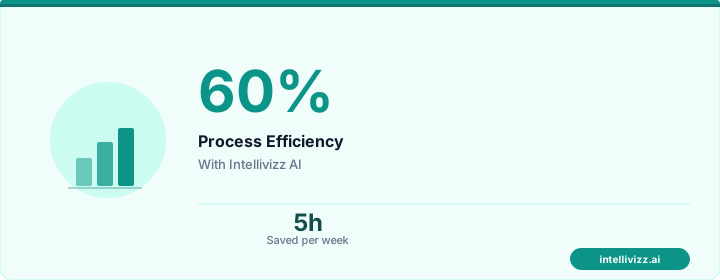
⚖️ Every missed call could be a $5,000+ case
See how automation transforms industry operations
Core Features of Legal Intake Software
Instant Lead Capture and Response
Modern intake systems capture leads from every channel — website forms, phone calls, chat widgets, social media, and referral partner portals — into a single unified inbox. The moment a lead arrives, an automated response fires within seconds: a personalized email or text acknowledging the inquiry, providing expected next steps, and often including a self-scheduling link for a consultation.
For phone inquiries, an AI receptionist for law firms can answer calls 24/7, conduct an initial screening interview, and either schedule a consultation directly or route urgent matters to an on-call attorney.
Smart Intake Forms
Legal intake forms powered by conditional logic adapt based on practice area and case type. A personal injury intake asks different questions than a family law matter. The forms collect only relevant information, pre-populate fields where possible, and are designed for mobile completion (critical when 60%+ of clients access them from their phones).
Key form features: e-signature capability for retainer agreements and fee disclosures, document upload for relevant records (police reports, contracts, medical records), real-time validation to prevent incomplete submissions, and multilingual support for diverse client bases.
Automated Conflict Checking
Conflict checks are a mandatory ethical requirement that manual processes often delay or miss. Intake software automates this by cross-referencing new client and adverse party information against your entire firm database — including variations in name spelling, associated entities, and related matters. Results are flagged instantly rather than waiting for a manual search.
Practice Area Routing
Not every inquiry belongs on the same attorney's desk. Intelligent routing assigns leads based on practice area, geographic jurisdiction, attorney availability, case value estimation, and retainer capacity. A criminal defense inquiry goes to one team; a real estate closing goes to another — automatically, without administrative coordination.
Retainer and Fee Agreement Automation
Once a client qualifies, the system generates a practice-area-specific retainer agreement populated with client information, fee structure, and engagement terms. The client receives it via email or text with an e-signature link. Many firms see retainer execution time drop from days to hours when this step is automated.
Integration With Practice Management
Legal intake software should connect seamlessly with your practice management system (Clio, MyCase, PracticePanther, Smokeball) and legal CRM. When a client signs a retainer, the system should automatically: create the matter in your PMS, generate the client record, populate billing information, assign the attorney and staff, and create initial task templates.
This eliminates the double-entry that plagues firms using disconnected systems and ensures nothing falls through the cracks during the transition from prospect to active client.
Measuring Intake Performance
The metrics that matter for intake optimization:
- Speed to first contact: Time from inquiry to first firm response (target: under 5 minutes).
- Intake completion rate: Percentage of qualified leads who complete the full intake process (target: 60-80%).
- Time to retainer: Days from first contact to signed retainer (target: same-day for straightforward matters).
- Lead source ROI: Which channels produce the highest-quality, best-converting leads.
- Drop-off points: Where in the intake funnel are potential clients abandoning the process?
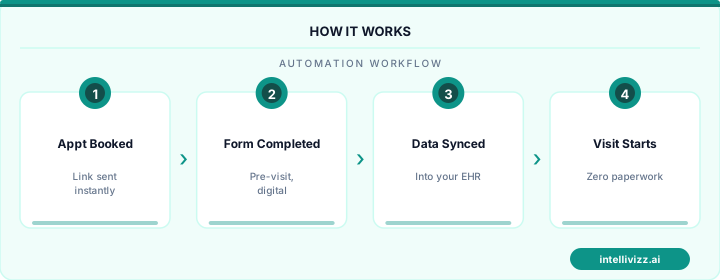
⚖️ Every missed call could be a $5,000+ case
From manual processes to automated excellence
The Automated Intake Stack
A complete law firm intake automation stack combines: website lead capture (chat + forms), AI phone answering for after-hours and overflow calls, automated intake form delivery and tracking, conflict check automation, e-signature for retainer agreements, PMS integration for matter creation, and automated follow-up sequences for leads who don't convert immediately.
The firms that invest in this infrastructure see dramatic improvements: 40-60% faster intake, 25-35% higher conversion rates, and significant reductions in administrative overhead. In a competitive legal market, speed and professionalism at intake are often the deciding factors in who wins the client.
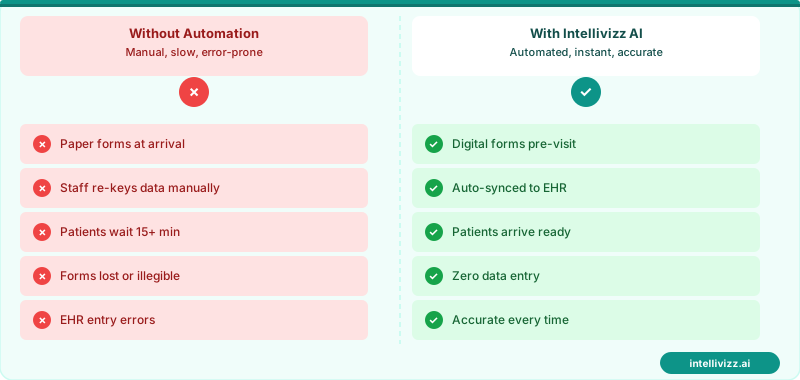
⚖️ The intake process is your first client experience — make it effortless.
Smart intake software converts inquiries into signed retainers faster.
Intake Automation Beyond the Form
Most legal intake software stops at the form — collect the information, populate a spreadsheet, and hand it to a paralegal. But the real leverage is in what happens next: instant conflict checks against your existing client database, automated scheduling of a consultation call, and a pre-consultation packet sent to the prospective client before they hang up the phone. Firms that automate these downstream steps report 40–60% shorter time-to-retainer compared to manual processes.
The consultation scheduling step is particularly high-value. Every hour between a prospective client's initial contact and their scheduled consultation is an hour in which a competitor can close them. Intake software that books the consultation in real time — at the moment of inquiry — closes that window entirely.
What to Look For in Legal Intake Software
Not all intake platforms are built with law firms in mind. Beyond basic form collection, evaluate platforms against these criteria specific to legal practice:
- Conflict-of-interest screening: Automated cross-reference against existing client records
- Jurisdiction-specific intake fields: Configurable by practice area (PI, family, criminal, business)
- E-signature integration: Retainer agreements signed in the same flow as intake
- HIPAA and attorney-client privilege considerations: Data storage and transmission standards
- CRM sync: Push intake data to your practice management system without re-entry
"We cut our average intake-to-retainer time from 4.2 days to 18 hours. Most of that gain came from automating the consultation scheduling step — prospective clients now book before they hang up." — Managing partner, personal injury firm
For firms looking to improve response speed more broadly, see how speed-to-lead automation applies to legal lead management.
Ready to grow your firm with automation? Explore our professional services automation solutions, Legal Case Status Update Automation: End the #1 Bar..., or Law Firm Client Onboarding Automation: From Signed....
Relevant AI Automations
AI Review Management
All-in-one review management: automated review requests, AI-powered responses, and review repurposing for web & social — 3 engines in 1.
Missed Call Text-Back for New Prospects
When a prospective client calls but no one answers, the system instantly sends an SMS within 60 seconds offering to sche
Missed Call AI Text-Back
Instantly respond to every missed call with AI-powered SMS, capturing leads 24/7