
Portfolio Company Reporting Automation: Get Accurate Data Without Chasing CFOs
The Quarterly Reporting Nightmare
Every quarter, private equity operating teams face the same grind: email portfolio company CFOs requesting financials, follow up when reports are late, reconcile inconsistent formats, spot-check numbers, compile everything into a standardized format, and deliver to the investment committee — often days behind schedule. For a firm with 15-20 portfolio companies, this process consumes 40-60 hours per reporting cycle.
The manual approach doesn't just waste time — it introduces risk. Inconsistent reporting formats make comparison difficult. Late submissions delay investment decisions. Manual data entry creates errors that undermine confidence in the numbers. And the operating team spends so much time on data collection that they have little bandwidth for the value-creation work that actually moves EBITDA.
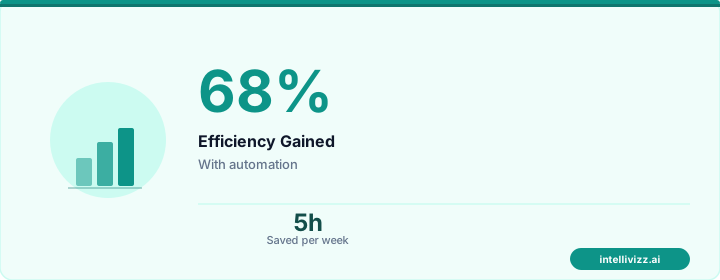
📊 Portfolio visibility drives better outcomes
From manual processes to automated excellence
What Automated Portfolio Reporting Looks Like
Standardized Data Collection
Automated platforms provide portfolio companies with standardized templates or direct system integrations that pull financial data automatically:
- Direct accounting integration: Connect to QuickBooks, NetSuite, Sage, or other portfolio company accounting systems to pull financials automatically
- Standardized web portals: Portfolio company CFOs input KPIs through a structured form — same format every time, validated on entry
- Template automation: Pre-formatted Excel templates with validation rules that reject incomplete or inconsistent submissions
- API connections: For larger portfolio companies with ERP systems, direct API feeds eliminate manual reporting entirely
Automated Reminders and Escalation
The system handles the follow-up that currently consumes hours of team time:
- Automated reminders at T-14, T-7, T-3, and T-1 days before the reporting deadline
- Escalation to the deal partner when a portfolio company misses the deadline
- Dashboard showing submission status across all portfolio companies in real time
- Historical tracking of reporting timeliness by company (identifying chronic late reporters)
Data Validation and Consolidation
Once data arrives, automation handles quality control:
- Automatic validation against prior periods (flag changes exceeding defined thresholds)
- Cross-check calculations (does revenue minus COGS equal gross profit?)
- Consolidation into standardized fund-level reports
- Trend analysis and variance commentary generation
Key Metrics to Automate
The most impactful reporting automation covers both financial and operational KPIs:
| Category | Metrics |
|---|---|
| Financial | Revenue, EBITDA, gross margin, net income, cash balance, debt levels, capex |
| Operational | Headcount, customer count, churn rate, pipeline value, NPS, utilization |
| Growth | MoM/YoY revenue growth, customer acquisition cost, LTV, sales velocity |
| Risk | Covenant compliance, cash runway, customer concentration, key person dependency |
Integration with LP Reporting
Portfolio company data feeds directly into LP investor relations reporting, creating an end-to-end automated pipeline: portfolio company → fund-level consolidation → LP quarterly report. This eliminates the double-handling that occurs when operating teams compile portfolio data manually and then IR teams reformat it for LP consumption.
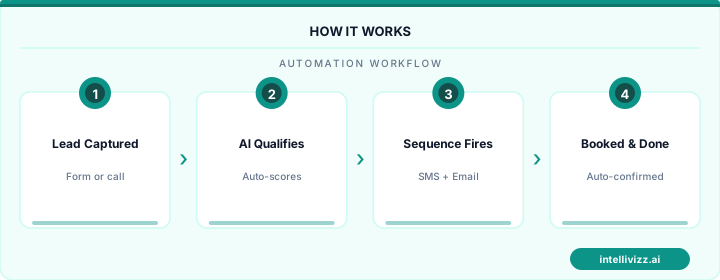
📊 Portfolio visibility drives better outcomes
See how automation transforms industry operations
The Portfolio Reporting Maturity Model
Not every portfolio company is ready for the same level of automation. The reporting maturity model helps PE firms assess where each company stands and what's achievable:
| Level | Stage | Characteristics | Automation Approach | Time to Report |
|---|---|---|---|---|
| 1 | Manual / Ad Hoc | Spreadsheets emailed monthly, no standard format, CFO is a one-person show | Structured templates with validation | 30-45 days |
| 2 | Standardized | Consistent templates, defined KPIs, basic accounting software (QuickBooks) | Web portal submission + auto-validation | 20-30 days |
| 3 | Integrated | ERP/NetSuite in place, structured chart of accounts, dedicated controller | API-based auto-pull + exception alerts | 10-15 days |
| 4 | Fully Automated | Real-time data warehouse, automated consolidation, self-serve dashboards | Continuous reporting with real-time KPI feeds | 3-5 days |
Most PE portfolios have a mix: 1-2 companies at Level 3-4, the majority at Level 2, and a few stragglers at Level 1. The automation strategy should meet each company where it is, not force a one-size-fits-all approach.
Data Quality Scorecard
Before automating report consolidation, assess the data quality coming from each portfolio company. Garbage in, garbage out applies doubly to automated systems:
📋 Portfolio Company Data Health Check
| Dimension | Question | Red Flag | Score (1-5) |
|---|---|---|---|
| Timeliness | Do financials close within 15 days of month-end? | Consistently late by 30+ days | ___ |
| Completeness | Are all required KPIs reported each period? | Missing 3+ KPIs regularly | ___ |
| Accuracy | Do submitted numbers reconcile without adjustments? | Restatements every quarter | ___ |
| Consistency | Is the chart of accounts stable period-over-period? | Categories change frequently | ___ |
| Granularity | Is data available at the needed level of detail? | Only top-line summaries available | ___ |
Scoring: 20-25 = Ready for API integration | 15-19 = Portal submission with validation | 10-14 = Structured templates needed | Below 10 = Requires finance function remediation first For a deeper dive into dashboard design and data collection, see our guide on PE portfolio company KPI dashboards.
Five Portfolio Reporting Pitfalls (and How to Avoid Them)
- Automating bad data: Connecting to a portfolio company's accounting system before their chart of accounts is standardized means automated reports will be consistently wrong — faster. Always remediate data quality before building integrations.
- Over-engineering KPIs: Requesting 50+ metrics from a 30-person company with one bookkeeper guarantees non-compliance. Start with 8-12 core metrics and expand as the company matures.
- Ignoring the CFO experience: If the reporting portal is harder to use than email, portfolio company CFOs will revert to sending spreadsheets. Invest in UX for the submission interface.
- No feedback loop: When the operating team spots an error, the correction should flow back to the portfolio company with specific guidance — not just a "please fix and resubmit" email.
- Treating all companies equally: A $500M revenue platform company and a $10M bolt-on acquisition have vastly different reporting capabilities. The maturity model above ensures the right approach for each.
Implementation Approach
- Month 1: Audit current reporting processes and data sources across all portfolio companies
- Month 2: Configure standardized templates and deploy the reporting portal
- Month 3: Onboard portfolio companies with training and parallel reporting (old + new process)
- Quarter 2: Full automation with direct integrations for the most data-mature companies
The AI readiness assessment framework helps identify which portfolio companies are ready for direct integration versus which need the structured template approach first.
ROI for PE Firms
- Time savings: 40-60 hours/quarter → 8-12 hours/quarter per fund
- Timeliness: Reports delivered 10-15 days earlier per cycle
- Accuracy: Data errors reduced 90%+ through automated validation
- Scalability: Same team can manage 2-3x more portfolio companies
- Decision speed: Investment committee gets actionable data faster, enabling quicker interventions
Data Governance and Regulatory Compliance in Portfolio Reporting
Portfolio company reporting automation in private equity must address data governance requirements that extend far beyond dashboard visualization. The regulatory and audit landscape imposes structural constraints on how financial data flows from portfolio companies to fund-level consolidation — constraints that dashboard tools alone cannot satisfy.
Audit trail compliance demands that every data point in a portfolio report be traceable to its source document, transformation logic, and approval chain. SOX reporting requirements — applicable when portfolio companies are publicly traded or when the PE fund itself has public investors — mandate that financial data maintain an unbroken chain of custody from the general ledger entry to the consolidated report. Automated reporting systems must log every data extraction timestamp, every formula applied, every manual override entered by a controller, and every approval granted by a CFO or fund accountant. Without this granular audit trail, external auditors from firms like Deloitte, PwC, or KPMG will issue qualified opinions that erode LP confidence.
Data lineage mapping provides the structural backbone for audit compliance. Each metric in a portfolio report — revenue, EBITDA, net working capital, capex — must be traceable through a documented lineage that specifies the source system (QuickBooks, NetSuite, SAP, or a bespoke ERP), the extraction method (API pull, SFTP file drop, manual upload), any transformation rules applied (currency conversion, pro-rata allocation, normalization adjustments), and the final destination field in the consolidated report. Automated lineage documentation eliminates the manual spreadsheet-mapping exercises that consume 20-30 hours per portfolio company per reporting cycle.
Multi-entity consolidation rules introduce complexity that single-company reporting never encounters. A PE fund holding 12 portfolio companies across 4 countries must apply entity-specific chart-of-account mappings, segment-level eliminations, and reporting-hierarchy roll-ups. Intercompany elimination entries — removing revenue recognized by Company A for services sold to Company B when both are owned by the same fund — require automated matching of intercompany receivables and payables, identification of mismatches, and generation of elimination journal entries. Failure to automate intercompany eliminations is the single most common source of material misstatement in PE fund reporting.
Currency translation methodology introduces another layer of governance complexity. Portfolio companies reporting in EUR, GBP, CAD, or BRL must be translated to the fund's reporting currency (typically USD) using the correct exchange rate methodology: current-rate method for balance sheet items, average-rate method for income statement items, and historical-rate method for equity accounts. The choice between temporal and current-rate methods depends on the functional currency determination for each entity. Automated reporting systems must apply the correct methodology per entity, source exchange rates from a reliable feed (European Central Bank, Federal Reserve, or a commercial provider like Xe or OANDA), and calculate cumulative translation adjustments (CTA) that flow through other comprehensive income on the consolidated balance sheet.
Minority interest calculation — required when the fund holds less than 100% of a portfolio company — demands precise allocation of earnings, dividends, and equity adjustments between the controlling interest (the fund) and non-controlling interests (co-investors, management holdcos, or rollover equity holders). Automated reporting must track ownership percentages per entity, apply them to each line item in the financial statements, and generate the minority interest footnote disclosures required under ASC 810 or IFRS 10. When ownership percentages change mid-period due to follow-on investments, management equity vesting, or co-investor exits, the calculation becomes a waterfall that manual spreadsheets handle poorly and automated systems handle reliably.
Ready to leverage AI across your portfolio? Explore our private equity automation solutions.
Relevant AI Automations
Investor Relations Automation Suite
Transform LP communications from weeks of work to one click
AI Voice Agent — Investor & Deal Source Receptionist
AI voice agent answers inbound calls from LPs, deal sources, and founders 24/7 — captures intent, qualifies the caller, and books follow-up calls automatically
Portfolio Company Reporting Bot
Automate quarterly data collection from portfolio companies