
AI Readiness Assessment for Private Equity: Evaluate Portfolio Companies Before You Invest in AI
Why AI Readiness Matters for PE
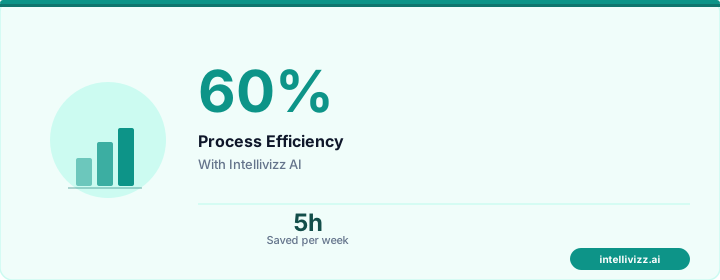
Private equity firms are increasingly looking to AI as a value creation lever for portfolio companies. The logic is compelling: automate operations, reduce headcount costs, improve decision-making, and boost EBITDA ahead of exit. But the reality is messier — 60% of AI implementations fail to deliver expected ROI, often because the portfolio company wasn't ready for AI in the first place.
A structured AI readiness assessment prevents these failures by evaluating whether a portfolio company has the data, processes, talent, and culture needed to benefit from AI — before committing capital to implementation.
📊 Portfolio visibility drives better outcomes
The data speaks for itself
The AI Readiness Framework
Dimension 1: Data Maturity (30% of Score)
AI is only as good as the data it's trained on. Assess:
- Data availability: Does the company have digital records for the processes you want to automate? Paper-heavy operations need digitization before AI.
- Data quality: Are records accurate, complete, and consistent? Garbage in, garbage out applies doubly to AI.
- Data accessibility: Is data trapped in siloed systems, or can it be extracted and integrated? Legacy ERP systems with no API are a red flag.
- Historical depth: Most AI models need 12-24 months of historical data. New companies or recently migrated systems may lack sufficient training data.
- Data governance: Are there policies for data quality, access, and privacy? Regulated industries (healthcare, finance) have additional requirements.
Dimension 2: Process Maturity (25% of Score)
AI automates processes — but only well-defined ones. Assess:
- Process documentation: Are workflows documented, or does institutional knowledge live in employees' heads?
- Process standardization: Are processes consistent across locations, departments, and staff members?
- Decision rules: Can business decisions be expressed as rules or criteria? Highly subjective processes are harder to automate.
- Volume and frequency: AI delivers the most value on high-volume, repetitive processes. Low-volume, one-off tasks rarely justify AI investment.
Dimension 3: Technology Infrastructure (20% of Score)
- Cloud readiness: Cloud-based systems are easier to integrate with AI tools. On-premise legacy systems add complexity and cost.
- API availability: Can existing systems exchange data programmatically? Integration is the #1 cost driver in AI implementations.
- Security posture: AI systems need access to potentially sensitive data. Does the company have adequate security controls?
- IT capacity: Does the company have IT staff who can support implementation, or will the PE firm need to provide technical resources?
Dimension 4: Organizational Readiness (15% of Score)
- Leadership buy-in: Does the CEO/management team view AI as a priority, or is this being pushed top-down by the PE firm?
- Change management capacity: Has the company successfully implemented technology changes before?
- Talent: Are there employees who can champion and manage AI tools, or does the company lack technical sophistication?
- Culture: Is the organization data-driven or intuition-driven? Culture change is the slowest variable.
Dimension 5: Use Case Viability (10% of Score)
- Clear ROI path: Can you quantify the expected savings or revenue impact?
- Implementation timeline: Will AI deliver value within the PE firm's typical hold period (3-5 years)?
- Vendor availability: Are there proven AI solutions for this company's industry and use cases?
- Competitive pressure: Are competitors already using AI, creating urgency to adopt?
Scoring and Prioritization
Rate each dimension on a 1-5 scale:
| Score | Meaning | Action |
|---|---|---|
| 4.0-5.0 | AI-ready | Proceed with implementation; prioritize highest-ROI use cases |
| 3.0-3.9 | Nearly ready | Address gaps (usually data quality or integration) before full AI rollout |
| 2.0-2.9 | Significant gaps | Invest in foundation (digitization, process standardization) first; AI in 12-18 months |
| 1.0-1.9 | Not ready | Focus on operational basics; AI is premature and will waste capital |
Common AI Use Cases by Portfolio Company Type
- Healthcare practices: Patient scheduling, phone automation, billing, and recall — high readiness in most modern practices
- Professional services: Client intake, CRM automation, document processing — moderate readiness, often limited by legacy systems
- Manufacturing: Predictive maintenance, quality control, supply chain optimization — high data availability but integration complexity
- Retail/hospitality: Demand forecasting, inventory, customer communication — generally high readiness with modern POS systems
📊 Portfolio visibility drives better outcomes
Smart technology, better results
The Assessment Process
- Pre-assessment (1 week): Collect documentation — system inventory, process maps, data architecture, org chart
- On-site assessment (2-3 days): Interview leadership, department heads, and front-line staff. Review systems. Observe processes.
- Scoring and analysis (1 week): Rate each dimension, identify gaps, and estimate remediation timelines and costs
- Recommendations (deliverable): Prioritized roadmap with recommended AI use cases, prerequisites, estimated ROI, and implementation timeline
Integrating the AI readiness assessment into your broader AI due diligence process ensures that technology investments are grounded in reality rather than hype — protecting fund returns and setting portfolio companies up for genuine AI-driven value creation.
📊 AI adds portfolio value — but only if your infrastructure is ready to support it.
Assess before you invest. Readiness determines return.
The Data Infrastructure Question PE Firms Miss
Most AI readiness frameworks focus on organizational culture and leadership buy-in — important factors, but secondary to the more fundamental question: is the data infrastructure ready? AI systems require clean, accessible, consistently structured data. Portfolio companies that have consolidated their operational data into a unified system (CRM, ERP, or data warehouse) are AI-ready. Companies with data scattered across spreadsheets, siloed software, and paper records are not — regardless of how enthusiastic their leadership team is about AI adoption.
The pre-acquisition diligence process should now include a data infrastructure audit alongside the standard financial and legal review. A company with $10M revenue and a clean data infrastructure is worth more than a $12M revenue company with fragmented data — because the former can compound returns through AI far faster than the latter.
Scoring Portfolio Companies for AI Readiness
A practical AI readiness scorecard for PE portfolio reviews should evaluate five dimensions: (1) data consolidation, (2) process documentation, (3) integration capability of existing software, (4) staff technical aptitude, and (5) leadership AI fluency. Score each dimension 1–5. Companies scoring below 12 out of 25 need infrastructure work before AI deployment. Companies scoring 18+ can begin AI projects within 90 days of acquisition.
| Readiness Dimension | Weight | What to Assess |
|---|---|---|
| Data consolidation | 30% | Single source of truth vs. fragmented systems |
| Process documentation | 20% | SOPs exist and are followed consistently |
| Software integration capability | 25% | API access, webhook support, modern stack |
| Staff technical aptitude | 15% | Comfort with new software, training capacity |
| Leadership AI fluency | 10% | Ability to set AI strategy and resource appropriately |
For a broader perspective on AI deployment across business types, see our guide to business workflow automation with AI.
Ready to leverage AI across your portfolio? Explore our private equity automation solutions, or read our guide to PE Portfolio Company KPI Dashboard: Design, Data....
Relevant AI Automations
Investor Relations Automation Suite
Transform LP communications from weeks of work to one click
AI Voice Agent — Investor & Deal Source Receptionist
AI voice agent answers inbound calls from LPs, deal sources, and founders 24/7 — captures intent, qualifies the caller, and books follow-up calls automatically
Portfolio Company Reporting Bot
Automate quarterly data collection from portfolio companies