
Waitlist Management for Medical Offices: Turn Cancellations into Revenue Instead of Empty Chairs
The Cancellation Revenue Problem
When a patient cancels, your practice has minutes — not hours — to fill that slot. Yet most medical offices still manage waitlists with paper lists, sticky notes, or spreadsheets that require manual phone calls to work through. By the time staff reach the third or fourth patient on the list, the slot has passed.
The economics are straightforward: each unfilled cancellation slot costs $200-$500 in lost revenue, and the average practice has 3-5 cancellations per provider per day. That's $150,000-$500,000 annually walking out the door — not because patients don't want the appointment, but because the administrative process can't move fast enough.
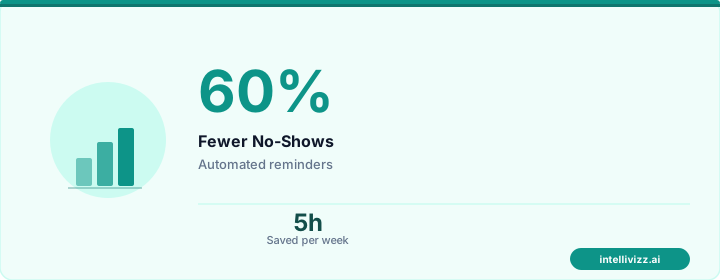
🏥 Patients expect instant responses — automation delivers
Smart technology, better results
Why Manual Waitlist Management Fails
The traditional waitlist workflow has fatal inefficiencies:
- Cancellation comes in by phone — staff notes the opening
- Staff locates the waitlist (paper, spreadsheet, or sticky note)
- Staff calls the first patient — reaches voicemail, leaves message
- Staff calls the second patient — answers but can't make that time
- Staff calls the third patient — doesn't answer
- 15-20 minutes have passed; staff gets pulled to another task
- The slot goes unfilled
This process fills only 10-15% of cancelled slots. The failure isn't the staff — it's the medium. Phone calls are inherently slow, sequential, and dependent on the other person answering at the exact right moment.
How Automated Waitlist Management Works
Automated systems flip the process from push (staff calling patients) to pull (patients self-selecting):
- Cancellation detected — either through the scheduling system or when staff marks the slot as open
- Instant notification — within 60 seconds, all eligible waitlisted patients receive a text: "An opening on [date] at [time] with Dr. [name] just became available. Reply YES to claim it."
- First responder wins — the first patient to reply YES is automatically booked into the slot. Others receive "Sorry, this slot has been filled."
- Confirmation sent — the booked patient receives appointment details, preparation instructions, and calendar integration
The entire process takes 2-5 minutes with zero staff involvement. And because text messages have a 98% open rate and 90-second average response time, waitlisted patients respond fast.
Results: What Medical Offices Actually Achieve
Practices using automated waitlist management consistently report:
- 40-60% of cancelled slots filled (vs 10-15% with manual processes)
- Average fill time of 8 minutes from cancellation to new booking
- Zero additional staff time required per cancellation
- Revenue recovery of $80,000-$200,000 annually per provider
- Patient satisfaction increase — waitlisted patients appreciate faster access
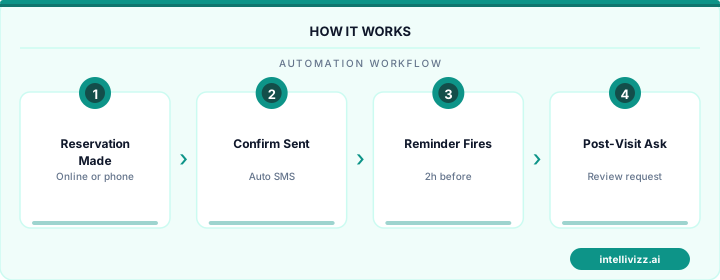
🏥 Patients expect instant responses — automation delivers
The data speaks for itself
Building an Effective Waitlist Strategy
Capture Waitlist Patients at Every Touchpoint
Don't wait for patients to ask. Train staff to offer waitlist placement whenever the next available appointment is more than 2 weeks out: "The next opening with Dr. Smith is March 28th. Would you like me to add you to the waitlist in case something opens sooner?" Practices that actively offer waitlist placement maintain lists 3-5x larger than those that wait for patient requests.
Segment by Flexibility
Not all waitlisted patients are equally flexible. Capture preferences when adding patients:
- Any time, any day — these patients fill 60% of openings
- Specific days only — match them to same-day cancellations
- Mornings or afternoons only — reduce unnecessary notifications
- Specific provider only — don't notify them for other providers' openings
Pair with No-Show Prevention
The most effective approach combines no-show prevention with waitlist backfill. Automated reminders that include a "Need to reschedule?" option give patients an easy path to cancel formally — triggering the waitlist fill process earlier, when fill rates are highest (48+ hours notice vs day-of).
Integration with Existing Systems
Modern waitlist platforms integrate with major practice management systems and EHRs. The integration enables:
- Automatic detection of cancelled or no-show appointments
- Direct scheduling into the PMS without manual rebooking
- Insurance eligibility verification for waitlisted patients before booking
- Automatic generation of pre-visit paperwork for newly booked patients
Practices already using an AI receptionist often find that waitlist management is included or easily added, creating a unified scheduling ecosystem where every cancellation automatically triggers a backfill attempt.
Specialty-Specific Considerations
Different specialties have different waitlist dynamics:
- Dermatology — Long original wait times mean large waitlists; fill rates are among the highest at 55-65%
- Primary Care — Shorter wait times but higher daily cancellation volume; automation saves the most staff time here
- Surgical specialties — Longer appointments mean each unfilled slot has higher revenue impact ($500-$1,500); even modest fill rate improvements are high-value
- Pediatrics — Parent schedules are complex; offering multiple time alternatives rather than a single slot improves fill rates 20%
Frequently Asked Questions
What if multiple patients respond YES at the same time?
Automated systems use first-come-first-served logic with millisecond precision. The first YES response gets the slot; subsequent responders are told the slot was filled and remain on the waitlist for future openings.
Should I remove the waitlist option for same-day openings?
No — same-day fills are lower (20-30%) but still valuable. Many patients, especially retirees and remote workers, can come in with short notice. The automation handles it instantly, so there's no staff cost to attempting the fill.
Does automated waitlist management reduce no-shows for the backfilled appointment?
Yes. Waitlisted patients who self-select into an opening have a no-show rate of only 3-5%, compared to 18-25% for standard appointments. They're highly motivated — they wanted an earlier slot and actively chose it.
Advanced Waitlist Optimization Techniques
Basic waitlist management fills some cancelled slots. Advanced optimization maximizes fill rates, matches patients to ideal appointment types, and turns your waitlist into a predictable revenue recovery channel. These techniques separate reactive practices from proactive ones.
Priority Scoring Algorithms
Not every waitlisted patient should receive the same priority when a slot opens. Build a scoring model that weights factors like time on the waitlist, appointment urgency, revenue value of the visit type, and patient reliability history. A patient who has been waiting three weeks for a high-value procedure and has zero prior no-shows should receive the offer before someone added yesterday for a routine check-up. Automated scoring eliminates the front desk guesswork that often defaults to whoever picks up the phone first, rather than who represents the best operational and financial fit.
Same-Day Fill Rate Targets
Set a concrete target for same-day cancellation backfill — best-in-class practices achieve 70-80 percent fill rates for cancellations that occur with at least two hours notice. Track this metric weekly and investigate dips immediately. Common failure points include notification delays, overly narrow candidate pools, and cumbersome confirmation workflows that require patients to call back. Shorten the response window by using two-way SMS that lets patients claim a slot with a single reply, and expand your candidate pool by including patients from related appointment types.
Pairing your waitlist with cancellation backfill automation ensures slots are offered within minutes of a cancellation, dramatically increasing your fill rate.
Patient Preference Matching Systems
Sophisticated waitlist systems capture more than just "any available slot." Record each patient's preferred days, time ranges, providers, and locations. When a cancellation matches a patient's preferences, the acceptance rate jumps from roughly 30 percent to over 65 percent because you are offering something they actually want. This preference data also reveals scheduling demand patterns — if 40 patients prefer Tuesday mornings but you only have three Tuesday morning slots, that signals a template redesign opportunity.
For more on reducing empty chairs, explore our guide on reducing no-shows at your medical practice or learn about automated cancellation backfill workflows.
Ready to modernize your practice? Explore our healthcare automation solutions, or read our guide to AI Appointment Scheduling for Medical Offices: Beyond....