
Voice AI Agents: The Complete Guide to Automating Business Phone Calls
The telephone remains one of the most important channels for small and mid-size businesses. Potential customers call to ask about services, book appointments, request quotes, and resolve issues. Yet for many businesses, answering every call promptly is a persistent challenge. Staff get pulled into meetings. After-hours calls go to voicemail. Peak periods overwhelm the front desk. Each missed call is a missed opportunity that often goes to a competitor who picks up faster.
Voice AI agents are changing this equation. These intelligent systems answer phone calls in a natural, conversational manner, handle routine inquiries, book appointments directly into your calendar, qualify leads based on your criteria, and transfer complex calls to the right team member. They operate around the clock, never take a sick day, and maintain a consistently professional tone.
This guide covers everything you need to know about Voice AI agents: how they work, what they can do, how much they cost, and how to determine if this technology is the right fit for your business.
How Voice AI Agents Work
A Voice AI agent combines several technologies to simulate a natural phone conversation. At its core, the system uses automatic speech recognition to convert the caller's spoken words into text. That text is then processed by a large language model, which understands the intent behind the caller's words and generates an appropriate response. Finally, text-to-speech technology converts the response back into natural-sounding spoken audio and delivers it to the caller in real time.
Modern Voice AI agents handle the full complexity of real conversations. They understand accents, manage interruptions, ask clarifying questions, and adapt their responses based on context. A caller asking to reschedule an appointment gets a different conversational flow than one asking about pricing for a specific service.
What Voice AI Agents Can Do for Your Business
The capabilities of today's Voice AI agents extend far beyond simple auto-attendant menus. Here are the most common and high-value use cases.
Inbound Call Answering and Routing
The most immediate benefit is eliminating missed calls. A Voice AI agent answers every call within two rings, greets the caller by name if they are in your CRM, and routes them to the appropriate department or team member. For calls that do not require a human, the agent handles the entire interaction independently.
Appointment Scheduling and Rescheduling
Voice AI agents integrate directly with your calendar and booking system. A patient calling a dental practice can book their next cleaning without ever speaking to a receptionist. See how an AI receptionist for dental offices handles appointment booking, insurance questions, and after-hours calls. A homeowner calling a real estate agent can schedule a showing for the next available time slot. The agent checks availability in real time, confirms the appointment, and sends a confirmation via text message or email. Combined with smart reminder sequences, this approach can dramatically reduce patient no-shows in medical practices.
Lead Qualification
Not every caller is a qualified prospect. Voice AI agents can ask a series of qualifying questions, such as budget range, timeline, location, or specific service needs, and score the lead based on your criteria. High-value leads get transferred to a salesperson immediately. Lower-priority inquiries receive a follow-up email or text with relevant information.
After-Hours and Overflow Handling
During business hours, the AI agent can serve as a first responder that handles routine calls and transfers complex ones to your team. After hours, it becomes your virtual receptionist, ensuring that no call goes unanswer
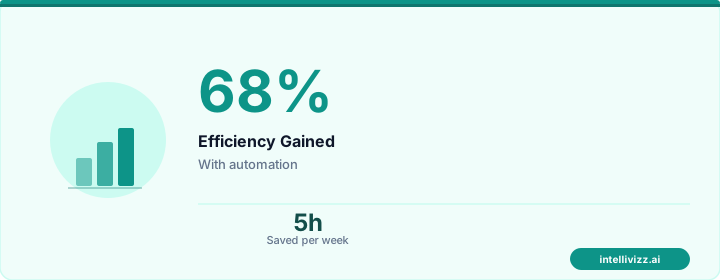
💡 Automation handles the routine — you handle the growth
See how automation transforms industry operations
ed. Callers receive immediate assistance rather than a generic voicemail message, and urgent matters can trigger real-time notifications to on-call staff.
Outbound Call Campaigns
Voice AI is not limited to answering calls. Businesses use outbound Voice AI agents to confirm upcoming appointments, follow up with leads who submitted web forms, conduct satisfaction surveys, and re-engage dormant customers. These campaigns run at scale, making hundreds or thousands of calls in the time it would take a human team to make a dozen.
Industry-Specific Applications
Different industries leverage Voice AI in ways tailored to their unique needs.
In healthcare, Voice AI agents handle appointment booking, prescription refill requests, insurance verification questions, and after-hours triage routing. HIPAA-compliant AI receptionist implementations ensure that patient data is handled securely throughout the conversation.
In real estate, agents answer property inquiries, schedule showings, collect buyer preferences, and provide basic listing information. The AI can handle multiple calls simultaneously during a new listing launch when inquiry volume spikes. Real estate teams use voice AI to capture every lead — see our AI receptionist for real estate guide.
In professional services, law firms, accounting practices, and consulting fi
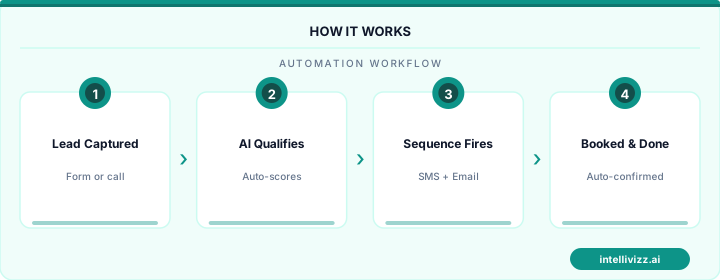
💡 Automation handles the routine — you handle the growth
From manual processes to automated excellence
rms use Voice AI to screen potential clients, collect intake information, and schedule consultations. This frees up skilled professionals to focus on billable work rather than administrative phone duties.
In hospitality, hotels and restaurants use Voice AI to handle reservation requests, answer questions about amenities and menus, and manage cancellations or modifications without tying up front desk staff. Hotels are leading adopters — learn about AI receptionists for hotels.
What It Costs
Voice AI pricing typically follows a per-minute model. Industry rates range from approximately $0.08 to $0.25 per minute of conversation, depending on the provider, features, and volume. A small business handling 50 calls per day with an average call duration of three minutes might spend $360 to $1,125 per month on Voice AI, significantly less than the salary and benefits of an additional receptionist.
The return on investment calculation is straightforward. If your average customer lifetime value is $1,000 and Voice AI helps you capture even five additional leads per month that would have otherwise gone to voicemail, the system pays for itself many times over.
How to Evaluate Whether Voice AI Is Right for You
Voice AI delivers the strongest ROI in businesses where phone calls are a primary customer touchpoint and where missed calls directly impact revenue. Ask yourself these questions.
Do you miss more than 10 percent of incoming calls? Do callers frequently reach voicemail during business hours? Does your team spend more than two hours per day on routine phone inquiries? Do you lose potential customers to competitors who respond faster?
If you answered yes to any of these, Voice AI is likely a high-impact investment.
Getting Started
Implementing a Voice AI agent does not require ripping out your existing phone system. Most solutions integrate with your current business phone number and CRM. The setup process typically involves defining your call flows, uploading your knowledge base (FAQs, services, pricing, availability), and testing the agent with sample calls before going live.
Platforms like Intellivizz offer pre-configured Voice AI workflows for specific industries, so you can deploy a fully functional phone agent in days rather than months. The system learns and improves over time as it handles more calls and you refine its responses.
The businesses that adopt Voice AI now are setting a new standard for responsiveness. When a potential customer calls and gets a knowledgeable, friendly response within seconds, any time, day or night, that experience creates a lasting impression that voicemail simply cannot match.
Ready to get started with automation? Explore our AI automation solutions, Virtual Receptionist vs AI Receptionist: Which Is..., or The Real Cost of Missed Business Calls (And How to Fix....