
AI Chatbots for Customer Service: Reduce Response Time by 90% Without Sacrificing Quality
Customer expectations have fundamentally shifted. A decade ago, a 24-hour email response was considered acceptable. Today, 82 percent of consumers expect a response within 10 minutes when they reach out to a business online. For small and mid-size businesses without dedicated support teams, meeting this expectation manually is nearly impossible. This gap between customer expectations and operational capacity is exactly where AI chatbots deliver transformative value.
Modern AI chatbots are a far cry from the scripted, menu-driven bots of five years ago. Powered by large language models, today's conversational AI understands natural language, remembers context within a conversation, and provides nuanced, helpful responses that feel remarkably human. They handle the routine so your team can focus on the complex.
This article explains how AI chatbots work, where they deliver the most value, and how to deploy one for your business without a steep learning curve.
The Evolution from Rule-Based Bots to Conversational AI
Early chatbots operated on decision trees. A user clicked a button, the bot followed a pre-defined path, and anything outside that path resulted in a dead end or a generic "I don't understand" message. These bots were frustrating for users and limited in utility.
Modern AI chatbots powered by large language models operate differently. They process the full text of a customer's message, understand the underlying intent, and generate a contextually appropriate response. If a customer types "I booked an appointment for Tuesday but I need to move it to Thursday," the AI understands that this is a rescheduling request, identifies the relevant appointment, and initiates the rescheduling flow without the customer needing to navigate a menu.
This shift from rigid rules to genuine language understanding is what makes today's chatbots effective enough to handle a significant portion of customer interactions independently.
Five Ways AI Chatbots Create Value for Your Business
The businesses seeing the strongest returns from AI chatbots deploy them in focused, high-impact scenarios rather than trying to replace all human interaction at once.
1. Instant Responses to Common Questions
Every business has a set of questions that come up repeatedly. What are your hours? Do you accept insurance? How much does a consultation cost? What areas do you serve? AI chatbots handle these inquiries instantly and accurately, drawing from a knowledge base you configure. This eliminates the friction of waiting for a human response and frees your team from answering the same questions dozens of times per day.
2. After-Hours Lead Capture
A significant percentage of website visitors arrive outside business hours. Without a chatbot, these visitors browse your site, fail to find immediate answers, and leave. An AI chatbot engages them in conversation, answers their questions, collects their contact information, and even schedules appointments. By the time your team arrives in the morning, qualified leads are waiting in your CRM with full context about what the prospect needs. For businesses where customers prefer calling over chatting, voice AI agents that automate business phone calls deliver the same 24/7 coverage for inbound calls.
3. Appointment Booking and Management
AI chatbots integrated with your scheduling system let customers book, reschedule, or cancel appointments directly through the chat interface. This is particularly valuable for healthcare practices, salons, professional service firms, and any business where appointments drive revenue. The chatbot checks real-time availability, confirms the booking, and sends reminders, all without human involvement.
4. Pre-Sales Qualification
When a potential customer visits your website and starts a conversation, the chatbot can ask qualifying questions to determine their needs, budget, and timeline. Qualified leads are either connected to a sales representative in real time or flagged for priority follow-up. This ensures your sales team spends their time on prospects most likely to convert rather than fielding exploratory inquiries that may not be a fit. Chatbots are also transforming hiring — see how recruiting chatbots automate candidate screening.
5. Post-Purchase Support and Onboarding
After a customer makes a purchase or signs up for a service, the chatbot guides them through onboarding steps, answers setup
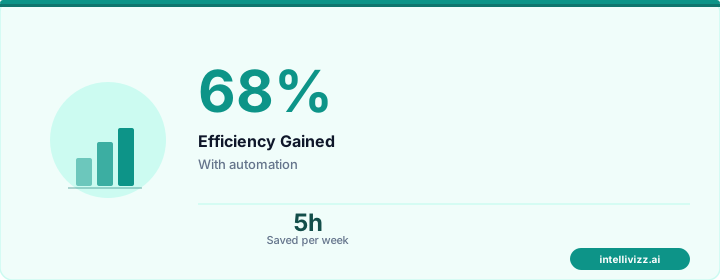
💡 Automation handles the routine — you handle the growth
See how automation transforms industry operations
questions, provides documentation links, and handles common support requests. This reduces support ticket volume and ensures customers get value from your product or service quickly, improving retention rates.
Measuring the Impact
The metrics that matter most when evaluating chatbot performance are response time, resolution rate, and customer satisfaction.
Response time drops dramatically with AI chatbots, from an average of several hours for email-based support to under 10 seconds. This speed alone has a measurable impact on conversion rates and customer satisfaction.
Resolution rate measures the percentage of conversations the chatbot handles without requiring human escalation. Well-configured chatbots in focused use cases achieve resolution rates of 70 to 85 percent, meaning only a fraction of inquiries require human attention.
Customer satisfaction, often measured through post-conversation surveys, tends to increase with chatbot deployment because customers value speed and availability. When the chatbot cannot help, it provides a warm handoff to a human agent with full conversation context, so the customer never has to repeat themselves.
Common Concerns and How to Address Them
Business owners often worry that chatbots will frustrate customers or feel impersonal. These concerns are valid when applied to the simplistic bots of the past, but modern conversational AI addresses them directly.
Will customers know they are talking to a bot
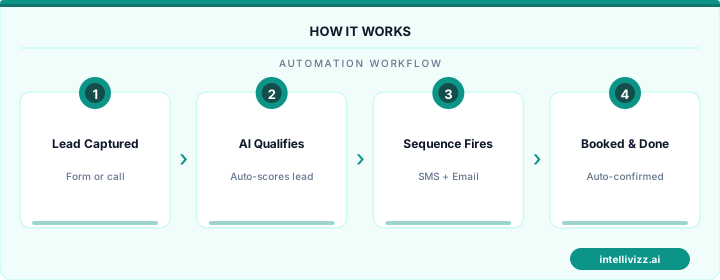
💡 Automation handles the routine — you handle the growth
From manual processes to automated excellence
? Transparency is important, and most businesses include a brief disclosure. However, customers overwhelmingly prefer an instant, helpful bot response to a delayed human one. The key is quality. If the chatbot provides accurate, relevant answers, customers are satisfied regardless of whether a human or AI is responding.
What happens when the chatbot cannot answer a question? Effective AI chatbots recognize when they have reached the limits of their knowledge and seamlessly escalate to a human agent. The conversation history transfers with the escalation, so the customer experience remains smooth.
Is it difficult to set up and maintain? With platforms designed for non-technical users, setting up an AI chatbot involves providing your business information, FAQs, and service details. The system generates a trained chatbot ready for deployment. Ongoing maintenance involves reviewing conversation logs periodically and updating the knowledge base as your business evolves.
Choosing the Right Chatbot for Your Business
When evaluating AI chatbot solutions, focus on four criteria.
First, language understanding. The chatbot must handle natural, conversational messages, not just keyword matching. Test it with messy, real-world messages to see how it performs.
Second, integrations. The chatbot should connect to your CRM, calendar, and communication tools so it can take action, not just answer questions. Booking an appointment or creating a lead record should happen automatically.
Third, customization. Your chatbot should reflect your brand voice, answer questions specific to your business, and follow conversation flows you define. A one-size-fits-all bot will not meet your customers' needs.
Fourth, analytics. You need visibility into conversation volume, resolution rates, common questions, and areas where the bot struggles. This data helps you continuously improve the chatbot's performance.
Getting Started with Intellivizz
Intellivizz provides AI chatbot automation templates tailored to specific industries, including healthcare, real estate, professional services, hospitality, and education. Each template comes pre-configured with industry-relevant conversation flows, FAQ handling, appointment booking, and lead capture capabilities.
Deployment takes days, not months. You provide your business details, customize the conversation flows, and connect your existing tools. The chatbot goes live on your website and immediately begins engaging visitors, capturing leads, and handling support inquiries.
The businesses that thrive in the next decade will be those that embrace AI automation for small business operations and meet customers where they are, when they are ready to engage, with helpful, instantaneous responses. AI chatbots make that possible at a fraction of the cost of scaling a human support team. For a comprehensive deep dive, read our complete customer service chatbot guide.
Ready to get started with automation? Explore our Speed to Lead Automation: Why Responding in 5 Minutes....