
AI Receptionist for Law Firms in Washington, DC: Never Miss a Client Call Again
The Missed Call Problem for DC Law Firms
Washington, DC is one of the most competitive legal markets in the country, with over 55,000 active attorneys in the metro area. When a potential client calls your firm and gets voicemail, they don't leave a message — they call the next firm on Google. At stake: consultations worth $5,000-$50,000+ in legal fees, lost to a $0.35 missed phone call.
The problem is structural. DC law firms operate during business hours, but client calls peak during lunch (when staff is eating), after 5 PM (when working clients finally have a free moment), and weekends (when clients have time to address personal legal matters). These high-value calling windows coincide exactly with your lowest staffing levels.
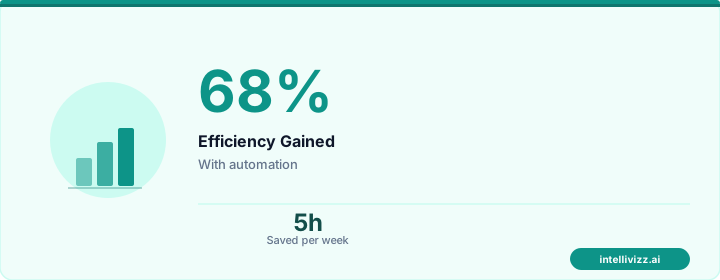
⚖️ Every missed call could be a $5,000+ case
The data speaks for itself
How AI Receptionists Serve DC Law Firms
An AI receptionist for law firms answers every call on the first ring with a professional greeting customized to your firm, then handles the interaction with practice-area intelligence:
Client Intake
- Captures caller name, contact information, and nature of legal need
- Asks qualifying questions specific to your practice areas (personal injury: when/where did the incident occur? Family law: are you seeking divorce, custody, or both?)
- Screens for conflicts of interest using configurable filters
- Determines urgency — distinguishing "I need to file before a deadline" from "I'm exploring options"
Consultation Scheduling
- Accesses your calendar in real time and offers available consultation slots
- Confirms bookings with automated confirmation texts and emails
- Sends pre-consultation questionnaires to gather additional case details before the meeting
- Sends reminder sequences to reduce consultation no-shows
Practice Area Routing
For firms with multiple practice areas, AI routes calls intelligently:
- Immigration matters → immigration team calendar and intake questions
- Real estate closings → real estate paralegal's schedule
- Litigation inquiries → senior associate for screening
- Existing client matters → routed to assigned attorney with case context
DC-Specific Advantages
Multilingual Capability
DC's international population requires multilingual intake. AI receptionists handle 40+ languages — particularly valuable for immigration, international business, and family law practices serving DC's diverse communities (Spanish, French, Amharic, Mandarin, Vietnamese).
Government Client Sensitivity
Many DC clients are government employees or contractors with security clearance concerns. AI systems maintain strict confidentiality, never share information between calls, and can be configured with enhanced privacy protocols for sensitive matters.
Extended Hours Coverage
DC's working culture means potential clients are often available only before 8 AM or after 7 PM. AI provides true 24/7 coverage, capturing calls from Senate staffers working late, military families calling from overseas time zones, and corporate clients dealing with weekend emergencies.
ROI for DC Law Firms
The financial case is straightforward:
- Average DC law firm receives 30-50 calls/day
- 30-35% are missed or go to voicemail
- Of those, 40% are potential new clients
- Average new client value: $8,000-$25,000
- Monthly missed client revenue: $15,000-$75,000
- AI receptionist cost: $300-$800/month
- ROI: 20-100x
Even capturing one additional client per month from previously missed calls more than pays for the entire system. Firms in the K Street corridor, Georgetown, and Dupont Circle areas — where client acquisition costs are highest — see the strongest returns.
DC firms also using AI to get more clients and automated client intake software create a comprehensive pipeline from first call through signed retainer, minimizing loss at every stage.
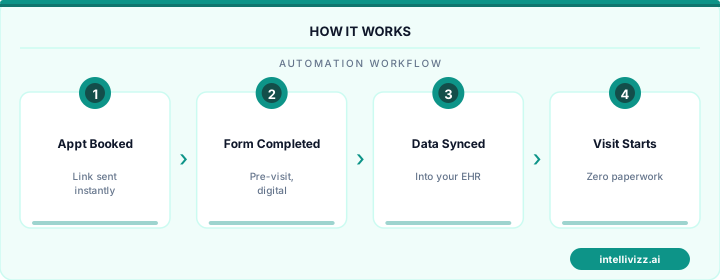
⚖️ Every missed call could be a $5,000+ case
Smart technology, better results
DC's Legal Market: Practice Area Dynamics and Client Expectations
Washington, DC's legal market is unlike any other in the United States. The presence of the federal government, regulatory agencies, and international organizations creates a unique concentration of practice areas: administrative law, government contracts, lobbying and public policy, immigration, and international trade — in addition to the standard mix of litigation, real estate, corporate, family, and criminal law. Each practice area attracts a distinct client profile with different communication expectations and urgency levels.
Government contractors and corporations dealing with regulatory matters expect enterprise-grade responsiveness — they're accustomed to calling outside business hours and reaching a person or intelligent system. Immigration clients, particularly those facing removal proceedings or visa denials, may call in a state of high distress and need to reach someone immediately. Family law clients facing divorce or custody disputes are emotionally volatile and require a combination of empathy and efficiency in initial contact. Criminal defense clients may call from detention facilities or in the immediate aftermath of an arrest — situations where after-hours availability is not optional, it's essential to the representation.
The DC bar has a particular concentration of BigLaw firms, boutique firms, and solo practitioners. BigLaw firms have large receptionist and intake staff. Boutiques and solos — which represent the majority of DC law firms by number — frequently struggle with call coverage, particularly when attorneys are in court, depositions, or client meetings. This is the gap that AI receptionists fill most effectively.
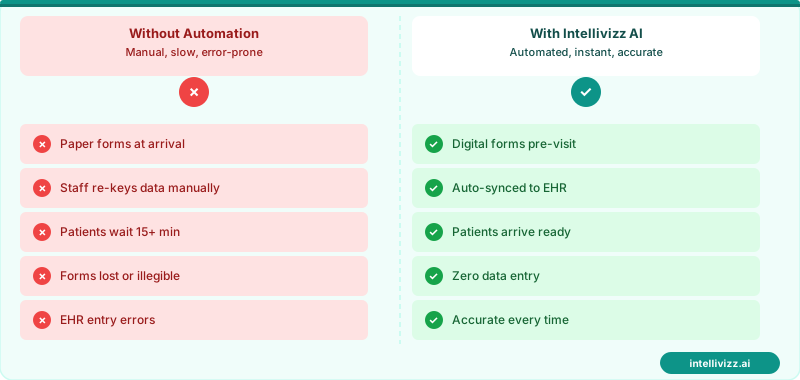
⚖️ DC attorneys are in court — AI ensures no client call goes unanswered
Law firms using AI receptionists capture 35% more qualified consultation requests per month.
Ethical Considerations for AI Receptionists in Law Firms
The DC Bar (and the ABA Model Rules that inform it) imposes specific obligations on law firms regarding client communication that intersect with AI receptionist deployment. Rule 1.4 (Communication) requires that lawyers keep clients reasonably informed and respond to reasonable requests for information. An AI receptionist must be configured to clearly identify itself as an automated system — representing an AI as a human receptionist would create ethical exposure and potentially constitute deceptive communication to a client or prospective client.
Rule 1.18 (Duties to Prospective Clients) is particularly relevant: once a prospective client discloses information during an intake call, even if no engagement letter is signed, the firm may have duties of confidentiality to that prospective client. AI intake systems must be configured to avoid eliciting sensitive case details during the initial screening — their role is to capture contact information and schedule a consultation, not to conduct a substantive legal intake. Detailed case facts should wait for the attorney-supervised consultation. The AI script should explicitly state "We'll discuss the details of your situation with one of our attorneys" rather than inviting detailed disclosure.
| Practice Area | AI Handling Priority | Escalation Trigger | Key Script Constraint |
|---|---|---|---|
| Criminal Defense | Urgent | Any mention of arrest/detention | No facts, schedule only |
| Immigration | High | Removal/deportation mentioned | Language support critical |
| Family Law | Standard | Safety concern mentioned | Empathetic tone required |
| Corporate/Regulatory | Standard | Agency deadline mentioned | Confidentiality emphasis |
Case Management Integration and After-Hours Coverage
DC law firms using AI receptionists benefit most when the system integrates with their case management software. Platforms like Clio, MyCase, and PracticePanther allow AI receptionists to check attorney availability calendars in real time, create new contact records for prospective clients automatically, and log call summaries to the matter file. This integration eliminates the data re-entry burden that often makes receptionist services less useful — attorneys return from court to find consultation bookings already entered in their case management system with accurate contact information and call notes. You may also want to explore law firm no-show reduction for strategies to protect consultation revenue.
After-hours coverage is particularly valuable for DC firms because of the geographic distribution of their clients. International clients (common in DC's trade, policy, and diplomatic legal community) are often calling from time zones 6-12 hours ahead of Eastern Time — their business hours are DC's after-midnight hours. Government contractor clients on the West Coast call 9 a.m. Pacific time, which is noon in DC — a time when DC attorneys are frequently in lunch meetings or court. An AI receptionist that captures these time-shifted calls and schedules consultations in the next available slot ensures that geographic and time zone distribution never means lost business. For broader automation strategies for professional services firms, see the guide on accounting firm automation in Northern Virginia, which shares many applicable workflow principles.
Measuring the Business Impact of AI Reception in DC Law Firms
Law firms implementing AI receptionists should track three core business metrics: new consultation bookings per month (a direct output of the AI's inquiry capture function), consultation-to-retention rate (the percentage of consultations that convert to engaged clients, which reflects the quality of the clients the AI is capturing), and average time-to-first-contact for new inquiries (how quickly prospective clients receive an initial response). These three metrics, measured before and after AI implementation, provide a clear picture of business development impact.
For DC law firms where new client acquisition is competitive, the time-to-first-contact metric is often the most revealing. Before AI implementation, the typical DC boutique or solo firm takes 4–8 hours to respond to a new inquiry during business hours and may take 16–24 hours to respond to after-hours inquiries. With AI reception, the first response is immediate — within seconds of the inquiry being made. Research on professional services purchasing behavior consistently shows that the first firm to respond to an inquiry wins the engagement 35–50% of the time, independent of price or reputation differences between competitors. This first-mover advantage is the primary value driver for many DC law firm AI receptionist deployments.
Beyond new client acquisition, AI receptionists benefit DC law firms through improved current client service. Clients who call with questions about their matter status, billing, or upcoming deadlines during peak hours — when paralegals and associates are in client meetings or depositions — historically reached voicemail and waited hours for a callback. AI reception can handle many of these routine inquiries using matter status data from the case management system, or route them to the appropriate team member for immediate callback scheduling. This improvement in client responsiveness directly affects client satisfaction scores and retention rates, which are the primary drivers of referral volume in the legal market.
Ready to grow your firm with automation? Explore our professional services automation solutions, Law Firm Missed Call Text Back: Why Every Unanswered..., or Law Firm Client Onboarding Automation: From Signed....