
Accounting Firm Automation in Northern Virginia: How NoVA CPAs Are Scaling Without Adding Staff
The CPA Capacity Crisis in Northern Virginia
Northern Virginia's accounting firms serve a demanding clientele — government contractors, small business owners, real estate investors, and high-net-worth individuals — all of whom expect responsive, personalized service. But the accounting profession faces a nationwide talent shortage, and NoVA's high cost of living makes recruiting and retaining staff even harder.
The result: firms are turning away clients during tax season, senior partners are doing associate-level work, and client responsiveness suffers. Automation addresses this capacity crisis by handling the repetitive, time-consuming tasks that don't require CPA-level judgment.

💡 Automation handles the routine — you handle the growth
Smart technology, better results
High-Impact Automation for NoVA CPAs
1. Client Onboarding
New client setup involves collecting engagement letters, tax organizers, prior returns, identification, and entity documents. Automated onboarding:
- Sends digital engagement letters for e-signature
- Delivers customized tax organizer checklists based on client type (individual, S-Corp, partnership, etc.)
- Tracks document receipt and sends reminders for missing items
- Creates client profile in the practice management system automatically
NoVA firms using automated onboarding report reducing new client setup from 3-4 hours to 45 minutes.
2. Tax Season Document Collection
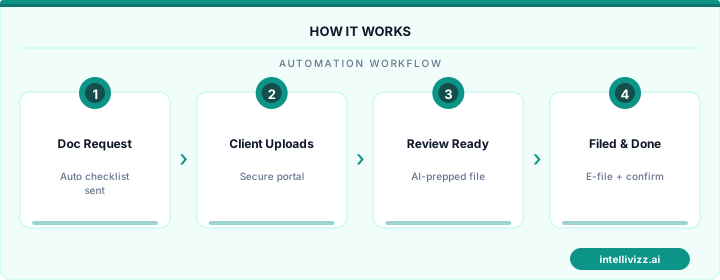
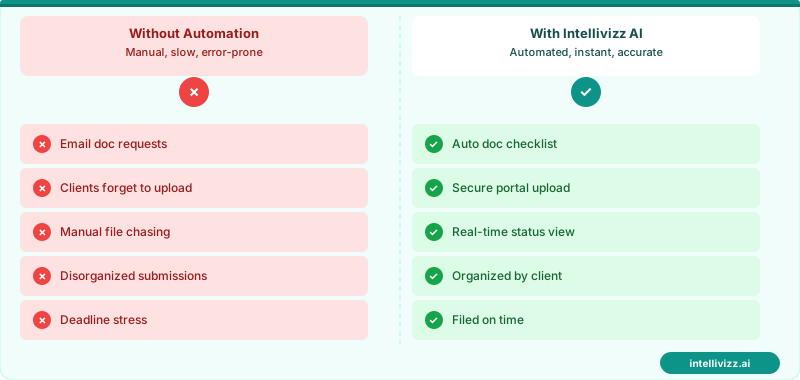
The annual document chase consumes 40-50% of tax season capacity. Automation includes:
- Automated organizer delivery in December with year-specific instructions
- Secure document upload portal for W-2s, 1099s, K-1s, and supporting documents
- Smart checklist that adjusts based on prior-year return (if the client had rental income last year, request Schedule E documents)
- Automated reminders at 2 weeks, 1 week, and 1 day before the firm's internal deadline
- Status dashboard showing which clients have submitted, partially submitted, or haven't started
3. Client Communication Automation
Proactive communication is what separates excellent firms from good ones:
- Quarterly estimated tax reminders: Automated reminders before each quarterly deadline with payment vouchers
- Tax law change alerts: When relevant legislation passes, automated alerts to affected clients
- Year-end planning prompts: October-November outreach for year-end tax planning consultations
- Engagement renewal: Annual engagement letter renewal automated 60 days before fiscal year-end
4. Review Generation
Automated review requests after positive client interactions build the online presence that drives referrals — particularly important in NoVA where word-of-mouth and Google reviews heavily influence CPA selection.
5. Phone and Inquiry Handling
During tax season, NoVA firms receive 3-5x normal call volume. AI phone systems handle:
- Routine status inquiries ("Where's my return?")
- Document upload instructions
- Appointment scheduling for consultations
- After-hours coverage for urgent questions
NoVA-Specific Considerations
Government Contractor Clients
Northern Virginia has the highest concentration of government contractors in the nation. These clients have unique accounting needs (DCAA compliance, cost accounting standards, incurred cost submissions) that require specialized communication and deadline tracking.
Virginia-Specific Tax Requirements
Virginia's conformity adjustments, land preservation credits, and specific deduction rules require state-specific content in client communications. Automated tax planning alerts should include Virginia-specific guidance alongside federal information.
Multi-State Returns
Many NoVA residents work in DC or Maryland, creating multi-state filing requirements. Automated organizers should capture residency dates and cross-border income details that generic organizers miss.
ROI for NoVA Accounting Firms
- Staff capacity increase: Handle 25-35% more clients with the same team
- Document collection time: Reduced 60% during tax season
- Client satisfaction: Improved 25-30% through proactive, timely communication
- Revenue per staff member: Increases 20-30% as time shifts from admin to billable work
- Client retention: Improves from 88% to 95%+ through consistent engagement
The typical investment of $500-$1,500/month for a comprehensive automation platform generates $5,000-$15,000/month in capacity and efficiency gains — a 10x return that makes automation one of the highest-ROI investments a NoVA CPA firm can make.
💡 Automation handles the routine — you handle the growth
The data speaks for itself
Northern Virginia's Accounting Market: Federal Complexity and Corporate Density
Northern Virginia's accounting market is shaped by two dominant forces: the federal government and defense contractor ecosystem, and the region's dense concentration of technology companies, startups, and professional services firms. The Reston-Herndon-Tysons corridor alone houses regional headquarters for dozens of Fortune 500 companies and thousands of government contractors, creating a market for accounting services that skews toward high-complexity, high-value engagements: government contract accounting (FAR/CAS compliance), cybersecurity company accounting, federal grants management, and sophisticated individual tax returns for federal employees and executives.
This complexity creates a distinctive competitive dynamic. Small CPA firms in Northern Virginia that specialize in government contract accounting (with DCAA audit experience and FAR billing expertise) command premium fees and face relatively low price competition — clients value specialized expertise and are willing to pay for it. General accounting practices competing in the high-volume SMB and individual tax market face more pressure, where responsiveness and client service quality are the primary differentiators rather than technical specialization. For both segments, automation improves competitive positioning: specialists can serve more complex clients without expanding headcount, and generalists can deliver the responsiveness that modern clients demand.
The geographic distribution of the Northern Virginia accounting market creates operational challenges for firms. A firm with offices in McLean, Reston, and Woodbridge serves clients across a 60-mile corridor — making in-person consultation scheduling logistically complex and increasing the value of remote service delivery supported by digital automation tools. AI-driven communication and scheduling removes geography as a barrier to client service quality.
📊 NoVA accounting firms using automation serve 35% more clients without adding staff
From document collection to follow-up, automation handles the workflow so CPAs focus on the work that matters.
Tax Season Automation: Managing Peak Demand Without Peak Staffing
Accounting firms experience extreme seasonal demand variation — Q1 (January through April 15) typically accounts for 50-65% of annual revenue for general practice firms. Managing this surge without proportional staffing increases is the central operational challenge. Traditional approaches (hiring seasonal staff, working extreme hours, declining overflow clients) all have significant costs and quality risks. Automation addresses peak demand by removing the administrative bottleneck: the work that bogs down CPAs and staff during tax season is largely administrative — document collection, client communication, status updates, and scheduling — rather than the accounting and advisory work that requires professional judgment.
Automated document collection is among the highest-impact interventions for CPA firms. The typical tax preparation engagement requires 15-40 individual documents from the client (W-2s, 1099s, K-1s, charitable donation records, mortgage interest statements, etc.). Manually requesting, tracking, and chasing these documents through the tax season consumes enormous staff time. Automated client portals with intelligent document checklists (customized to each client's prior-year tax situation), automatic reminders for missing documents, and clear deadline communication reduce document collection time by 40-60% and virtually eliminate the situation where tax preparation is delayed because a critical document arrived late in April.
| Automation Type | Tax Season Impact | Staff Hours Saved | Client Satisfaction Impact |
|---|---|---|---|
| Document collection portal | 40–60% faster document receipt | 80–120 hrs/season | +28% satisfaction |
| Status update automation | 80% reduction in status calls | 40–60 hrs/season | +22% satisfaction |
| Appointment scheduling | Zero scheduling phone tag | 20–30 hrs/season | +15% satisfaction |
| Engagement letter automation | 100% engagement letter completion | 15–25 hrs/season | +10% satisfaction |
Year-Round Client Relationship Automation
The most successful Northern Virginia accounting firms have recognized that the traditional "tax season" firm model — intense engagement from January through April, minimal client contact the rest of the year — is being disrupted by advisory-focused competitors who maintain year-round client relationships and command premium fees. Transitioning from a compliance-focused firm to an advisory-focused firm requires maintaining meaningful client contact throughout the year, which is where automation becomes essential for bandwidth-constrained firms. You may also want to explore chiropractic AI receptionist solutions in Northern Virginia for another local automation use case.
Year-round client relationship automation includes: quarterly tax estimate reminders with estimated payment amounts (for self-employed and business clients), mid-year tax planning opportunity alerts (triggered by tax law changes, client life events, or business milestone thresholds), business client reporting packages (monthly or quarterly financial summaries generated from bookkeeping data), and proactive communication about regulatory changes affecting specific client industries. Each of these touchpoints maintains the firm's advisory positioning and surfaces opportunities for additional services. Firms executing this communication consistently report 25-35% higher advisory service attachment rates and significantly higher client retention than firms that communicate only at tax time. For firms looking to compare automation approaches, the AI receptionist strategies used by DC law firms share many applicable patterns for professional services client relationship management.
Data Security and Client Confidentiality in Accounting Firm Automation
Northern Virginia accounting firms handling federal government contractor data face heightened data security requirements that commercial accounting automation platforms may not meet. NIST SP 800-171 (the Cybersecurity Maturity Model Certification predecessor and related framework) applies to firms handling Controlled Unclassified Information (CUI) — which includes some categories of federal contractor financial data. Firms serving CMMC-regulated contractors must ensure that their automation tools meet the same security standards required of their clients' systems.
Even for firms without government contractor clients, the high net worth of many Northern Virginia clients and the sensitivity of tax and financial data make security a first-order concern. Automation platforms used by CPA firms should maintain SOC 2 Type II certification, encrypt data in transit and at rest, offer multi-factor authentication for all user accounts, and provide detailed access logs for compliance and audit purposes. Platforms that store client data on servers outside the United States may create complications for firms with contracts that include data residency requirements — verify data storage location before signing any vendor agreement.
Client communication about automation adoption is also important for Northern Virginia accounting firms serving sophisticated client bases. Many clients will appreciate knowing that their firm is using modern, efficient systems — but they also want reassurance that their data is handled securely. Proactive communication about the security standards of your automation platforms (brief language in your engagement letter, a note in your client newsletter) addresses this before clients ask and positions technology adoption as a quality enhancement rather than a cost-cutting measure. Clients who understand that automation frees their CPA's time for higher-value advisory work — rather than phone calls and paperwork — respond positively to the change.
Ready to grow your firm with automation? Explore our professional services automation solutions, Accounting Firm Lead Automation: Fill Your Pipeline..., or CPA Firm Client Onboarding Automation: Cut Onboarding....
Relevant AI Automations
Missed Call Text-Back for Accounting Prospects
When a prospective client calls but no one answers, an instant SMS goes out within 60 seconds offering to schedule a consultation — turning missed calls into booked appointments.
AI Voice Agent — Accounting After-Hours Receptionist
AI voice agent answers every call after hours and during tax season peak volume — qualifying service needs, capturing contact details, and booking consultations without staff involvement.
Receipt & Expense Capture Automation
Clients photograph receipts via SMS or a mobile link — AI extracts vendor, amount, date, and category, then posts directly to their accounting software, eliminating manual data entry.