
Accounting Firm Lead Automation: Fill Your Pipeline Year-Round Without Cold Outreach
Why Most Accounting Firms Struggle With Lead Generation
The average CPA firm receives the majority of its new clients through referrals — other clients, financial advisors, attorneys, bankers, and professional contacts who recommend the firm to someone they know. An AI receptionist for accounting firms captures and qualifies inbound leads 24/7, ensuring no prospect falls through the cracks. This is a fundamentally passive lead generation model, and it produces a familiar problem: the pipeline is either full or empty, with little predictability and no consistent mechanism for filling gaps.
Referrals are excellent leads — they convert at 25–45% versus 2–8% for cold digital inquiries — but they are not controllable. When a firm wants to grow, or when a major client departs and revenue needs to be replaced, the referral network cannot be turned up on demand. Accounting firms that add systematic lead automation alongside their referral foundation build a growth engine that operates in both directions: referrals provide high-quality warm leads, while automated digital lead generation provides volume and predictability.
The second challenge is seasonal concentration. Tax season creates intense demand from January through April, followed by a relative quiet period from May through September, then a moderate uptick from October through December as year-end planning conversations begin. A lead generation system that only operates during tax season misses the opportunity to fill the pipeline in advance of the season and to cross-sell advisory services during the off-season months when clients are making financial decisions that will affect their tax situation the following year.
This article covers how modern accounting firms are using automated lead capture, lead scoring, and multi-sequence nurture systems to generate consistent new business year-round — and how those systems integrate with the referral-based relationships that remain the foundation of accounting practice growth.

💡 Automation handles the routine — you handle the growth
From manual processes to automated excellence
Where Accounting Leads Come From in 2026
Before building an automation system, it is essential to map every lead source that requires coverage. Accounting firm leads arrive through distinct channels, each with different characteristics, response expectations, and conversion rates:
Google Search and Local SEO
Prospective clients searching for terms like "CPA near me," "tax preparation [city]," "bookkeeping services for small business," or "accounting firm for real estate investors" represent some of the highest-intent leads an accounting firm can receive. These prospects have identified a need, searched for solutions, and are actively evaluating providers. Response time is critical — leads that receive a response within 5 minutes convert at dramatically higher rates than those who wait hours for a callback.
Google's Local Services Ads (LSAs) are increasingly important for accounting firms, particularly for consumer tax preparation and small business bookkeeping. LSA leads are delivered with the prospect's phone number and basic inquiry context, and Google tracks response speed and rate as ranking factors. Accounting firms that respond to LSA leads slowly not only lose individual prospects — they degrade their ranking position and reduce future lead volume.
Website Contact Forms and Scheduling Links
Your firm's own website is typically your second-highest-quality lead source after direct referrals. Visitors who find the site, read service pages, and decide to reach out have already cleared a meaningful qualification bar. These leads deserve immediate automated acknowledgment (within minutes, not hours) and a structured follow-up sequence that keeps the firm top-of-mind while scheduling is arranged.
Embedding scheduling links directly in contact form confirmation messages — "While we review your inquiry, you can book a complimentary 30-minute consultation here" — dramatically increases conversion rates by capturing the prospect's intent at peak motivation rather than forcing them to wait for a callback.
LinkedIn and Professional Networks
LinkedIn is uniquely effective for accounting firms pursuing business clients — small business owners, CFOs, founders, and executives who are active on the platform and responsive to professionally relevant outreach. Automated LinkedIn sequences for accounting firms typically involve connection requests followed by value-first messages (sharing relevant content, not pitching services), moving toward a discovery call offer after relationship establishment. This approach is most effective for higher-value service lines: outsourced CFO, M&A advisory, business valuation, and audit services.
Referral Partner Networks
Financial advisors, estate planning attorneys, business attorneys, commercial bankers, and insurance brokers routinely encounter clients who need CPA services. Systematizing these referral relationships with automated tracking, periodic check-in sequences, and referral acknowledgment workflows converts what is typically an informal relationship into a reliable lead channel. When an attorney refers a client and receives an automated acknowledgment within 24 hours, followed by a quarterly relationship touchpoint, the relationship is maintained and repeat referrals are much more likely.
Accounting Directories and Platforms
Platforms like Accountant Near Me, Thumbtack, and industry-specific directories generate inquiry volume, particularly for sole proprietors and small businesses seeking bookkeeping and tax services. These leads are typically earlier-stage than website or referral leads, requiring multi-touch nurture sequences to convert. Single-response outreach to directory leads rarely converts — automated 3–5 step sequences over 7–14 days dramatically improve results.
The Seasonal Lead Pattern: Aligning Automation to the Calendar
Accounting firms operate on a defined seasonal calendar that any automated lead system must account for. Lead generation strategy and messaging should shift based on where the firm and its prospective clients are in the annual cycle:
Q4 (October–December): New Client Acquisition Season
The fourth quarter is the ideal time to acquire new tax clients for the following year. Prospects are making year-end financial decisions, thinking about whether their current CPA is meeting their needs, and motivated by tax planning opportunities that can still affect their current-year liability. Lead generation campaigns targeting "switch to a new CPA" messaging — emphasizing proactive tax planning, not just preparation — perform well in Q4. Automated sequences should lead with year-end tax strategies and offer a planning consultation rather than positioning the firm as a tax preparer.
Q1 (January–March): Tax Season Lead Capture
Tax season generates the highest organic inquiry volume of the year, but it also places the highest demand on firm staff capacity. Automated lead capture and qualification during Q1 is particularly valuable because it allows the firm to capture prospects without burdening staff who are at or near capacity. AI phone answering handles new inquiry calls and books consultations during overflow periods; automated email sequences keep prospects warm while human consultations are scheduled; and lead scoring prioritizes which prospects receive immediate human attention versus which can be handled through automated nurture.
For a comprehensive look at how to structure the client onboarding process for tax season new clients, CPA firm client onboarding automation covers the full intake-to-engagement workflow.
Q2 (April–June): Post-Season Recovery and Advisory Upsell
The weeks immediately after tax season represent a significant advisory opportunity that most accounting firms squander. Clients who just completed their tax return are in a heightened state of financial awareness — they've just seen the impact of their financial decisions on their tax liability, and they are receptive to conversations about planning, entity structure, retirement accounts, and business strategy. Automated post-season sequences that invite tax clients into planning conversations capture this window before it closes.
Post-season lead generation for new advisory clients follows the same pattern: targeting business owners who are evaluating their financial situation after filing and wondering if they could have done better. "Did your 2025 tax return surprise you? Here's how to change the outcome for 2026" is a message that lands in May in a way it cannot in February.
Q3 (July–September): Business Advisory and Bookkeeping Pipeline
The summer months are the best time to pursue longer sales cycles for higher-value services: outsourced CFO engagements, business advisory retainers, and bookkeeping service agreements. Business owners have more bandwidth for evaluation conversations, the pressure of tax season is behind them, and they have time to make thoughtful decisions about professional service relationships before the year-end rush begins again.
Lead Capture Automation: From Inquiry to CRM
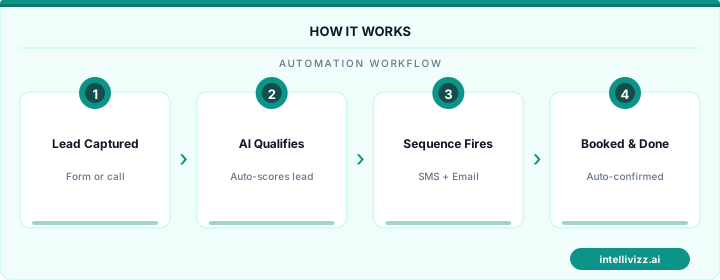
The first automation layer in any accounting firm lead system is comprehensive lead capture — ensuring that every inquiry from every channel is logged, acknowledged, and entered into a workflow without manual data entry. The key components are:
Website Form Integration
Contact forms should connect directly to the firm's CRM, triggering an immediate email acknowledgment and populating a lead record with the prospect's name, contact information, inquiry type, and any additional details captured in the form. Forms that ask a few qualifying questions — approximate gross revenue, service interest, current CPA status — enable immediate basic scoring without requiring a conversation.
Phone Lead Capture
Every inbound call to the firm, whether answered or missed, should be captured in the lead system. For answered calls, a brief intake form completed during the call populates the lead record. For missed calls, an automated SMS follow-up sent within 60 seconds — "Hi, this is [Firm Name]. We missed your call and want to help. Can you share a bit about what you're looking for?" — captures the prospect's intent before they move to the next firm in their search results. Research consistently shows that missed calls without immediate follow-up are effectively lost leads — the prospect's decision window is measured in minutes, not days.
Third-Party Lead Integration
Leads from Google LSA, directory platforms, and referral partners should flow into the same CRM through API integrations or Zapier/Make workflows, ensuring that every prospect is in a single system and no leads exist only in an email inbox or a platform's native interface. Fragmented lead tracking across multiple systems is one of the primary causes of lead loss in accounting firms — a lead captured in one platform that isn't transferred to the CRM within hours is a lead at high risk of being forgotten.
💡 Automation handles the routine — you handle the growth
See how automation transforms industry operations
Lead Scoring for Accounting Firms
Not all leads warrant equal investment of follow-up time and resources. Lead scoring assigns point values to prospect characteristics and behaviors, allowing the firm to prioritize the leads most likely to convert into high-value engagements. Accounting firm lead scoring models typically evaluate:
| Scoring Dimension | Indicators | Score Weight |
|---|---|---|
| Revenue Potential | Business revenue, number of entities, employee count | High |
| Service Fit | Service interests align with firm's strongest offerings | High |
| Urgency | Deadline-driven need (tax due, audit, sale closing) | High |
| Decision Stage | Currently has no CPA vs. evaluating providers vs. switching | Medium |
| Engagement Signals | Pages visited, content downloaded, email opens/clicks | Medium |
| Geographic Fit | Within firm's target service radius or industry niche | Low-Medium |
| Lead Source Quality | Referral > Organic Search > Paid > Directory | Medium |
High-scoring leads trigger immediate human follow-up — a partner or senior staff member calls the prospect directly within the hour. Medium-scoring leads enter an accelerated automated sequence with a human touchpoint at day 2. Lower-scoring leads enter a standard nurture sequence with human follow-up triggered when the prospect engages with nurture content.
Nurture Sequences by Service Line
The most sophisticated element of accounting firm lead automation is service-line-specific nurture sequences. A prospect interested in tax preparation receives different content and different CTAs than a prospect interested in business advisory services — because they are at different decision stages, have different informational needs, and are evaluating the firm on different criteria.
Individual Tax Preparation Leads
Individual tax prospects typically have a simple decision framework: do I trust this firm, is their pricing reasonable, and is the process easy? Nurture sequences for individual tax leads should address each concern: client testimonials that establish trust, transparent pricing communication or a pricing FAQ, and clear explanation of the firm's process (what to gather, how to submit documents, when to expect results). A well-designed 5-message sequence over 7–10 days converts significantly better than a single follow-up call.
Small Business Tax and Bookkeeping Leads
Small business leads have a more complex decision framework. The owner is evaluating the firm's expertise with their business type, their industry knowledge, their responsiveness, and the ROI of professional services compared to doing it themselves or using a cheaper option. Nurture content for small business leads should include industry-specific case studies, concrete examples of tax savings achieved for similar businesses, and educational content that demonstrates the firm's expertise in their sector. For the document-gathering aspect of the engagement, tax document collection automation can be a useful reference for prospects wondering about the process.
Business Advisory and Outsourced CFO Leads
Advisory service leads are longer-cycle prospects — decision timelines of 30–90 days are common, and the evaluation process is more involved. Nurture sequences for advisory prospects should be longer (8–12 touches over 30–60 days), more content-rich (white papers, financial planning guides, case studies with quantified outcomes), and include offers for value-delivery touchpoints like a complimentary financial health review or industry benchmark analysis. These leads convert on demonstrated expertise and relationship trust, not speed or price.
Audit and Compliance Leads
Audit and compliance leads — typically nonprofits, government contractors, businesses approaching capital raises, or businesses facing regulatory requirements — often arrive with a specific trigger event (upcoming audit requirement, grant application, investor due diligence). These leads have high urgency and high value, and should be routed immediately to a partner with the relevant expertise. Nurture sequences for audit leads that haven't yet committed should emphasize the firm's technical credentials, industry experience, and specific audit service offerings.
Referral Partner Automation
For most accounting firms, referral partners — financial advisors, estate attorneys, business attorneys, commercial bankers, business brokers — are the single most reliable source of high-quality leads. Automating referral partner relationship management converts what is typically an informal, relationship-dependent process into a systematic program with measurable results:
- Referral acknowledgment: When a referred prospect identifies their referral source, an automated message goes to the referring partner within 24 hours, acknowledging the referral and committing to excellent service for their client.
- Outcome notification: At appropriate intervals (new client engaged, first service completed, relationship milestones), automated updates keep the referring partner informed — with their permission — about how their referred client is being served.
- Quarterly relationship touchpoints: Automated check-in messages to referral partners every 90 days maintain the relationship during periods without active referrals. Content-rich touchpoints — sharing a relevant article, inviting partners to a firm event, or sharing a resource specific to their client type — are more effective than generic "just checking in" messages.
- Referral partner portal: Some firms create a simple portal where referral partners can submit referrals directly, track the status of referred prospects, and access firm materials they can share with clients. This infrastructure makes referring easy and demonstrates that the firm takes the referral relationship seriously.
ROI of Accounting Firm Lead Automation
The business case for automated lead generation in accounting firms is built on concrete metrics. Industry benchmarks provide useful reference points:
Additional ROI dimensions that accounting firm owners consistently cite after implementing lead automation:
- Staff time recovery: Automated lead capture, acknowledgment, and initial nurture recover 5–8 hours per week of admin and partner time previously spent on manual follow-up tasks.
- Conversion rate improvement: Firms that reduce their average lead response time from 24+ hours to under 5 minutes typically see a 40–80% improvement in lead-to-consultation conversion rates.
- Off-season pipeline: Firms with automated lead systems maintain 30–50% more consistent new client acquisition outside of tax season, reducing the revenue volatility that characterizes firms dependent solely on tax work.
- Referral partner activation: Systematic referral partner management increases referral volume from existing partners by 25–40% — not by adding new partners, but by maintaining relationships with existing ones consistently enough that referrals happen regularly rather than sporadically.
For firms building a complete client acquisition and retention system, CPA firm client onboarding automation covers the process from signed engagement to active client relationship. And for practices managing the intense communication volume of tax season, accounting firm automation strategies provides a regional perspective on how competitive markets are approaching systematic practice growth. The firms building sustainable, scalable accounting practices in 2026 are not the ones working longer hours — they are the ones who have built systems that generate, qualify, and convert leads while the partners focus on the high-value work that only they can do.
Ready to grow your firm with automation? Explore our professional services automation solutions.
Relevant AI Automations
AI Review Management
All-in-one review management: automated review requests, AI-powered responses, and review repurposing for web & social — 3 engines in 1.
Missed Call Text-Back for New Prospects
When a prospective client calls but no one answers, the system instantly sends an SMS within 60 seconds offering to sche
Missed Call AI Text-Back
Instantly respond to every missed call with AI-powered SMS, capturing leads 24/7