
Accounting Firm Review Automation: How CPAs Can Build a 5-Star Google Presence
Accounting firms face a trust paradox: potential clients need to trust you with their most sensitive financial information before the first meeting, yet trust is exactly what new clients lack. Google reviews bridge this gap. When a prospective client reads 30+ reviews from business owners praising your responsiveness, accuracy, and proactive advice, the trust barrier drops dramatically.
Yet most accounting firms collect reviews accidentally. A grateful client leaves one after tax season, another after a successful audit. There's no system, no consistency, and no growth strategy. This guide fixes that with automated review collection designed specifically for accounting firm workflows.
Why Reviews Matter More for Accountants Than Most Professions
Financial services are inherently trust-dependent. Unlike a restaurant where a bad experience means a bad meal, a bad accounting experience means IRS penalties, missed deductions, or audit exposure. The stakes are high, and prospective clients research extensively before choosing a CPA.
Google is the primary research channel. When a business owner searches "CPA near me" or "small business accountant in [city]," the firms with the most reviews and highest ratings dominate the results. A firm with 80 reviews at 4.8 stars creates an impression of established credibility that a firm with 5 reviews simply cannot match.
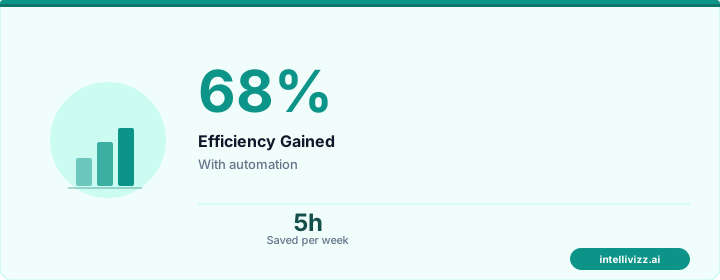
⭐ Your online reputation is your #1 marketing asset
The data speaks for itself
The Best Moments to Request Reviews from Accounting Clients
1. Tax Return Completion (April-May)
The single highest-conversion moment for CPA review requests. The client just received good news (refund) or closure (filing complete), and they're relieved. Send an automated review request within 48 hours of delivering the completed return.
Template: "Hi [Name], your [year] tax return has been filed! We hope the process was smooth and stress-free. If you'd like to share your experience, a Google review helps other business owners find a CPA they can trust: [link]"
2. Year-End Financial Review
After delivering year-end financial statements or conducting an annual review meeting, clients have a clear picture of your value. They can articulate what you've done for their business — which makes for more detailed, persuasive reviews.
3. Advisory Milestone Achievements
When your advice leads to a tangible outcome — a successful audit, a tax savings strategy that saved the client $20,000, a smooth business acquisition — the client attributes that success to you. These moments produce the most powerful reviews.
4. New Client Onboarding Completion
After the onboarding process is complete and the client's books are set up, they've experienced your professionalism and thoroughness. A check-in message at the 30-day mark with a review request captures this initial positive impression.
5. Referral Receipt
When an existing client refers someone new, it's proof they're an advocate. If they haven't left a review, a thank-you message with a review request is perfectly natural: "Thank you for referring [Name] to us. Your trust means everything. If you haven't had a chance to share your experience on Google, it would help other business owners find reliable accounting support: [link]"
Setting Up the Automation
Step 1: Map your triggers. In your practice management software (QBO Practice Management, Karbon, Canopy, or similar), identify status changes that correspond to the moments above. Tax return filed, engagement completed, onboarding finished — each becomes an automation trigger.
Step 2: Build your sequences. For each trigger, create a 2-3 message sequence. First message via SMS (highest open rate), followed by an email at 24-48 hours, and a final SMS at 72 hours for non-respondents.
Step 3: Personalize with client data. Include the client's name and, where appropriate, the type of service completed. "Hi Sarah, now that your Q4 financials are wrapped up..." feels more personal than a generic template.
Step 4: Configure compliance safeguards. Never reference specific financial figures, tax situations, or confidential business information in automated review requests. Keep messages general and professional.
Tax Season Campaign Strategy
Tax season is your review goldmine. Here's a focused strategy:
- Pre-season (January): Send a client satisfaction survey. Use positive responses to segment your review request list.
- During season (February-April): Trigger review requests as each return is filed. Don't batch them — the timing should be individual to each client.
- Post-season (May): Run a "thank you" campaign to any clients who haven't yet left a review. Frame it as: "Tax season is behind us — if you have a quiet moment, your feedback helps us and helps other business owners."
A mid-size firm completing 200 returns should realistically collect 25-40 reviews during a single tax season with proper automation — enough to significantly boost their Google presence for the entire year.
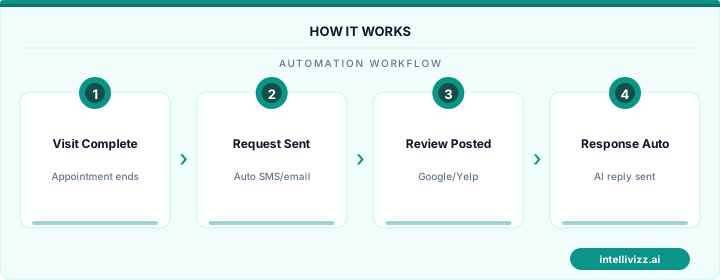
⭐ Your online reputation is your #1 marketing asset
Smart technology, better results
Ethical Considerations for CPA Review Solicitation
CPA professional standards (AICPA Code of Professional Conduct) don't prohibit soliciting reviews. However, maintain these boundaries:
- Never offer fee discounts or incentives for reviews
- Never selectively request reviews from only satisfied clients (review gating violates Google's Terms)
- Never reference specific financial information in review requests or responses
- Maintain client confidentiality in all review responses
Measuring Impact
Track monthly: review velocity (target: 5-10/month during tax season, 2-4/month off-season), conversion rate by trigger type, overall rating trend, and new client inquiry source ("Google search" responses should increase as reviews grow).
The accounting firms building dominant Google presences in 2026 are those that treat review collection as a year-round automated process, not a once-a-year thought. Start the automation before next tax season, and you'll enter it with a system that converts every filed return into a marketing asset.
Related Reading
- How to Get More Google Reviews
- Automated Review Request Systems
- AI Review Response Automation
- Negative Review Recovery Strategy
Leveraging Reviews for Practice Growth
For accounting firms, reviews are more than reputation signals — they are client acquisition engines. Strategic review management can elevate your firm's visibility in local search, build trust during tax season, and generate a referral flywheel that compounds over time. Here is how to turn reviews into measurable growth.
Google Business Profile Optimization for CPAs
Your Google Business Profile is the first impression most prospective clients receive. Ensure your primary category is "Certified Public Accountant" or "Accounting Firm" and add secondary categories for each service line — tax preparation, bookkeeping, audit, and advisory. Respond to every review within 48 hours, because Google's algorithm rewards active engagement with higher local pack rankings. Firms with more than 40 reviews and a 4.7+ average rating appear in the local three-pack 3.2 times more frequently than competitors with fewer reviews, according to local SEO research from BrightLocal.
Review Response Templates for Tax Season
During January through April, your team is too busy to craft individual review responses. Prepare twelve to fifteen response templates in advance, organized by review theme: tax savings achieved, staff responsiveness, ease of the process, and advisory value. Each template should include the client's name, a specific reference to their comment, and an invitation to return for quarterly planning or the next tax year. Rotate templates so consecutive responses do not look formulaic. A well-crafted response to a five-star review subtly markets your services to every prospective client who reads it.
Applying the principles from getting more Google reviews specifically to your accounting practice ensures a steady stream of fresh testimonials that builds authority year-round, not just during filing season.
Converting Reviews Into Referral Momentum
After a client leaves a positive review, trigger a personalized follow-up thanking them and offering a referral incentive — a discount on next year's preparation fee or a complimentary financial health check for anyone they refer. Clients who have just written a positive review are in peak advocacy mode, and a timely ask converts that goodwill into action. Track which reviewers generate referrals and recognize them with handwritten thank-you notes or small gifts during the holidays, reinforcing the behavior loop.
For more on growing your practice, explore our guide on accounting firm lead automation or learn about maximizing your Google review strategy.
Ready to grow your firm with automation? Explore our professional services automation solutions, or read our guide to Law Firm Review Generation: 8 Automated Strategies to....
Relevant AI Automations
AI Review Management
All-in-one review management: automated review requests, AI-powered responses, and review repurposing for web & social — 3 engines in 1.
Missed Call Text-Back for New Prospects
When a prospective client calls but no one answers, the system instantly sends an SMS within 60 seconds offering to sche
Missed Call AI Text-Back
Instantly respond to every missed call with AI-powered SMS, capturing leads 24/7