
AI Review Response Automation: How to Reply to Every Google Review in Under 60 Seconds
Responding to every Google review is one of the highest-leverage reputation management activities a business can perform. Google's algorithm favors businesses with high response rates, and prospective customers are 68% more likely to trust a business that actively engages with reviewers. Yet most businesses respond to fewer than 30% of their reviews — and the gap is entirely due to time and bandwidth.
AI review response automation solves this by generating personalized, on-brand responses to every review within minutes of it being posted. This guide covers how these systems work, compares the leading tools, and walks you through implementation.
Why Review Response Rate Matters
Google has confirmed that review response is a factor in local search ranking. Beyond the algorithm, responding to reviews delivers three tangible benefits:
- Trust building: Prospective customers see that you care about feedback. A 2025 BrightLocal study found that 88% of consumers are more likely to choose a business that responds to all reviews.
- Review encouragement: When customers see that reviews get acknowledged, they're more motivated to leave their own. Response rates above 80% correlate with 25-30% higher review velocity.
- Damage control: Quick, professional responses to negative reviews limit their impact. Unaddressed negative reviews have 2x the deterrent effect on potential customers.
⭐ Your online reputation is your #1 marketing asset
Smart technology, better results
How AI Review Response Automation Works
Modern AI review response systems operate in one of two modes:
Fully Automated (AI Drafts and Posts)
The AI detects a new review, generates a personalized response based on the review content and sentiment, and posts it to your Google Business Profile automatically. Response time: under 5 minutes.
Best for: High-volume businesses (restaurants, retail) with 20+ reviews/month where speed matters more than personalization.
AI-Assisted (AI Drafts, Human Approves)
The AI generates a response draft and sends it to you (via email, Slack, or SMS) for approval. You review, optionally edit, and approve with one click. Response time: typically under 30 minutes during business hours.
Best for: Professional services (medical, legal, financial) where tone and compliance are critical. Especially important for healthcare practices navigating HIPAA.
Key Features to Look For
When evaluating AI review response tools, prioritize these capabilities:
- Sentiment analysis: The AI should detect whether a review is positive, neutral, or negative and adjust the response tone accordingly.
- Brand voice customization: The best tools let you define your brand voice (professional, friendly, casual) and maintain it consistently across all responses.
- Topic extraction: AI should identify what the reviewer is praising or complaining about (wait times, staff, quality, pricing) and reference it specifically in the response.
- Compliance safeguards: For healthcare and legal businesses, the tool should be configured to never reference specific services, treatments, or case details in responses.
- Multi-platform support: Google, Yelp, Facebook, and industry-specific platforms (Healthgrades, Avvo, TripAdvisor) should all be supported.
- Escalation rules: Negative reviews below a configurable threshold (e.g., 1-2 stars) should be flagged for human review rather than auto-responded.
Tool Comparison: AI Review Response Platforms
Birdeye: Comprehensive reputation platform with AI-generated response suggestions. Supports 200+ review sites. Best for multi-location businesses. Pricing: $300-500/month.
Podium: Popular with SMBs for its combined messaging and review platform. AI response feature generates drafts that you approve before posting. Best for businesses already using Podium for customer messaging. Pricing: $250-400/month.
Reputation.com: Enterprise-grade platform with advanced AI response capabilities, including industry-specific response models for healthcare, hospitality, and automotive. Best for large organizations. Pricing: Custom (typically $500+/month).
Intellivizz: Combines AI review response automation with broader business automation — review generation, missed call handling, lead follow-up, and appointment reminders. Best for businesses that want review management as part of a unified automation platform rather than a standalone tool. Pricing: competitive with standalone options.
⭐ Your online reputation is your #1 marketing asset
The data speaks for itself
Setting Up AI Review Response Automation
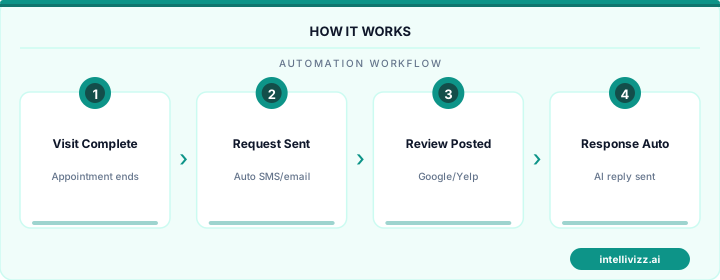
Step 1: Connect your review profiles. Link your Google Business Profile (and other platforms) to your AI response tool via OAuth. This grants the tool permission to read reviews and post responses on your behalf.
Step 2: Define your brand voice. Provide examples of ideal responses for positive, neutral, and negative reviews. Most tools let you input 5-10 sample responses that the AI learns from.
Step 3: Set response rules. Configure which reviews get auto-responded vs. flagged for human review. Common rules: auto-respond to 4-5 star reviews, flag 1-2 star reviews, and either auto-respond or flag 3-star reviews based on content.
Step 4: Configure escalation alerts. Set up notifications (email, SMS, Slack) for negative reviews that need human attention. Speed matters — you want to address negative reviews within hours, not days.
Step 5: Monitor and refine. Review the AI-generated responses weekly for the first month. Adjust your brand voice settings and response rules based on any responses that missed the mark.
Measuring Impact
Track these metrics to quantify the ROI of AI review response automation:
- Response rate: Percentage of reviews that receive a response (target: 100%)
- Average response time: Time from review posted to response published (target: under 1 hour)
- Review velocity change: Whether higher response rates drive more incoming reviews
- Negative review resolution rate: Percentage of negative reviews where the customer updates their rating after your response and outreach
- Local search ranking: Monitor your Google Local Pack position over time
AI review response automation is rapidly becoming standard practice for businesses that take their online reputation seriously. The combination of automated response generation and automated review collection creates a flywheel: more reviews generate more visibility, which drives more customers, who leave more reviews. The businesses that build this flywheel first gain a compounding advantage that competitors struggle to overcome.
Training Your AI for Brand-Consistent Responses
An AI review responder is only as good as the training data and guardrails you provide. Without careful calibration, automated responses can feel robotic, miss nuance, or — worst case — escalate a situation. Here is how to ensure your AI stays on-brand and handles complexity gracefully.
Voice-and-Tone Calibration
Feed your AI a style guide that defines your brand's voice along specific dimensions: formal versus conversational, empathetic versus solution-oriented, concise versus detailed. Provide at least 30 examples of ideal responses across different review types — glowing five-star praise, constructive four-star feedback, and frustrated one-star complaints. Test the AI against 50 real reviews and have your team score each response on brand alignment before going live. Re-calibrate quarterly as your brand voice evolves, because the AI will not adapt on its own — it will continue producing responses based on its original training set indefinitely.
Handling Complex Complaint Threads
Not every negative review is a straightforward service failure. Some involve billing disputes, misunderstandings about scope, or emotionally charged personal situations. Train your AI to recognize complexity indicators — mentions of legal action, medical outcomes, employee names, or discriminatory language — and flag these for human review rather than generating an automated response. A poorly worded response to a complex complaint can create legal liability or go viral on social media. Build a complexity scoring model that evaluates review length, sentiment intensity, and keyword triggers to determine whether the AI should respond, draft for human editing, or escalate entirely.
Understanding when to deploy AI versus human judgment is central to an effective negative review recovery strategy that protects your reputation while maintaining response speed.
Escalation Triggers for Human Intervention
Define explicit rules for when the AI must route a review to a human team member. Common triggers include reviews mentioning specific employees by name, any review rated one star with more than 200 words, reviews containing profanity or threats, and reviews from repeat complainers. Set up real-time notifications so escalated reviews reach the right person within 15 minutes during business hours. Track the ratio of AI-handled versus human-escalated reviews monthly — a healthy target is 75-85 percent AI-handled, with the remainder benefiting from human nuance and judgment.
For more on reputation management, explore our guide on dental practice reputation management or learn about turning negative reviews into loyalty opportunities.
Ready to get started with automation? Explore our AI automation solutions, or read our guide to Automated Review Request Systems: How They Work and....