
Law Firm No-Show Reduction: How to Protect Consultation Revenue
The Consultation No-Show Problem Is a Revenue Problem
Every missed consultation at a law firm represents a compounded loss. The obvious loss is the billable time — an attorney or paralegal blocked for 30–60 minutes that generates zero revenue. The less obvious loss is the opportunity cost: the prospective client who needed legal representation, received no service, and will now call a competing firm. And the hidden loss is the administrative cost of the intake process already invested: the initial phone screen, the conflict check, the calendar coordination, the file preparation.
Industry data on consultation no-show rates in legal settings is consistent across practice areas: free initial consultations — still common in personal injury, family law, and criminal defense — see no-show rates of 20–30%. Paid consultations, where the prospective client has agreed to pay a consultation fee upfront, see no-show rates of 10–15%. Even at the lower end, a firm running 20 paid consultations per week at a 10% no-show rate is absorbing two wasted appointment slots weekly — roughly 100 lost consultation hours per year.
At a conservative consultation billing rate of $300/hour and 45-minute appointment slots, that is $45,000 in annual gross revenue that evaporated before any engagement letter was signed. For firms with free consultations, the math is different but the operational disruption is the same: schedules blocked, staff time invested, and prospects who needed help that never received it.
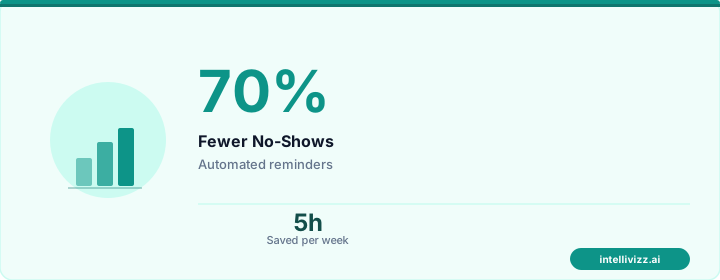
⚖️ Protect Every Consultation Slot
Automated systems that cut legal consultation no-shows by 50–70%
Why Legal Consultation No-Shows Are Different from Medical No-Shows
Most of the literature on appointment no-show reduction is written for medical practices, dental offices, and similar healthcare settings. The strategies are partially transferable to law firms, but the vocabulary, tone, and mechanisms differ in ways that matter.
Legal consultations are not routine appointments — they are often triggered by an acute crisis: an arrest, a served divorce petition, a business dispute that has escalated, an employment termination. The emotional state of a prospective legal client is categorically different from that of a patient scheduling a check-up. Prospects who no-show a legal consultation frequently do so because the underlying situation has changed — they resolved the matter another way, they decided not to pursue the issue, they hired a different attorney, or the crisis that prompted the inquiry temporarily resolved itself.
This means that legal reminder sequences need to acknowledge the nature of the relationship being established, use professional and dignified language rather than clinical or commercial language, and offer genuine flexibility rather than punitive cancellation messaging. A reminder that reads "Don't forget your appointment — we look forward to speaking with you about your legal matter" performs significantly better in legal contexts than language borrowed from medical or service business templates.
Practice Area Differences in No-Show Rates
| Practice Area | Consultation Type | Typical No-Show Rate | Primary Driver |
|---|---|---|---|
| Personal Injury | Free consult | 25–35% | Urgency fades; multiple firms contacted simultaneously |
| Family Law / Divorce | Free or low-cost | 20–30% | Emotional ambivalence; situation flux |
| Criminal Defense | Free consult | 20–28% | Retained another attorney; situation resolved |
| Estate Planning | Paid ($150–$350) | 8–14% | Low urgency; easy to postpone |
| Business / Transactional | Paid ($200–$500) | 6–12% | Deal fell through; timeline shifted |
| Immigration | Paid ($100–$200) | 12–18% | Appointment anxiety; contact information quality |
Understanding why prospects no-show in a specific practice area is essential for designing the right intervention. A personal injury firm dealing with high free-consultation no-shows needs a different system than an estate planning firm dealing with low-urgency rescheduling behavior.
The Conflict Check as a No-Show Prevention Tool
One of the most underutilized no-show reduction strategies in legal practice is conducting the conflict check before the consultation is scheduled, rather than at the time of the appointment. When a prospective client arrives for a consultation — or worse, when they call to confirm — and the firm then discovers a conflict of interest that prevents representation, the appointment is cancelled at the last minute. From a no-show rate reporting perspective, this is counted as a cancellation, not a no-show. But the underlying problem is identical: a slot was blocked that generated no revenue.
Automating the conflict check intake as part of the appointment confirmation sequence eliminates this category of wasted consultations. The workflow is straightforward: after a prospective client schedules a consultation, an automated sequence collects the names of all parties involved (opposing party, related entities, witnesses) before the appointment is confirmed. This information is submitted to the firm's conflict check system — whether that is a dedicated system, the firm's practice management software, or a manual review process — and the consultation is only confirmed to the client after the conflict review is complete.
Firms that have implemented pre-appointment conflict screening report a 5–8% reduction in the total appointment cancellation rate, which is a meaningful improvement on top of the gains from reminder sequences alone. For more on the complete intake workflow, see our guide to legal client intake software.
📋 Pre-Screening That Saves Consultation Slots
Conflict checks before confirmation eliminate a full category of wasted appointments
Designing a Legal Consultation Reminder Sequence
An effective reminder sequence for law firm consultations respects the professional relationship being established while creating the behavioral nudges that drive attendance. The sequence below reflects best practices across practice areas, with language calibrated for legal settings.
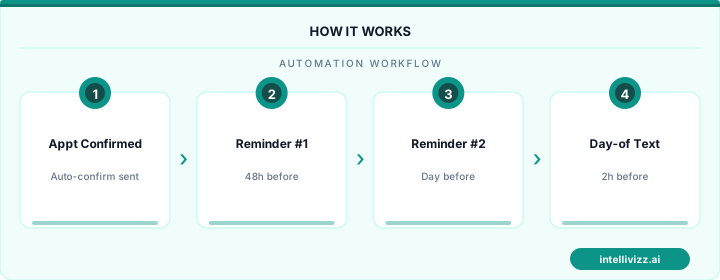
The Four-Touch Legal Consultation Sequence
- Booking confirmation (immediate): Sent immediately upon scheduling. Includes the attorney's name, the consultation date and time, the meeting format (in-person address with parking/transit notes, or virtual meeting link), and a one-click link to reschedule if needed. Critically, this message should acknowledge the prospective client's situation with dignity: "We have reserved time for you with [Attorney Name] to discuss your [matter type]. We look forward to speaking with you." The confirmation also requests any documents the attorney will need to review before the consultation, along with a secure document upload link — this pre-consultation document collection both prepares the attorney and increases the prospect's invested commitment to attending.
- 72-hour reminder: A professional reminder that reconfirms the appointment details and invites the prospect to confirm attendance with a single reply or button click. Non-confirmation by the following morning places the appointment in a high-risk queue for follow-up outreach. This reminder also provides any remaining preparation instructions: what documents to bring, what information to have available.
- 24-hour reminder: A brief confirmation reminder with the meeting link (for virtual) or directions (for in-person). This message should include the attorney's direct contact information in case the prospect needs to reach the firm on the day of the appointment — this both reduces friction for day-of questions and signals that the firm takes the appointment seriously.
- Same-day confirmation (2–3 hours before): The final touchpoint. Short, professional, and practical: the meeting details, a reminder to have their documentation ready, and a note that the attorney is prepared and looking forward to the conversation. For virtual consultations, include the meeting link a second time with a one-click join button.
This sequence, implemented correctly, reduces no-show rates for paid consultations from the 10–15% range to 3–6%. For free consultations, the reduction is from the 20–30% range to 8–14% — still higher, because the financial commitment is lower, but meaningfully improved. The incremental investment in these messages is minutes of system configuration; the return is measured in recovered consultation revenue every week.
Retainer and Consultation Fee Requirements
The most direct mechanism for reducing consultation no-shows is creating a financial commitment at the point of booking. This takes two forms in legal practice: a consultation fee paid upfront, or a credit card authorization held as a no-show deposit.
Consultation Fees
Charging for an initial consultation — typically $150–$500 depending on practice area and market — has a direct and measurable impact on no-show rates. Prospective clients who have paid for a consultation have a concrete financial reason to attend. The consultation fee also pre-qualifies prospects: someone unwilling to invest in a consultation to discuss their legal matter is unlikely to retain the firm at professional rates.
Consultation fees are most easily defended in practice areas where the consultation itself delivers clear value: estate planning, business formation, contract review, immigration case assessment. They are harder to implement — and may affect case volume — in personal injury and family law, where free consultations are market norms in many geographic areas.
Credit Card Authorization Holds
For firms that choose to maintain free consultations, a credit card authorization hold at booking — $50–$150 per appointment, released upon attendance — creates financial accountability without requiring a fee. The authorization is communicated transparently at booking: "To reserve your consultation slot, a credit card authorization of $75 will be placed on your card. This hold is released in full when you attend your appointment." No-shows result in the hold being charged; attendees see no charge.
Firms that have implemented authorization holds on free consultations report no-show rate reductions of 40–60% compared to unprotected free consultation scheduling. The authorization hold also functions as a pre-qualification mechanism: prospects who are not serious enough to provide a credit card are unlikely to retain the firm regardless of whether they attend the consultation.
Virtual Consultations as a No-Show Reduction Strategy
Offering virtual consultations — via video conference — as the default or an option for initial consultations directly reduces a category of no-shows driven by logistical friction: transportation barriers, parking challenges, work schedule conflicts, and geographic distance from the firm's office. The evidence from law firms that have shifted initial consultations to virtual formats is consistent: no-show rates for virtual consultations run 3–5 percentage points lower than for equivalent in-person consultations.
The mechanism is straightforward. A prospective client who can join a consultation from their home office, car, or lunch break has fewer practical obstacles to attendance than one required to navigate to a law office, find parking, and clear an hour-plus in their schedule. For practice areas where the consultation is primarily a conversation — personal injury case assessment, family law intake, criminal defense evaluation — the legal quality of a virtual consultation is equivalent to an in-person meeting.
Virtual consultations also improve the effectiveness of the reminder sequence: the meeting link in the reminder email eliminates friction at the moment of joining, and a one-click test-connection option in the 24-hour reminder reduces the technical anxiety that causes some prospects to no-show rather than troubleshoot a video platform they haven't used before.
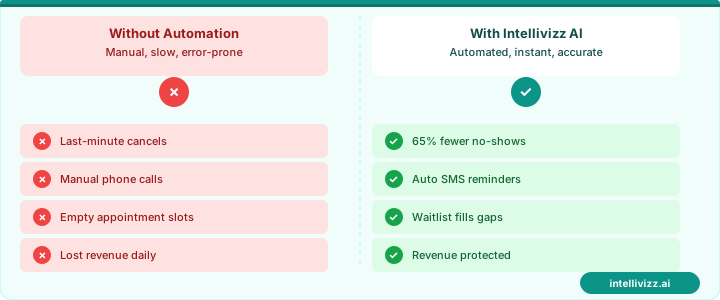
💻 Virtual Consultations Reduce No-Shows by 3–5 Points
Eliminating logistical friction is one of the highest-ROI no-show interventions
No-Show Response Protocol: What Happens When a Prospect Doesn't Appear
Even with a well-designed prevention system, some percentage of consultations will still be missed. The no-show response protocol determines whether that missed appointment becomes a lost client or a rescheduled engagement.
The protocol should be automated and immediate:
- At T+5 minutes: An automated outreach message to the prospect via their preferred channel. Tone should be solution-oriented rather than accusatory: "We had a consultation reserved for you with [Attorney Name] at [time]. We hope everything is all right — if you are available to connect now, please call us directly at [number], or click below to select a new consultation time." This message recovers a meaningful percentage of no-shows who had a logistical problem — traffic, childcare issue, work conflict — rather than a change of intent.
- At T+24 hours: If the prospect has not rescheduled, a second outreach offering a new appointment. This message can also include a brief reminder of the firm's capabilities and recent client outcomes (without violating confidentiality) to re-establish the value proposition.
- At T+72 hours: Final outreach with a no-obligation invitation to reschedule. After three unreturned contacts, the prospect is moved to a long-term nurture sequence rather than active follow-up, preserving firm resources for engaged prospects.
For firms with comprehensive lead follow-up automation, the no-show recovery workflow integrates directly with the broader prospect nurture system. Our guide to attorney lead follow-up automation covers the full sequence from initial inquiry through post-consultation engagement. For the broader question of how missed calls from prospective clients are handled before they even reach the scheduling stage, law firm missed call text-back addresses the first point of contact failure.
Building the System: Integration Requirements
A functioning law firm no-show reduction system requires coordination between several technology components:
| Component | Function | Example Platforms |
|---|---|---|
| Scheduling software | Appointment booking, calendar management, availability rules | Clio Grow, Lawmatics, Calendly, Acuity |
| CRM / intake system | Prospect record, matter type, conflict check data | Clio, MyCase, Practice Panther, Smokeball |
| Automation platform | Reminder sequences, no-show follow-up, drip campaigns | GoHighLevel, HubSpot, ActiveCampaign |
| Payment processor | Consultation fee collection, CC authorization holds | LawPay, Stripe, CPACharge |
| Video conferencing | Virtual consultation delivery | Zoom, Microsoft Teams, Google Meet |
For firms that have already invested in practice management software with integrated scheduling — Clio Grow, Lawmatics, or similar platforms — the automation layer is typically added on top via integration with a marketing automation platform like GoHighLevel. For firms building the system from scratch, the selection of a legal-focused CRM with native scheduling capabilities typically provides the cleanest implementation path.
The complete picture of technology and workflow for new client onboarding after a consultation converts to a retainer is covered in our guide to law firm client onboarding automation. And for an overview of AI-powered intake and scheduling at the front end of the consultation pipeline, the AI receptionist for law firms resource covers the complete phone and intake automation stack.
Measuring No-Show Reduction ROI
The financial case for investing in a no-show reduction system is straightforward to model for any law firm:
- Calculate your current monthly consultation volume and no-show rate.
- Multiply missed consultations by average consultation value (fee, or imputed value of a retained client multiplied by your consultation-to-retention conversion rate).
- Apply a conservative 50% no-show reduction to estimate recovered consultations.
- Compare recovered revenue to the monthly cost of the automation platform.
For a mid-size firm conducting 40 consultations per month at a 20% no-show rate, recovering just half of those eight wasted slots — four additional consultations per month — at a $400 average consultation value generates $1,600 in monthly recovered revenue. The automation platform enabling this typically costs $200–$400 per month. The ROI is typically established within the first 30 days.
No-show reduction is one of the highest-return, lowest-disruption improvements available to any law firm's intake operation. The investment is in system design and configuration, not additional headcount. The returns are immediate and measurable, and they compound as the system learns from your specific practice's patterns and the sequence timing is refined to match your clients' behavior.
Ready to grow your firm with automation? Explore our professional services automation solutions.