
Real Estate Review Generation: How Top Agents Automate Their Google Reviews
In real estate, Google reviews are the digital equivalent of yard signs — they tell the neighborhood you're active, trusted, and successful. Agents with 50+ reviews on Google receive measurably more inquiry calls, website visits, and referrals than agents with fewer than 10, regardless of how many homes they've actually sold.
Yet most agents collect reviews sporadically. They ask after a closing when they remember, send an occasional email, and hope for the best. The strategies for getting more Google reviews apply directly to agents and brokerages. Pairing review generation with real estate listing marketing automation creates a compounding growth engine. The agents dominating their markets have automated the entire process — turning every closed deal, open house, and client interaction into a review opportunity without lifting a finger.
Why Reviews Are a Real Estate Agent's Best Marketing Investment
When a homeowner searches "best real estate agent near me" or "top rated realtor in [city]," Google shows agents with the most reviews and highest ratings first. Local SEO for real estate is driven primarily by three factors: proximity, relevance, and prominence — and reviews are the #1 signal for prominence.
But reviews do more than rankings. They serve as pre-qualification. A buyer reading 40 reviews describing your market knowledge, negotiation skills, and responsiveness has already decided to trust you before the first call. You're not selling yourself in the initial conversation — the reviews already did that.
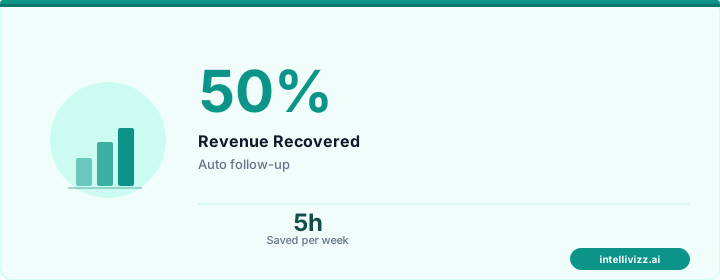
⭐ Your online reputation is your #1 marketing asset
Smart technology, better results
The 5 Best Moments to Trigger Review Requests
1. Post-Closing (The Gold Standard)
The day a deal closes is the highest-emotion, highest-satisfaction moment in the real estate transaction. Your buyer just got keys. Your seller just got paid. Send an automated review request within 4-6 hours of closing confirmation.
Template: "Congratulations on your closing today! 🎉 It was a pleasure helping you through this journey. If you'd like to share your experience, a Google review helps other families find an agent they can trust: [link]"
This single trigger typically accounts for 40-50% of all reviews an agent collects through automation.
2. Post-Open House (For Buyer's Agents)
After showing homes, buyers are engaged and evaluating their agent relationship. A check-in message 24 hours after a showing day that includes a review request captures reviews from clients well before closing.
Template: "Hi [Name], I hope you enjoyed touring homes yesterday! If you're feeling good about our search so far, a quick Google review helps me continue serving clients like you: [link]"
3. Offer Acceptance
When your client's offer is accepted (or their home receives an accepted offer), excitement is high. This is a natural moment for a review request, especially for listing agents whose transaction may have moved quickly.
4. Home Anniversary
One year after closing, send a personalized "home anniversary" message. It's a touchpoint that shows you remember — and it's an excellent moment for a review request from clients who didn't leave one at closing.
Template: "Happy 1-year home anniversary, [Name]! 🏡 I hope you're loving the house. If you haven't had a chance to share your experience, your story could help other buyers: [link]"
5. Referral Thank-You
When a past client refers someone new, thank them with a personal message — and include a review request if they haven't left one. Referral sources are your warmest advocates; their reviews tend to be the most detailed and persuasive.
Building the Automated Workflow
Here's how to set up end-to-end review automation in your real estate business:
Step 1: Choose your CRM trigger point. Most real estate CRMs (Follow Up Boss, KVCore, LionDesk, Intellivizz) allow you to set automation triggers based on deal stage changes. Map each review opportunity moment to a specific stage change.
Step 2: Build your sequences. For each trigger, create a 2-3 message sequence:
- Message 1: SMS at trigger time with direct Google review link
- Message 2: Email at +24 hours with slightly different wording
- Message 3: Final SMS at +72 hours (only if no review detected)
Step 3: Personalize with merge fields. Use your CRM's merge fields to include the client's name, property address, and transaction type. Personalized messages convert at 2-3x the rate of generic templates.
Step 4: Set up monitoring. Configure alerts for new reviews so you can respond within a few hours. Pair your review generation automation with AI-powered review response automation for a complete reputation management system.
Platform Recommendations for Real Estate Agents
For solo agents: An all-in-one platform like Intellivizz that combines review automation with lead follow-up, missed call text-back, and CRM capabilities offers the best value. One platform, one monthly cost, everything automated.
For teams with existing CRMs: If you're already on Follow Up Boss or KVCore, use their built-in automation features for review requests, or connect them to a review-specific tool via Zapier.
For brokerages: Multi-agent platforms like Birdeye or Reputation.com offer office-wide review management with individual agent profiles.
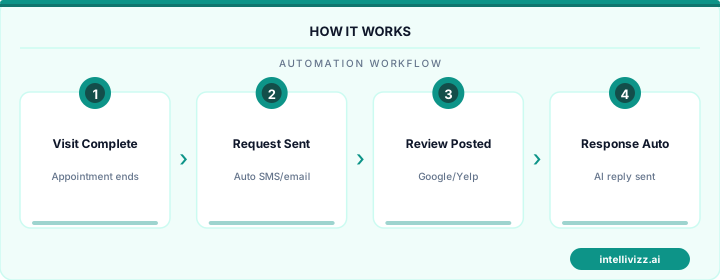
⭐ Your online reputation is your #1 marketing asset
The data speaks for itself
Scaling Your Review Velocity
To build a dominant review profile, you need consistent velocity over time. Here's a realistic growth trajectory:
- Month 1-3: Post-closing automation generates 2-5 reviews/month (depending on transaction volume)
- Month 3-6: Add reactivation campaign for past clients. Velocity increases to 5-10/month.
- Month 6-12: All trigger points active, including anniversaries and referral thank-yous. 8-15 reviews/month.
- Year 2: 100+ total reviews. Your Google Business Profile becomes a significant competitive advantage in local search.
The agents who automate review collection in early 2026 will be the ones with 100+ reviews by the end of the year. That's a moat competitors can't build overnight — it takes consistent effort over time, and automation is the only way to maintain that consistency.
Every deal you close without asking for a review is a marketing asset you've left on the table. Set up the automation once, and let every transaction, showing, and interaction work for your reputation automatically.
Review Velocity and Local SEO Impact
In real estate, local search visibility directly correlates with lead volume. Google's algorithm weighs review velocity — the rate at which new reviews arrive — as a significant ranking factor. Here is how to build and maintain review momentum that drives local SEO performance.
Review Freshness Signals for Google Maps
Google prioritizes businesses with recent reviews over those with stale review profiles, even if the stale profile has a higher overall rating. A real estate agent with 50 reviews but none in the past three months will rank below a competitor with 30 reviews who receives two new ones per week. Establish a minimum cadence of two to three new reviews per month to maintain freshness signals. After every closing, home tour feedback session, or successful referral, trigger your review automation within 24 hours while the positive experience is still vivid. Consistent velocity matters more than occasional bursts followed by drought periods.
Review Diversity Across Platforms
While Google reviews carry the most local SEO weight, diversifying across Zillow, Realtor.com, Facebook, and Yelp strengthens your overall online authority. Search engines view multi-platform review presence as a trust signal — it indicates genuine customer satisfaction rather than manufactured social proof on a single platform. Rotate your primary review request destination quarterly: ask January closings for Google reviews, February for Zillow, and March for Realtor.com. This rotation builds a balanced portfolio that protects you if any single platform changes its algorithm or review policies.
Applying proven techniques from getting more Google reviews to your real estate practice establishes the foundational review engine that feeds all of your local search visibility.
Competitor Review Gap Analysis
Identify the top five agents or brokerages in your target market and analyze their review profiles: total count, average rating, response rate, and velocity. Find the gaps — if the market leader has 200 reviews but responds to only 40 percent, you can differentiate by maintaining a 100 percent response rate. If no competitor has significant Zillow reviews, that platform becomes your blue ocean opportunity. Set specific targets to close the gaps that matter most for ranking: if the third-position agent has 85 Google reviews and you have 60, closing that 25-review gap is a concrete, achievable goal with measurable SEO impact.
For more on real estate marketing, explore our guide on real estate lead automation or learn about maximizing your Google review strategy.
Ready to build a lead system that works while you sleep? Explore our real estate automation solutions, or read our guide to Real Estate Client Referral Program: Automate Your #1....
Relevant AI Automations
AI Review Management
All-in-one review management: automated review requests, AI-powered responses, and review repurposing for web & social — 3 engines in 1.
AI Voice Agent — Property Inquiry Handler
AI voice agent answers inbound calls, qualifies buyer/seller intent, captures property preferences, budget, timeline, an
Website Property Search Lead Capture
Captures leads from website property search, IDX integration, or landing page forms