
School Weather Closure Notification System: Decision Protocols and Multi-Channel Delivery
Why Weather Closures Demand a Dedicated Communication System
School emergency communication covers a wide spectrum of events — lockdowns, medical emergencies, facility hazards, and community threats. But weather-related closures and delays are categorically different from these scenarios in one critical way: they are predictable, recurring, and affect every family simultaneously. A school that handles an unexpected lockdown brilliantly may still frustrate hundreds of families during a winter storm if its weather communication process relies on a single superintendent's manual judgment, an all-staff email, and a text blast sent at an unpredictable time.
The stakes of weather closure communication are significant. Parents arrange childcare based on school status. They decide whether to commute in hazardous conditions based on whether school is open. Bus drivers alter their own schedules. After-school program staff mobilize or stand down. A notification that arrives at 6:45 AM is useful; one that arrives at 7:30 AM — after families have already departed — is not. A system that sends conflicting messages about delay status versus full closure creates chaos in households across the district.
A dedicated school weather closure notification system is distinct from a general school emergency communication system because it is built specifically around the decision timelines, trigger conditions, and communication requirements unique to weather disruptions. This article covers the full architecture: decision protocols by weather event type, notification timing and channel strategy, bus route status communications, make-up day scheduling, remote learning activation, and integration with external weather data sources.
❄️ Weather Decision to Family Notification — Fully Systematized
From storm forecast to parent confirmation, before 6 AM
Weather Event Types and Their Distinct Protocols
Not all weather-related school disruptions follow the same decision logic. A mature weather closure notification system maintains separate protocols for each event category, because the decision variables, timing requirements, and communication content differ substantially.
Winter Storm Protocol
Winter storm decisions are the most complex and highest-stakes weather closure calls in most school districts. The decision must balance road safety for buses and personal vehicles, facility conditions (parking lots, walkways, HVAC function), staff ability to report, and forecast uncertainty at the time a decision is required (typically 4:30–5:30 AM for a full-day call).
A structured winter storm decision framework includes these checkpoints:
- 11 PM the night before: Superintendent or designee reviews National Weather Service forecast, checks district road conditions via transportation director, reviews forecasted accumulation and temperature trajectory. At this checkpoint, a preliminary status is set (no change, elevated monitoring, high probability of delay or closure) and communicated to senior leadership.
- 4:00 AM: Final conditions assessment. Transportation director reports from early road check. Facilities director reports on building conditions. Decision is made for full closure, 2-hour delay, or normal operation.
- 4:30–5:00 AM: Notification sequence initiates. This window is critical — it must allow families sufficient time to arrange childcare or adjust commute plans before the 7:00–8:30 AM window when most households begin school-day logistics.
- 6:30 AM: Secondary confirmation notification sent to all families confirming status, particularly important after a delay decision where families may have received conflicting information from media or neighbors.
Hurricane and Tropical Storm Protocol
Unlike winter storms, tropical weather events typically allow 48–72 hours of lead time. This enables a multi-day notification cadence that manages family expectations before a final closure decision is made:
- 72 hours out: Initial awareness communication — district is monitoring the storm and will provide updates. Families advised to check district website and messaging channels.
- 48 hours out: Status update based on current forecast track. If school closure probability is high, preliminary guidance on remote learning activation or extended closure duration.
- 24 hours out: Final decision communicated. If closing, number of closure days communicated with anticipated return date.
- Real-time during storm: Facility status updates, damage assessment communications, revised return-to-school timeline updates as conditions develop.
Excessive Heat Advisory Protocol
Heat-related school closures or early dismissals are increasingly common in school districts across the South, Southwest, and increasingly the Mid-Atlantic and Northeast as climate patterns shift. Unlike winter storms, heat events often develop mid-day, creating the possibility of early dismissal decisions rather than preemptive closures. This requires a different communication framework:
- Morning notification: If heat advisory is forecast, families receive an early warning about potential early dismissal by 9:00 AM, enabling childcare planning.
- Mid-day decision point: If the decision to dismiss early is made (typically when building temperatures exceed safe thresholds in non-air-conditioned facilities), a second notification targets 11:00–11:30 AM for a 1:00–2:00 PM dismissal.
- Bus and transportation coordination: Early dismissal requires immediate driver notification and route sequencing — the transportation communication sequence runs in parallel with the parent notification, not after it.
The Decision Timeline: Closure vs. Delay vs. Early Dismissal
Families consistently report that the timing and clarity of closure communication matters as much as the decision itself. A clearly communicated 2-hour delay received at 5:00 AM is far more useful than a closure decision communicated at 7:15 AM. The decision matrix below represents best practice for the notification timing decision:
| Event Type | Decision Deadline | Primary Notification Target | Confirmation Notification |
|---|---|---|---|
| Full day closure (winter) | 4:30 AM | 5:00–5:30 AM | 6:30 AM |
| 2-hour delay | 5:00 AM | 5:30–6:00 AM | 7:00 AM |
| Early dismissal (heat) | 11:30 AM | 11:45 AM–12:00 PM | 12:30 PM |
| Early dismissal (storm) | 12:00 PM | 12:15–12:30 PM | 1:00 PM |
| After-school cancellation only | 2:00 PM | 2:15–2:30 PM | N/A |
| Extended closure (hurricane) | 24 hrs prior | 24 hrs prior | Morning of each day |
Each notification window in the table above represents a target, not just a best-effort goal. A weather notification system should have these timing targets built into its workflow as automated triggers — not dependent on an administrator manually remembering to send a message at 5:30 AM while also coordinating with transportation, facilities, and senior leadership.
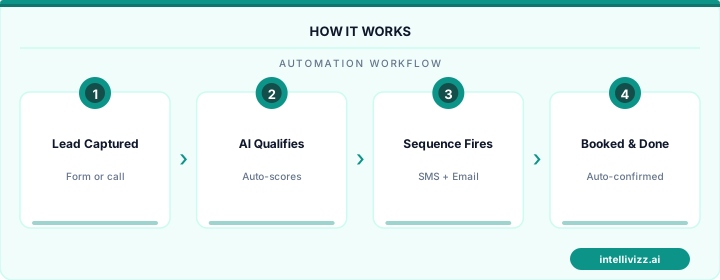
🕐 Decision to Delivery in Under 30 Minutes
Automated notification sequences triggered the moment leadership makes the call
Multi-Channel Notification Delivery
Weather closure notifications must reach every family regardless of their communication preference or language. A system that relies on a single channel — email only, or website post only — will systematically fail to reach the families who most need timely notice: those without reliable internet access, those who check email infrequently, those who primarily communicate via SMS, and non-English-speaking families who need translated communications.
An effective multi-channel weather notification stack delivers simultaneously across:
- SMS/Text message: The highest-urgency, highest-open-rate channel for weather closures. Messages should be brief, definitive, and include the date and action clearly in the first five words: "CLOSURE: Jefferson Middle School CLOSED Thursday, Feb 6."
- Automated voice call: Reaches families who may not have seen the text — particularly older household members who may be responsible for childcare arrangements. Voice calls are particularly effective for delay decisions where families need to hear a human-caliber confirmation of the change.
- Email: Provides detailed information — bus route changes, remote learning instructions, make-up day calendar — that cannot fit in a 160-character text.
- School app push notification: For districts with a school mobile app, push notifications reach families immediately regardless of text message opt-in status.
- Website homepage banner: Automatically updated by the notification system to reflect current status — not requiring manual administrator login to the CMS.
- Social media posting: Automated posting to the district's Facebook and Twitter/X accounts ensures the notification reaches community members who follow the school but are not in the parent directory.
- Multi-language delivery: For districts with significant non-English-speaking populations, the notification system should deliver translated versions automatically based on family language preference recorded in the student information system.
The district-level implementation of multi-channel notification is covered in depth in our guide to school communication automation for Maryland districts, which addresses the specific technical and compliance requirements for multi-district notification at scale.
Bus Route Status Communication
For many families, the most actionable piece of information in a weather disruption is not whether school is open but whether their child's bus is running. A 2-hour delay that includes normal bus service has completely different implications for a family than a 2-hour delay where bus service is cancelled and parents must provide transportation.
Bus route status communication should be handled as a parallel notification stream, not an afterthought appended to the closure notification. The operational requirements include:
- Route-level status: Individual bus routes may be cancelled, delayed, or modified based on specific road conditions in different parts of the district. The transportation director needs to communicate route-specific decisions to affected families, not a blanket statement that may not be accurate for their route.
- Driver notification: Transportation staff must receive their own notification sequence — not through the parent notification channel — with route-specific operational instructions. This notification runs before the parent notification.
- Real-time updates: During the day of disruption, families may need updates on delayed bus arrivals or route modifications that develop after the initial notification. The system should support ad hoc route-specific messages without requiring a full district-wide notification broadcast.
- After-school bus status: When school closes early, after-school bus routes must be activated immediately. Families with children enrolled in after-school programs receive a separate notification about program cancellation and transportation to home.
Remote Learning Activation Triggers
In the post-COVID era, most school districts have the technical infrastructure for remote learning but lack systematic protocols for activating it in response to weather events. The question is no longer "can we do remote learning?" but "under what conditions do we switch to remote learning versus full closure, and how do we activate it?"
A weather notification system with remote learning integration addresses three distinct scenarios:
- Planned remote day (weather forecast): When a significant storm is forecast with high confidence 24–48 hours out, the district announces a planned remote learning day rather than a closure. Families receive notification with remote learning schedule, platform login reminders, and teacher availability hours. This preserves instructional days without requiring staff to report in unsafe conditions.
- Extended closure pivot: When a storm-related closure extends beyond the anticipated duration (building damage, extended road closures), the district may activate remote learning for days 3+ of a closure to avoid instructional day loss. The notification system automatically sends platform access reminders and updated learning schedules.
- Heat closure remote learning: For heat-related closures where the safety issue is building temperature (not travel conditions), remote learning is often the appropriate response — staff and students can work from air-conditioned home environments. The notification system activates the remote learning sequence simultaneously with the closure notification.
For schools managing the full parent communication workflow — including routine absence reporting that integrates with weather day attendance tracking — the system described in our guide to school absence reporting automation can be configured to treat weather closure days as automatic attendance excusals without requiring individual parent absence submissions.
Make-Up Day Scheduling Automation
Every closure day creates a downstream scheduling problem: state-required instructional minutes must be made up, and the make-up day schedule must be communicated to families, staff, and ancillary service providers. Make-up day communication is one of the most frequently mishandled aspects of weather closure management — decisions made weeks after the storm, communicated through a single email that many families miss, creating calendar conflicts and low attendance on the make-up day.
An automated make-up day workflow integrates with the closure notification to begin the downstream communication immediately:
- The closure notification includes the district's make-up day policy and an approximate timeline for the make-up day announcement (e.g., "We will confirm the make-up day schedule within 5 school days").
- An internal workflow assigns the make-up day decision to the appropriate administrator with a deadline, preventing the decision from being perpetually deferred.
- Once the make-up day is scheduled, the notification system automatically broadcasts to all families via the same multi-channel sequence used for the original closure.
- The make-up day notification is automatically added to the school's published calendar and triggers an update to any integrated calendar subscriptions used by families.
Parent Acknowledgment Tracking
For standard weather closures, acknowledgment tracking is not typically required — the notification is informational, not actionable. But for extended closures (3+ days), remote learning activations, and situations where specific parent action is required (completing an at-home learning packet, confirming emergency contact availability), acknowledgment tracking provides valuable operational intelligence.
The system can track which families have opened or responded to a critical weather notification, identify families who have not received confirmation of delivery (due to outdated contact information), and route follow-up communications specifically to unconfirmed households. This capability is particularly important for districts serving populations with diverse communication preferences or limited access to digital channels.
For a broader view of how weather closure notification fits within the full school communication automation stack — including routine parent communication, absence management, and enrollment workflows — the overview at parent communication automation for schools provides a comprehensive framework applicable to districts of any size.
🌡️ Weather API Monitoring to Notification — Automated
Real-time weather data triggers decision workflows before staff arrive
Weather API Integration for Automated Monitoring
The most advanced school weather notification systems integrate directly with weather data APIs to reduce the overnight monitoring burden on administrators and improve decision timing. Rather than requiring a superintendent to set an alarm for 3:30 AM to check weather conditions manually, the system monitors forecast feeds and alerts the decision-maker when threshold conditions are reached.
Integration points include:
- National Weather Service API: Free, authoritative source for local forecasts, watches, warnings, and advisories. The system monitors for winter storm warnings, heat advisories, and flash flood warnings issued for school district ZIP codes.
- Commercial weather APIs (Tomorrow.io, Weather.com API): Provide hyperlocal hourly forecasting and road condition indices that supplement NWS data for early morning decision-making.
- State DOT road condition feeds: Several state transportation departments publish real-time road condition data that can be incorporated into the decision support workflow.
The integration does not automate the closure decision itself — that responsibility remains with school leadership. What it automates is the information delivery and alert workflow: ensuring the decision-maker has accurate, current data at the right time, and that once a decision is made, the notification sequence executes immediately across all channels without manual steps.
State and District Notification Requirements
School districts operate within state-level requirements for closure notification that vary significantly by jurisdiction. Some states require notification to the state Department of Education when a closure day is declared (for instructional calendar compliance tracking). Others require specific documentation of emergency closure decisions for audit purposes. Many require that closure announcements reach families by a specific time — often 6:00 AM — to comply with state-mandated parental notification standards.
A compliance-oriented weather notification system maintains a log of every notification sent, including channel, timestamp, delivery status, and recipient count. This log serves as the documentation record for state compliance purposes and provides the operational data needed to evaluate and improve the notification process after each weather event.
Implementation Checklist for School Weather Notification Systems
| Component | Priority | Implementation Complexity |
|---|---|---|
| Multi-channel notification platform (SMS + voice + email) | Critical | Low — platform selection and directory import |
| Decision timeline protocol documentation | Critical | Low — administrative process design |
| Bus route status communication workflow | High | Medium — transportation director integration |
| Multi-language notification capability | High | Medium — translation integration with SIS |
| Remote learning activation sequence | High | Medium — LMS integration |
| Website status auto-update | Medium | Medium — CMS API integration |
| Weather API monitoring and alerts | Medium | High — API integration and threshold logic |
| Acknowledgment tracking and follow-up | Medium | Medium — platform configuration |
| Make-up day scheduling automation | Lower | Low — workflow and calendar integration |
The multi-channel notification platform is the foundation on which every other component rests. Districts that have not yet consolidated parent contact information into a reliable, deduplicated directory should treat that data project as a prerequisite to notification system implementation — even the best notification platform cannot reach families whose contact information is outdated or incomplete. For districts building out the broader parent communication infrastructure, our guide to automated school communication systems covers the data and platform foundations that enable weather notification as one capability within a comprehensive communication stack.
Weather disruptions are not going away, and the frequency of extreme weather events affecting school operations has increased measurably over the past decade. Districts that build systematic, automated weather notification capabilities are not just solving a communications problem — they are building the institutional resilience to handle weather-related disruptions with the speed, consistency, and multi-channel reach that modern families expect and that student and family safety requires.
Ready to modernize your school's operations? Explore our education automation solutions.
Relevant AI Automations
AI Review Management
All-in-one review management: automated review requests, AI-powered responses, and review repurposing for web & social — 3 engines in 1.
Missed Call Text-Back
Instantly respond to missed calls from prospective parents with AI-powered SMS, capturing enrollment leads 24/7
AI Voice Agent - Inbound
AI answers calls 24/7, handles FAQs about programs, tuition, availability, and books tours