
Expired Listing Outreach Automation: How Top Agents Win Relisted Inventory at Scale
The Expired Listing Opportunity Every Agent Is Leaving on the Table
Every morning, real estate agents across the country start their day the same way: pull the MLS, filter for expired listings, and start dialing. It is one of the oldest prospecting strategies in the business — and for good reason. Sellers whose listings expired are frustrated, motivated, and actively reconsidering their options. They have already decided to sell. They just need a new approach.
The data tells a compelling story. Approximately 25-30% of expired listings relist within 60 days, most often with a different agent. That means every single expired listing in your market is a potential commission opportunity with a seller who is already educated, already committed to selling, and already disappointed with their previous representation. You do not have to convince them to sell. You have to convince them you are the agent who can actually get it done.
The problem is execution. Most agents pursue expired listings the same way they did in 1995: manual calls, handwritten notes, maybe a postcard campaign run through a local print shop. In a competitive market, that approach is far too slow and far too inconsistent to capture meaningful market share. While you are manually dialing through yesterday's expireds, three other agents already sent letters, two sent texts, and one knocked on the door at 8 AM.
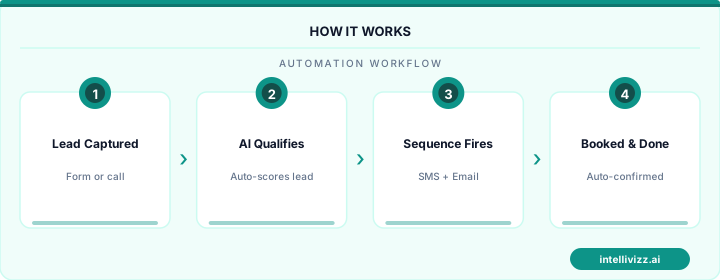
Expired listing outreach automation changes that calculus entirely. A well-designed system identifies expireds the moment they hit the list, triggers a coordinated multi-touch sequence across mail, email, SMS, phone, and social within hours — not days — and tracks every interaction in your CRM so you always know exactly where each seller stands. The result is a consistent pipeline of relist appointments without the manual grind that burns out most agents before they ever develop the skill.
Sellers who relisted within 60 days of expiration chose a new agent 68% of the time. The agent who made first meaningful contact — not just first contact — won the listing at a significantly higher rate.

🏠 Speed wins in real estate — automate your lead response
See how automation transforms industry operations
Data Sourcing: Where Expired Listing Leads Come From
Before you can automate outreach, you need reliable, real-time data on which listings have expired. There are three primary sources, each with different quality, cost, and speed characteristics.
MLS Direct Feeds
The most accurate source of expired listing data is the MLS itself. Most MLSs provide RETS or RESO Web API access that allows licensed members to pull property status changes in near real time. When a listing flips from Active to Expired or Withdrawn at midnight, your system can capture it by 12:01 AM and begin the outreach sequence before your competitors wake up.
The limitation is licensing. MLS data use agreements typically restrict automated bulk contact to members, and some boards have rules around solicitation of active listings versus expired ones. Know your board's policies before automating any outreach at scale.
Third-Party Data Aggregators
Services like REDX, Vulcan7, Landvoice, and SmithDouglas Homes aggregate expired listing data from MLSs across the country and append phone numbers, email addresses, and skip-traced contact information. For agents who are not MLS data-savvy or who work across multiple MLS jurisdictions, these services dramatically reduce the time between a listing expiring and a phone number hitting your dialer.
Quality varies. Skip-traced phone numbers are often landlines, Google Voice numbers, or numbers associated with a previous resident rather than the current owner. Build your sequences with the assumption that 20-30% of contact data will be wrong, and design your automation to handle bounces and invalid numbers gracefully without stopping the entire sequence.
Public Records and Tax Data
County assessor and recorder data is publicly available in most jurisdictions and can serve as a verification layer or primary data source in markets where MLS data is harder to access. Tax records give you owner name, mailing address, and often a phone number associated with the property. They update less frequently than MLS feeds but are authoritative for ownership verification.
Designing the Multi-Touch Outreach Sequence
The most effective expired listing sequences run for 30 days minimum and use five or more touch points across multiple channels. The first 72 hours are critical — most sellers hear from 5-10 agents within the first day of expiration, so your sequencing in that window determines whether you are first or lost in the noise.
Day 1: Speed and Empathy
Your first contact should arrive within hours of the listing expiring — not days. The goal of day-one outreach is not to pitch your services. It is to acknowledge the seller's experience with genuine empathy before pivoting to value. A seller whose listing just expired at midnight did not have a great listing experience. They are frustrated. The agent who leads with "I can imagine how disappointing this is" lands far better than the agent who opens with "I have buyers for your price range."
Day one typically combines a direct mail piece (expedited printing and mailing), a handwritten-style digital letter via email, and an initial phone attempt. Do not send SMS on day one to a seller who has never heard of you — it reads as intrusive and dramatically reduces response rates compared to more professional first-touch channels.
Day 3: Value Before the Ask
By day three, the initial wave of competitor outreach has crested. Sellers who have not yet signed with a new agent are filtering through their options. This is your window to deliver something genuinely useful: a market analysis, a pricing assessment that diagnoses why the previous listing did not sell, or a specific marketing plan for their property type. Generic "I sell homes fast!" messaging falls flat here. Specific, property-level insight — "Based on comparable sales in the past 90 days, your home's previous list price was X% above market for its current condition" — earns a response.
Day 7: The SMS Introduction
A week after expiration, sellers who have not yet relisted are more open to a brief, respectful SMS. Keep it short. Introduce yourself by name, reference that you reached out earlier, and offer a single low-commitment ask — typically a 15-minute phone call or a free market review, not an appointment. Sellers who respond to SMS on day seven convert to appointments at a significantly higher rate than those reached only by phone or mail, because responding to a text requires active engagement rather than passive receipt.
Day 14: Social Proof and Differentiation
Two weeks in, your touchpoint should lead with proof of performance: a case study of a similar property you listed and sold, a testimonial from a seller in the same neighborhood, or documented marketing results from a comparable listing. This is also the right moment to explicitly address why previous listings fail — pricing, photography, marketing reach, agent communication — and to position your approach as structurally different rather than just "working harder."
Day 30: The Re-Engagement and the Offer
A month after expiration, sellers who have not relisted fall into two categories: those who are waiting for a market shift and those who are stuck deciding between agents. Your day-30 touch should acknowledge the time that has passed, offer a concrete action (a no-obligation listing consultation or updated CMA), and make it easy to say yes with a direct calendar link for scheduling. This is also a natural filtering point — sellers who have not engaged with any of your touches after 30 days may belong in a longer-term nurture sequence rather than active outreach.
- Day 1: Direct mail + email — empathy first, no hard pitch
- Day 3: Phone call + email — specific market insight, value delivery
- Day 7: SMS introduction — low-commitment ask
- Day 14: Email + optional second mail — social proof, differentiation
- Day 30: SMS + email — re-engagement, calendar link
Channel Strategy: Beyond the Phone Call
The agents who win expired listings in competitive markets do not rely on any single channel. They orchestrate a coordinated presence across mail, digital, and phone so that when the seller finally decides to reach out, your name is the one they remember. Here is how each channel contributes.
Direct Mail
Physical mail still stands out in an era of inbox overload. A high-quality, oversized postcard or a personal letter in a hand-addressed envelope commands attention at the mailbox. Services like Click2Mail, PostcardMania, and Lob integrate with CRM platforms to trigger individual mail pieces automatically when a contact enters an expired listing sequence, eliminating the batch-and-blast inefficiency of traditional mailer campaigns.
Email is your highest-volume, lowest-cost channel for content delivery. It also provides the richest analytics — open rates, click tracking, and reply detection that let your CRM automatically advance a seller to a more engaged status when they click a link or reply to your message. Design expired listing emails to look personal, not like a newsletter blast. Plain-text formatting with minimal imagery outperforms heavily designed HTML templates in open rate and reply rate for this audience.
Phone and Voicemail Drop
Cold calling expired listings is notoriously high-rejection. Ringless voicemail drops — a pre-recorded message delivered directly to the seller's voicemail without the phone ringing — offer a middle path: personal audio touch without the interruptive ring. Used appropriately and in compliance with TCPA regulations, voicemail drops on days three and seven of a sequence can materially increase callback rates.
Social Media Retargeting
For agents with advertising budgets, retargeting expired listing sellers across Facebook and Instagram is a powerful awareness layer. When you have the seller's email address or phone number, custom audience matching lets you serve ads specifically to that individual — not just their ZIP code or demographic profile. An expired listing seller who has seen your ads three times on social, received two letters, and gotten a personal voicemail is far more likely to accept your call on day seven than one who received only the call.
🏠 Speed wins in real estate — automate your lead response
From manual processes to automated excellence
Compliance: Do Not Call, State Rules, and MLS Policy
Expired listing prospecting sits at the intersection of several regulatory frameworks that must be understood and respected.
Federal Do Not Call Registry
The National Do Not Call Registry applies to phone calls to residential numbers. Sellers with DNC-registered numbers cannot be called for solicitation purposes — and "I am just following up on your expired listing" is solicitation in the eyes of regulators. Your automated dialing system must scrub against the DNC registry before making any outbound calls, and most compliance-forward dialers (Mojo, Vulcan7, REDX) handle this automatically. Do not assume — verify.
TCPA and SMS Consent
The Telephone Consumer Protection Act imposes strict rules on automated text messages. Sending an automated SMS to a number without prior express written consent from the recipient is a TCPA violation that can result in fines of $500-$1,500 per message. The fact that someone listed their home and their number appears in public records does not constitute consent. Work with a real estate compliance attorney to structure your SMS outreach appropriately — often this means using SMS only for sellers who have initiated contact or opted in through a form, not as a cold outreach channel.
State-Specific Solicitation Rules
Some states have additional solicitation restrictions beyond federal law. California, for example, has strong consumer protection rules around real estate solicitation. Florida has its own DNC list. Texas has rules about how quickly after expiration an agent may contact the seller. These vary significantly by jurisdiction — research your specific state's rules or consult with your broker's compliance team before launching any automated outreach program.
CRM Tracking and Conversion Metrics
An expired listing automation program without proper CRM tracking is a marketing expense, not a business system. The metrics that matter most are:
| Metric | What It Measures | Target Benchmark |
|---|---|---|
| Contact rate | % of expireds reached via any channel | 60-80% |
| Response rate | % who reply or call back | 8-15% |
| Appointment rate | % who schedule a listing consultation | 3-8% |
| Listing conversion | % of appointments that sign listing agreements | 40-60% |
| Cost per listing | Total outreach spend ÷ listings acquired | $150-$400 |
Your CRM should tag every expired lead with their source, the date they entered your sequence, every touch point delivered, and every engagement action (email opened, link clicked, call answered, reply received). This data powers automated status advancement — when a seller opens three emails and clicks your CMA link, your CRM should automatically move them from "Cold Outreach" to "Engaged" and alert you for a personal follow-up call, without you having to check manually.
Standing Out in a Crowded Field
Here is the uncomfortable truth: every hungry listing agent in your market is pursuing the same expired listings you are. The average newly expired seller in a competitive market hears from 6-12 agents in the first 72 hours. Volume alone does not win listings. Differentiation does.
The agents who consistently convert expired listings at above-average rates share three characteristics. First, they lead with insight rather than effort — they show up with data about why the listing failed (overpricing relative to condition, insufficient marketing reach, poor photography) rather than simply promising to "work harder." Second, they remove friction from the seller's next decision — a clear, easy-to-schedule consultation, a transparent listing plan, and no-pressure communication style that respects that the seller has already been through a difficult experience. Third, they stay in the pipeline longer — most agents give up after 2-3 touches and move on. The seller who decides to relist two weeks after you stopped reaching out becomes someone else's commission. Automation makes 30-day persistence cost-effective in a way that manual outreach never can.
For agents who want to complement expired listing outreach with a broader seller lead generation system, real estate listing marketing automation covers the full stack for getting and marketing listings. For nurturing seller leads that are not yet ready to relist, real estate drip campaign automation provides a framework for long-term seller nurture sequences. And for any agent building a scalable lead follow-up process, AI for real estate lead follow-up explains how AI-assisted response systems can keep more leads engaged without adding manual workload.
Building Your Expired Listing Automation System
The right technology stack for expired listing automation depends on your market, budget, and existing tools. At minimum, you need a data source for expired listing contact information, a CRM that supports workflow automation, and integrations with your mail, email, and communication channels. Common combinations include:
- REDX or Vulcan7 for expired listing data + phone numbers
- Follow Up Boss or Lofty (formerly Chime) for CRM and action plan automation
- Lob or Click2Mail for programmatic direct mail triggers
- Mojo or Kixie for power dialing with local presence
- ActiveCampaign or Klaviyo for advanced email sequencing with behavior tracking
The most important investment is not any single tool — it is the process design. Map every step of your sequence before you choose technology. Know what happens when a seller replies to day-three email before you automate day three. Know how your CRM handles a bounce on the day-one mailing before you commit to a 30-day sequence that depends on address accuracy. The agents who build durable expired listing systems spend more time on process design and less time chasing the newest tool.
Expired listings will always be one of the highest-return prospecting categories in residential real estate because the seller motivation is already established. The agents who capture that opportunity consistently are the ones who approach it systematically — with the right data, the right sequence, and the right automation to make consistency effortless. The technology is widely available. The discipline to implement it properly is what separates the agents who win listings from the ones who just call.
Ready to build a lead system that works while you sleep? Explore our real estate automation solutions, or read our guide to Realtor Prospecting Automation: How Top Agents Follow....
Relevant AI Automations
AI Review Management
All-in-one review management: automated review requests, AI-powered responses, and review repurposing for web & social — 3 engines in 1.
AI Voice Agent — Property Inquiry Handler
AI voice agent answers inbound calls, qualifies buyer/seller intent, captures property preferences, budget, timeline, an
Website Property Search Lead Capture
Captures leads from website property search, IDX integration, or landing page forms